5) At a work rate of 300 Watts, Puja’s heart rate was 150 bpm, exhaled %O2...
5) At a work rate of 300 Watts, Puja’s heart rate was 150 bpm, exhaled %O2 was 17%, exhaled %CO2 was 5%,
and minute volume was 40L/Min. Calculate Puja’s RQ.
A) 0.5
B) 0.8
C) 1.0
D) 1.25---- ANSWER
Homework Answers
5.% of oxygen in atmosphere = 21%
% of oxygen given out = 17%
So % of oxygen taken in = 4%
Total amount of oxygen taken in = 4×40/100 = 1.6L/min.
% of CO2 released out = 5%
Total amount of CO2 = 5× 40/100=2L/min.
RQ = amount of CO2 released/amountvof CO2 taken in = 5/4 = 1.25
Add Answer to:
5) At a work rate of 300 Watts, Puja’s heart rate was 150 bpm,
exhaled %O2...
Assume that an exhaled breath of air consists of 74.9 % N2, 15.2 % O2, 3.9...
Assume that an exhaled breath of air consists of 74.9 % N2, 15.2 % O2, 3.9 % CO2, and 6.0 %water vapor. 1) If the total pressure of the gases is 0.990 atm , calculate the partial pressure of N2. Express your answer using three significant figures. 2) If the total pressure of the gases is 0.990 atm , calculate the partial pressure of O2. Express your answer using three significant figures. 3) If the total pressure of the gases...
Steve is a runner with a target heart rate of 135 bpm. His resting pulse is...
 Steve is a runner with a target heart rate of 135 bpm. His resting pulse is 70 bpm. His blood volume is approximately 6.8 liters. At rest, his cardiac output is 63 tr/min A What must his stroke volume be? B. What is his EDV if his ESV is 50 ml? C. During his workout, his heart rate increases to 136 born and his cardiac output to 13,500 mL/min. Did his SV change with exercise? If his EDV is 160...
Please show all work for me to understand, thank you! Please use a heart rate of...
 Please show all work for me to understand, thank
you!
Please use a heart rate of 70.0 beats per minute instead of
7.00 beats per minute shown in the problem.
1) (20pts.) Given the average heart rate of a human is 7.00 beats per minute and the average volume flow of blood pumped out by the heart to the body is 70.0mL/beat. a) Determine the average flow rate for blood in units of milliliters per minute (mL/min). A person suffers...
Please show all work for me to understand, thank
you!
Please use a heart rate of 70.0 beats per minute instead of
7.00 beats per minute shown in the problem.
1) (20pts.) Given the average heart rate of a human is 7.00 beats per minute and the average volume flow of blood pumped out by the heart to the body is 70.0mL/beat. a) Determine the average flow rate for blood in units of milliliters per minute (mL/min). A person suffers...
J4.Person A has a heart rate 90 heartbeats per min, a cardiac output of 6.8 L blood per minute an...
 j4.Person A has a heart rate 90 heartbeats per min, a cardiac output of 6.8 L blood per minute and an end- diastolic volume of 170 mL blood. From this information, calculate the ciection fraction. Show your work Is the calculated value found to be normal, below normal or low? (2 marks for your work + 2 marks for correct answer 4 marks in total) 15. Answer the following questions based on the types of vertebrate circulatory systems a. List...
5. (4 points-1 point each) You are population. You choose to plot heart rate on the...
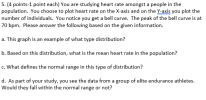 5. (4 points-1 point each) You are population. You choose to plot heart rate on the X-axis and on the Y-axis you plot the number of individuals. You notice you get a bell curve. The peak of the bell curve is at 70 bpm. Please answer the following based on the given information studying heart rate amongst a people in the a. This graph is an example of what type distribution? b. Based on this distribution, what is the mean...
Lance Armstrong (fully doped) had a maximum oxygen consumption (VO2) of 5.5 liters O2/min. If during...
Lance Armstrong (fully doped) had a maximum oxygen consumption (VO2) of 5.5 liters O2/min. If during maximum exertion his arterial oxygen content is 20 ml/100 ml blood and his venous content is 2 ml/100ml blood, a) calculate his cardiac output. In mammals in general, blood volume is equal to 7% of body mass (assume one liter of blood weighs 1.0 kg). If he weighs 65kg b) during this maximum exertion how long will it take to circulate his entire blood...
0.06 moles of a monatomic gas undergoes the cycle A ⟶B⟶C⟶A as shown on the P-V...
 0.06 moles of a monatomic gas undergoes the cycle A ⟶B⟶C⟶A as
shown on the P-V diagram below.
In the transition A⟶B the gas expands adiabatically and the
temperature drops from 600K to 400K. What is △U for this
transition? What is the work done on the gas? (This is the answer
to (a) in the table below)
During the transition B⟶C, the volume decreases from
2x10⁻³ m3 to 1x10⁻³ m3
at constant atmospheric pressure (isobaric). What is the work...
0.06 moles of a monatomic gas undergoes the cycle A ⟶B⟶C⟶A as
shown on the P-V diagram below.
In the transition A⟶B the gas expands adiabatically and the
temperature drops from 600K to 400K. What is △U for this
transition? What is the work done on the gas? (This is the answer
to (a) in the table below)
During the transition B⟶C, the volume decreases from
2x10⁻³ m3 to 1x10⁻³ m3
at constant atmospheric pressure (isobaric). What is the work...
0.06 moles of a monatomic gas undergoes the cycle A ⟶B⟶C⟶A as shown on the P-V...
 0.06 moles of a monatomic gas undergoes the cycle A ⟶B⟶C⟶A as
shown on the P-V diagram below.
In the transition A⟶B the gas expands adiabatically and the
temperature drops from 600K to 400K. What is △U for this
transition? What is the work done on the gas? (This is the answer
to (a) in the table below)
During the transition B⟶C, the volume decreases from
2x10⁻³ m3 to 1x10⁻³ m3
at constant atmospheric pressure (isobaric). What is the work...
0.06 moles of a monatomic gas undergoes the cycle A ⟶B⟶C⟶A as
shown on the P-V diagram below.
In the transition A⟶B the gas expands adiabatically and the
temperature drops from 600K to 400K. What is △U for this
transition? What is the work done on the gas? (This is the answer
to (a) in the table below)
During the transition B⟶C, the volume decreases from
2x10⁻³ m3 to 1x10⁻³ m3
at constant atmospheric pressure (isobaric). What is the work...
3. For the reaction C3H3(g) + 5 O2(g) ----> 3 CO2(g) + 4H20(1) the following rate...
 3. For the reaction C3H3(g) + 5 O2(g) ----> 3 CO2(g) + 4H20(1) the following rate data were determined at 30°C. Experiment Initial C3H8 Initial O2 id. Rate 0.200M 0.200 M 3.00 x 101 0.400 M 0.200 M 6.00 x 101 0.200 MO 0.400 M 1 .20 x 102 a) Determine the reaction order with respect to C3H8. b) Determine the reaction order with respect to 02. c) Calculate the rate constant at this temperature. d) Write the rate law...
A manual assembly line is to be designed to make a small consumer product. The work...
A manual assembly line is to be designed to make a small consumer product. The work elements, their times, and precedence constraints are given in the table below. The workers will operate the line for 400 min per day and must produce 300 products per day. A mechanized belt, moving at a speed of 1.25 m/min, will transport the products between stations. Because of the variability in the time required to perform the assembly operations, it has been determined that...
 Steve is a runner with a target heart rate of 135 bpm. His resting pulse is 70 bpm. His blood volume is approximately 6.8 liters. At rest, his cardiac output is 63 tr/min A What must his stroke volume be? B. What is his EDV if his ESV is 50 ml? C. During his workout, his heart rate increases to 136 born and his cardiac output to 13,500 mL/min. Did his SV change with exercise? If his EDV is 160...
 Please show all work for me to understand, thank
you!
Please use a heart rate of 70.0 beats per minute instead of
7.00 beats per minute shown in the problem.
1) (20pts.) Given the average heart rate of a human is 7.00 beats per minute and the average volume flow of blood pumped out by the heart to the body is 70.0mL/beat. a) Determine the average flow rate for blood in units of milliliters per minute (mL/min). A person suffers...
Please show all work for me to understand, thank
you!
Please use a heart rate of 70.0 beats per minute instead of
7.00 beats per minute shown in the problem.
1) (20pts.) Given the average heart rate of a human is 7.00 beats per minute and the average volume flow of blood pumped out by the heart to the body is 70.0mL/beat. a) Determine the average flow rate for blood in units of milliliters per minute (mL/min). A person suffers...
 j4.Person A has a heart rate 90 heartbeats per min, a cardiac output of 6.8 L blood per minute and an end- diastolic volume of 170 mL blood. From this information, calculate the ciection fraction. Show your work Is the calculated value found to be normal, below normal or low? (2 marks for your work + 2 marks for correct answer 4 marks in total) 15. Answer the following questions based on the types of vertebrate circulatory systems a. List...
 5. (4 points-1 point each) You are population. You choose to plot heart rate on the X-axis and on the Y-axis you plot the number of individuals. You notice you get a bell curve. The peak of the bell curve is at 70 bpm. Please answer the following based on the given information studying heart rate amongst a people in the a. This graph is an example of what type distribution? b. Based on this distribution, what is the mean...
 0.06 moles of a monatomic gas undergoes the cycle A ⟶B⟶C⟶A as
shown on the P-V diagram below.
In the transition A⟶B the gas expands adiabatically and the
temperature drops from 600K to 400K. What is △U for this
transition? What is the work done on the gas? (This is the answer
to (a) in the table below)
During the transition B⟶C, the volume decreases from
2x10⁻³ m3 to 1x10⁻³ m3
at constant atmospheric pressure (isobaric). What is the work...
0.06 moles of a monatomic gas undergoes the cycle A ⟶B⟶C⟶A as
shown on the P-V diagram below.
In the transition A⟶B the gas expands adiabatically and the
temperature drops from 600K to 400K. What is △U for this
transition? What is the work done on the gas? (This is the answer
to (a) in the table below)
During the transition B⟶C, the volume decreases from
2x10⁻³ m3 to 1x10⁻³ m3
at constant atmospheric pressure (isobaric). What is the work...
 0.06 moles of a monatomic gas undergoes the cycle A ⟶B⟶C⟶A as
shown on the P-V diagram below.
In the transition A⟶B the gas expands adiabatically and the
temperature drops from 600K to 400K. What is △U for this
transition? What is the work done on the gas? (This is the answer
to (a) in the table below)
During the transition B⟶C, the volume decreases from
2x10⁻³ m3 to 1x10⁻³ m3
at constant atmospheric pressure (isobaric). What is the work...
0.06 moles of a monatomic gas undergoes the cycle A ⟶B⟶C⟶A as
shown on the P-V diagram below.
In the transition A⟶B the gas expands adiabatically and the
temperature drops from 600K to 400K. What is △U for this
transition? What is the work done on the gas? (This is the answer
to (a) in the table below)
During the transition B⟶C, the volume decreases from
2x10⁻³ m3 to 1x10⁻³ m3
at constant atmospheric pressure (isobaric). What is the work...
 3. For the reaction C3H3(g) + 5 O2(g) ----> 3 CO2(g) + 4H20(1) the following rate data were determined at 30°C. Experiment Initial C3H8 Initial O2 id. Rate 0.200M 0.200 M 3.00 x 101 0.400 M 0.200 M 6.00 x 101 0.200 MO 0.400 M 1 .20 x 102 a) Determine the reaction order with respect to C3H8. b) Determine the reaction order with respect to 02. c) Calculate the rate constant at this temperature. d) Write the rate law...
Most questions answered within 3 hours.
-
Where is the error in this code sequence?
String s1 = "Hello";
String s2 = "ello";...
asked 11 months ago -
Financial data for Joel de Paris, Inc., for last year
follow:
Joel de Paris, Inc.
Balance...
asked 11 months ago -
Consider this reaction:
Al2(SO4)3 (aq)+ BaCl3
(aq) Al2Cl6 (aq)- +
3BaSO4(s) . What is the...
asked 11 months ago -
Suppose that Savneet is considering increasing her
recent random sample from 20 car rentals to 40...
asked 11 months ago -
Trucks arrive at an unloading terminal at an average rate of 120
per hour.
Trucks arrive...
asked 11 months ago -
Why are methanol and ethanol completely soluble in water while
octanol is not very little soluble....
asked 11 months ago -
A facilities manager at a university reads in a research report
that the mean amount of...
asked 11 months ago -
When the CuSO4 is rehydrated by adding water to the anhydrous
compound, is this an endothermic...
asked 11 months ago -
A ray of sunlight is passing from diamond into crown glass; the
angle of incidence is...
asked 11 months ago -
A block of mass 0.249 kg is placed on top of a light, vertical
spring of...
asked 11 months ago -
how do the kidneys compensate in the presences of acidosis
a) trigger hyperventilate
b) reserve acid...
asked 11 months ago -
Question 501 pts
The rental rate of capital to the firm increases. Which of the
following...
asked 11 months ago