CODE IN C++ Given: typedef char ItemType; // a struct type named NodeType that includes a...
CODE IN C++
Given:
typedef char ItemType;
// a struct type named NodeType that includes a ItemType and pointer
// (to a NodeType) field
struct NodeType {
ItemType value;
NodeType * next;
};
bool Delete (NodeType * & firstPtr, ItemType value)
{
NodeType * prev, * cur;
cur = Search (firstPtr, value, prev);
if (cur==NULL)
return false;
else {
// remove cur node from the linked list
if (prev!=NULL)
{ //not the first one
prev->next = cur->next; //bypass the cur node
}
else //cur is the first node
firstPtr = cur->next; //update the head pointer
delete cur; //deallocate the node itself
return true;
}
}
- Write a function to search for a value in the linked list, returning both the matching node, and the node before it, i.e. Search function. Note that this function can be used by the following functions:
/* Search for given value in the listed list pointed to by firstNodePtr,
* return the matching node's address, and
* set its previous node's address in prevNode parameter
@param firstNodePtr
@param value
@postcondition: if the value is found in the linked list,
the node's address will be returned, and
prevNode will point to the node before; if not found, return NULL, prevNode is NUL L
@return value: same as Search...
*/
NodeType * Search (NodeType * firstNodePtr, ItemType value, NodeType * & prevNode)
{
//Todo by you
}
- Write a function insert a new node before a node (of a giving value). Write a function that insert a number before an existing node in the linked list storing a certan value, e.g.,
If the linked list contains 1 ->10 -> 30,
and we want to insert a number 20 before node 30, we can call the above
function passing 20, 30 as parameters (in addition to the head), and
after the insertion, the list looks like:
1 -> 10 -> 20 -> 30.
Homework Answers
Though, I have documented the code still if you have any doubt feel free to comment. I'll try my best to resolve them as soon as possible.
PS: This program can be done using classes in that case we don't have to pass firstPtr n every function. Also, we can use Search() in insertBefore() and i leave this up to you for practice still if you need any help do let me know.
===============
Code:
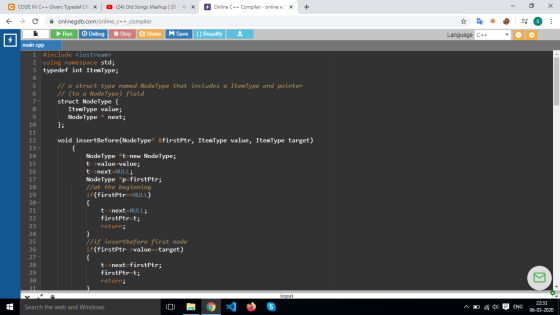
#include <iostream>
using namespace std;
typedef int ItemType;
// a struct type named NodeType that includes a ItemType
and pointer
// (to a NodeType) field
struct NodeType {
ItemType value;
NodeType * next;
};
void insertBefore(NodeType* &firstPtr, ItemType
value, ItemType target)
{
NodeType *t=new NodeType;
t->value=value;
t->next=NULL;
NodeType *p=firstPtr;
//at the
beginning
if(firstPtr==NULL)
{
t->next=NULL;
firstPtr=t;
return;
}
//if
insertbefore first node
if(firstPtr->value==target)
{
t->next=firstPtr;
firstPtr=t;
return;
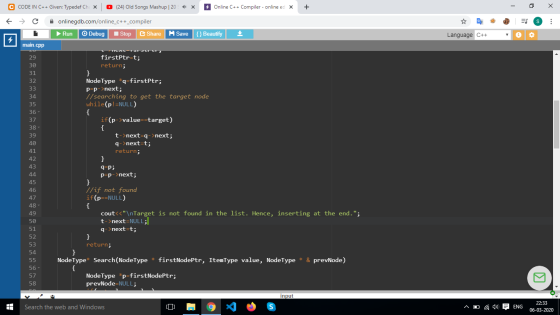
}
NodeType
*q=firstPtr;
p=p->next;
//searching to
get the target node
while(p!=NULL)
{
if(p->value==target)
{
t->next=q->next;
q->next=t;
return;
}
q=p;
p=p->next;
}
//if not
found
if(p==NULL)
{
cout<<"\nTarget is not found in the list. Hence, inserting at
the end.";
t->next=NULL;
q->next=t;
}
return;
}
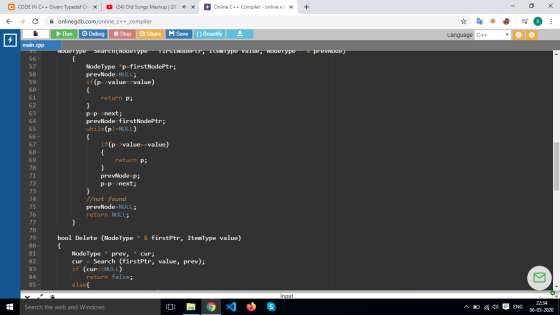
NodeType* Search(NodeType * firstNodePtr, ItemType value, NodeType
* & prevNode)
{
NodeType *p=firstNodePtr;
prevNode=NULL;
if(p->value==value)
{
return p;
}
p=p->next;
prevNode=firstNodePtr;
while(p!=NULL)
{
if(p->value==value)
{
return p;
}
prevNode=p;
p=p->next;
}
//not
found
prevNode=NULL;
return
NULL;
}
bool Delete (NodeType * & firstPtr, ItemType value)
{
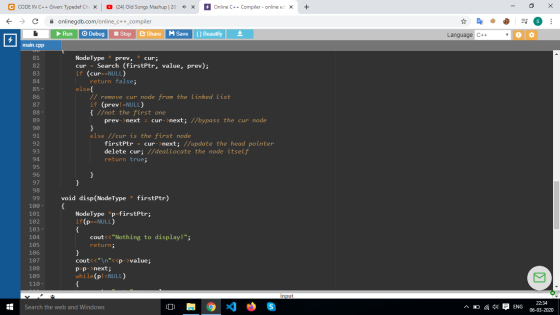
NodeType * prev, * cur;
cur = Search (firstPtr, value, prev);
if (cur==NULL)
return false;
else{
// remove cur node from the linked list
if (prev!=NULL)
{ //not the first one
prev->next = cur->next; //bypass the cur node
}
else //cur is the first node
firstPtr = cur->next; //update the head pointer
delete cur; //deallocate the node itself
return true;
}
}
void disp(NodeType * firstPtr)
{
NodeType *p=firstPtr;
if(p==NULL)
{
cout<<"Nothing to display!";
return;
}
cout<<"\n"<<p->value;
p=p->next;
while(p!=NULL)
{
cout<<" -> "<<p->value;
p=p->next;
}
return;
}
int main()
{
NodeType* firstPtr=NULL;
disp(firstPtr);
insertBefore(firstPtr,30,0);
disp(firstPtr);
insertBefore(firstPtr,10,30);
disp(firstPtr);
insertBefore(firstPtr,1,10);
disp(firstPtr);
insertBefore(firstPtr,20,30);
disp(firstPtr);
insertBefore(firstPtr,150,45);
disp(firstPtr);
if(Delete(firstPtr,1))
{
cout<<"\nDeleted 1 Sucessfully!";
disp(firstPtr);
}else
cout<<"\nNot Found!";
if(Delete(firstPtr,45))
{
cout<<"\nDeleted 45 Sucessfully!";
disp(firstPtr);
}else
cout<<"\nNot Found!";
return 0;
}
==============
Syntax:


===============
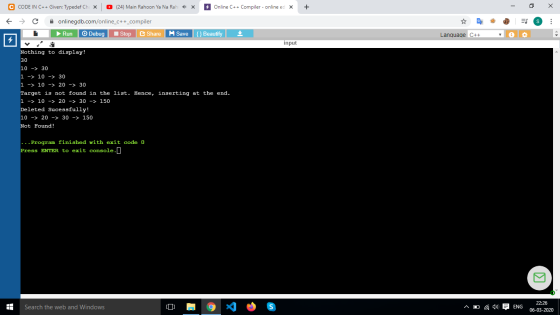
Output:
Add Answer to:
CODE IN C++
Given:
typedef char ItemType;
// a struct type named NodeType that includes a...
Consider the following C++ statements: struct node Type int info; node Type *link; nodeType *head, *p,...
 Consider the following C++ statements: struct node Type int info; node Type *link; nodeType *head, *p, q, *newNode; newNode = new node Type; 1. Write C++ statement to store 50 in the info field of the newNode. 2. Write C++ statement to set the link field of the newNode to NULL. 3. Write C++ statement to make head pointer points to newNode. 4. Write C++ statement to delete the first node in the linked list. (the first an the only...
Using the provided Linked List example code, linkedlist.c, as an example Make a node struct that...
Using the provided Linked List example code, linkedlist.c, as an example Make a node struct that holds ints instead of strings. In your main, insert 25 to 75 random integers with range (0 to 100) into a linked list of your nodes. Use a random to determine how many to make. Write a function int sum(NodePointer current) that returns the sum of the integers in the list by looping through the linked list. Write a function int count(NodePointer current) that...
() Given the following structure definition and typedef for a linked list of strings: typedef struct...
() Given the following structure definition and typedef for a linked list of strings: typedef struct node st node; struct node st { char *word; /* a valid string pointer or NULL */ node *next; /* next node in the list or NULL */ }; Write a C function, free list(), that takes as an argument one of these lists, possibly NULL, and frees all the strings as well as the list itself. Write robust code. void free list(node *list){
Please rewrite this function using recursive function #include using namespace std; struct Node { char ch;...
Please rewrite this function using recursive function #include using namespace std; struct Node { char ch; Node* next; }; class LinkedList { Node* head; public: LinkedList(); ~LinkedList(); void add(char ch); bool find(char ch); bool del(char ch); friend std::ostream& operator<<(std::ostream& out, LinkedList& list); }; LinkedList::LinkedList() { head = NULL; } LinkedList::~LinkedList() { Node* cur = head, * tmp; while (cur != NULL) { tmp = cur->next; delete cur; cur = tmp; } } void LinkedList::add(char ch) { Node* cur = head,...
Modify the below code to fit the above requirements: struct node { char data; struct node...
 Modify the below code to fit the above requirements:
struct node
{
char data;
struct node *next;
struct node *previous;
} *front, *MyNode, *rear, *MyPointer, *anchor *Valuenode ;
typedef struct node node;
int Push(char input)
{
if(IsFull()==1)
{
printf("The queue is full. Enter the ‘^’ character to
stop.\n");
return -1;
}
else if (IsFull()==-1)
{
node *MyNode=(node*)malloc(sizeof(node));
MyNode->data=input;
rear->next=MyNode;
MyNode->previous=rear;
MyPointer=rear=MyNode;
return 1;
}
else
{
node *MyNode=(node*)malloc(sizeof(node));
node *anchor=(node*)malloc(sizeof(node));
MyNode->data=input;
MyPointer=rear=front=MyNode;
MyNode->previous=NULL;
MyNode->next=NULL;
anchor->next=MyNode;
return 0;
}
}
char...
Modify the below code to fit the above requirements:
struct node
{
char data;
struct node *next;
struct node *previous;
} *front, *MyNode, *rear, *MyPointer, *anchor *Valuenode ;
typedef struct node node;
int Push(char input)
{
if(IsFull()==1)
{
printf("The queue is full. Enter the ‘^’ character to
stop.\n");
return -1;
}
else if (IsFull()==-1)
{
node *MyNode=(node*)malloc(sizeof(node));
MyNode->data=input;
rear->next=MyNode;
MyNode->previous=rear;
MyPointer=rear=MyNode;
return 1;
}
else
{
node *MyNode=(node*)malloc(sizeof(node));
node *anchor=(node*)malloc(sizeof(node));
MyNode->data=input;
MyPointer=rear=front=MyNode;
MyNode->previous=NULL;
MyNode->next=NULL;
anchor->next=MyNode;
return 0;
}
}
char...
I want the full code for this part and Its needs to be done in C++...
 I want the full code for this part and Its needs to be done in
C++
Use a linked list to implement the following skeleton of an unsorted list typedef int ItemType: struct NodeType ItemType item; NodeType "next; class List List(); // default constructor List( const List &x); I copy constructor: deep copy is required List & operator = (const List &x); // assignment operator: deep copy. 1s required bool IsThere(ItemType x); identify if x is in the list void...
I want the full code for this part and Its needs to be done in
C++
Use a linked list to implement the following skeleton of an unsorted list typedef int ItemType: struct NodeType ItemType item; NodeType "next; class List List(); // default constructor List( const List &x); I copy constructor: deep copy is required List & operator = (const List &x); // assignment operator: deep copy. 1s required bool IsThere(ItemType x); identify if x is in the list void...
In C++ Assume entries in a linked list are of type struct listrec: struct listrec {...
 In C++
Assume entries in a linked list are of type struct
listrec:
struct listrec
{
struct listrec *prev;
float
value;
struct listrec *next;
};
listrec *head, *tail;
Write a main() routine in which the user is asked the
number of nodes to create in the list (number greater than or equal
to zero) then create the following type of linked list (use a loop
to initialize list) based on the number of nodes requested:
Write a...
In C++
Assume entries in a linked list are of type struct
listrec:
struct listrec
{
struct listrec *prev;
float
value;
struct listrec *next;
};
listrec *head, *tail;
Write a main() routine in which the user is asked the
number of nodes to create in the list (number greater than or equal
to zero) then create the following type of linked list (use a loop
to initialize list) based on the number of nodes requested:
Write a...
This is a c programming problem. Would you please help me to write this problem??? I...
 This is a c programming problem.
Would you please help me to write this problem???
I really appreciate it if you add comments for explanation step
by step.
Thank you.
Reverse a Doubly linked list using recursion: Given a doubly linked list. Reverse it using recursion. Original Doubly linked list: next pointer - DDHIHI Null prev painter Reversed Doubly linked list: next pointer Start Pointer Null prev pointer Include: a) A struct for a node of the doubly linked list....
This is a c programming problem.
Would you please help me to write this problem???
I really appreciate it if you add comments for explanation step
by step.
Thank you.
Reverse a Doubly linked list using recursion: Given a doubly linked list. Reverse it using recursion. Original Doubly linked list: next pointer - DDHIHI Null prev painter Reversed Doubly linked list: next pointer Start Pointer Null prev pointer Include: a) A struct for a node of the doubly linked list....
***Using C++ and also please label "a" and "c" accordingly. Thank you!!**** a) Write the member...
 ***Using C++ and also please label "a" and "c" accordingly.
Thank you!!****
a) Write the member function void deleteNode() that will delete
the first node from the linked list.
b) Modify the LList to create a data member Node *cur that
points to the current node. Write the following member
functions:
• void forward() that moves the cur pointer to the next
node.
• void backward() that moves the cur pointer to the previous
node.
• void delete() that removes...
***Using C++ and also please label "a" and "c" accordingly.
Thank you!!****
a) Write the member function void deleteNode() that will delete
the first node from the linked list.
b) Modify the LList to create a data member Node *cur that
points to the current node. Write the following member
functions:
• void forward() that moves the cur pointer to the next
node.
• void backward() that moves the cur pointer to the previous
node.
• void delete() that removes...
Double linked list implementation of PutItem function. How to fix my code to get desired output b...
Double linked list implementation of PutItem function. How to fix my code to get desired output below: Output: 2 5 8 #ifndef ITEMTYPE_H #define ITEMTYPE_H enum RelationType { LESS, GREATER, EQUAL}; class ItemType { public: ItemType(); void setValue(int newValue); int getValue() const; RelationType ComparedTo(ItemType newItem); private: int value; }; #endif // ITEMTYPE_H // ItemType.cpp #include "ItemType.h" ItemType::ItemType() { value = 0; } void ItemType::setValue(int newValue) { value = newValue; } int ItemType::getValue() const { return value; } RelationType ItemType::ComparedTo(ItemType newItem)...
 Consider the following C++ statements: struct node Type int info; node Type *link; nodeType *head, *p, q, *newNode; newNode = new node Type; 1. Write C++ statement to store 50 in the info field of the newNode. 2. Write C++ statement to set the link field of the newNode to NULL. 3. Write C++ statement to make head pointer points to newNode. 4. Write C++ statement to delete the first node in the linked list. (the first an the only...
 Modify the below code to fit the above requirements:
struct node
{
char data;
struct node *next;
struct node *previous;
} *front, *MyNode, *rear, *MyPointer, *anchor *Valuenode ;
typedef struct node node;
int Push(char input)
{
if(IsFull()==1)
{
printf("The queue is full. Enter the ‘^’ character to
stop.\n");
return -1;
}
else if (IsFull()==-1)
{
node *MyNode=(node*)malloc(sizeof(node));
MyNode->data=input;
rear->next=MyNode;
MyNode->previous=rear;
MyPointer=rear=MyNode;
return 1;
}
else
{
node *MyNode=(node*)malloc(sizeof(node));
node *anchor=(node*)malloc(sizeof(node));
MyNode->data=input;
MyPointer=rear=front=MyNode;
MyNode->previous=NULL;
MyNode->next=NULL;
anchor->next=MyNode;
return 0;
}
}
char...
Modify the below code to fit the above requirements:
struct node
{
char data;
struct node *next;
struct node *previous;
} *front, *MyNode, *rear, *MyPointer, *anchor *Valuenode ;
typedef struct node node;
int Push(char input)
{
if(IsFull()==1)
{
printf("The queue is full. Enter the ‘^’ character to
stop.\n");
return -1;
}
else if (IsFull()==-1)
{
node *MyNode=(node*)malloc(sizeof(node));
MyNode->data=input;
rear->next=MyNode;
MyNode->previous=rear;
MyPointer=rear=MyNode;
return 1;
}
else
{
node *MyNode=(node*)malloc(sizeof(node));
node *anchor=(node*)malloc(sizeof(node));
MyNode->data=input;
MyPointer=rear=front=MyNode;
MyNode->previous=NULL;
MyNode->next=NULL;
anchor->next=MyNode;
return 0;
}
}
char...
 I want the full code for this part and Its needs to be done in
C++
Use a linked list to implement the following skeleton of an unsorted list typedef int ItemType: struct NodeType ItemType item; NodeType "next; class List List(); // default constructor List( const List &x); I copy constructor: deep copy is required List & operator = (const List &x); // assignment operator: deep copy. 1s required bool IsThere(ItemType x); identify if x is in the list void...
I want the full code for this part and Its needs to be done in
C++
Use a linked list to implement the following skeleton of an unsorted list typedef int ItemType: struct NodeType ItemType item; NodeType "next; class List List(); // default constructor List( const List &x); I copy constructor: deep copy is required List & operator = (const List &x); // assignment operator: deep copy. 1s required bool IsThere(ItemType x); identify if x is in the list void...
 In C++
Assume entries in a linked list are of type struct
listrec:
struct listrec
{
struct listrec *prev;
float
value;
struct listrec *next;
};
listrec *head, *tail;
Write a main() routine in which the user is asked the
number of nodes to create in the list (number greater than or equal
to zero) then create the following type of linked list (use a loop
to initialize list) based on the number of nodes requested:
Write a...
In C++
Assume entries in a linked list are of type struct
listrec:
struct listrec
{
struct listrec *prev;
float
value;
struct listrec *next;
};
listrec *head, *tail;
Write a main() routine in which the user is asked the
number of nodes to create in the list (number greater than or equal
to zero) then create the following type of linked list (use a loop
to initialize list) based on the number of nodes requested:
Write a...
 This is a c programming problem.
Would you please help me to write this problem???
I really appreciate it if you add comments for explanation step
by step.
Thank you.
Reverse a Doubly linked list using recursion: Given a doubly linked list. Reverse it using recursion. Original Doubly linked list: next pointer - DDHIHI Null prev painter Reversed Doubly linked list: next pointer Start Pointer Null prev pointer Include: a) A struct for a node of the doubly linked list....
This is a c programming problem.
Would you please help me to write this problem???
I really appreciate it if you add comments for explanation step
by step.
Thank you.
Reverse a Doubly linked list using recursion: Given a doubly linked list. Reverse it using recursion. Original Doubly linked list: next pointer - DDHIHI Null prev painter Reversed Doubly linked list: next pointer Start Pointer Null prev pointer Include: a) A struct for a node of the doubly linked list....
 ***Using C++ and also please label "a" and "c" accordingly.
Thank you!!****
a) Write the member function void deleteNode() that will delete
the first node from the linked list.
b) Modify the LList to create a data member Node *cur that
points to the current node. Write the following member
functions:
• void forward() that moves the cur pointer to the next
node.
• void backward() that moves the cur pointer to the previous
node.
• void delete() that removes...
***Using C++ and also please label "a" and "c" accordingly.
Thank you!!****
a) Write the member function void deleteNode() that will delete
the first node from the linked list.
b) Modify the LList to create a data member Node *cur that
points to the current node. Write the following member
functions:
• void forward() that moves the cur pointer to the next
node.
• void backward() that moves the cur pointer to the previous
node.
• void delete() that removes...
Most questions answered within 3 hours.
-
Where is the error in this code sequence?
String s1 = "Hello";
String s2 = "ello";...
asked 11 months ago -
Financial data for Joel de Paris, Inc., for last year
follow:
Joel de Paris, Inc.
Balance...
asked 11 months ago -
Consider this reaction:
Al2(SO4)3 (aq)+ BaCl3
(aq) Al2Cl6 (aq)- +
3BaSO4(s) . What is the...
asked 11 months ago -
Suppose that Savneet is considering increasing her
recent random sample from 20 car rentals to 40...
asked 11 months ago -
Trucks arrive at an unloading terminal at an average rate of 120
per hour.
Trucks arrive...
asked 11 months ago -
Why are methanol and ethanol completely soluble in water while
octanol is not very little soluble....
asked 11 months ago -
A facilities manager at a university reads in a research report
that the mean amount of...
asked 11 months ago -
When the CuSO4 is rehydrated by adding water to the anhydrous
compound, is this an endothermic...
asked 11 months ago -
A ray of sunlight is passing from diamond into crown glass; the
angle of incidence is...
asked 11 months ago -
A block of mass 0.249 kg is placed on top of a light, vertical
spring of...
asked 11 months ago -
how do the kidneys compensate in the presences of acidosis
a) trigger hyperventilate
b) reserve acid...
asked 11 months ago -
Question 501 pts
The rental rate of capital to the firm increases. Which of the
following...
asked 11 months ago