Please help me on all the questions !!!!!!!! Really need help! Will give a thumb up...
Please help me on all the questions !!!!!!!! Really need help! Will give a thumb up for helping.
Short Answer (6)
-
Explain why a public method should be declared to be final if it is called by a constructor.
-
In the linked implementation of a list, why shouldn’t the constructor call the method clear even
though they do the same exact assignment statements?
-
Outline the basic steps to add a node to the end of a linked implementation of a list.
-
Outline the basic steps to add a node to the beginning of an empty linked implementation of a
list.
-
Outline the basic steps to add a node to the beginning of a non-empty linked implementation of
a list.
-
Outline the basic steps to remove a node from the beginning of a list.
Homework Answers
Ans 1.
When a method is declared with finalkeyword, it is called a final method. A final method cannot be overridden. The Objectclass does this—a number of its methods are final.We must declare methods with final keyword for which we required to follow the same implementation throughout all the derived classes. The following fragment illustrates final keyword with a method:
class A
{
    final void m1()
    {
        System.out.println("This is a final method.");
    }
}

class B extends A
{
    void m1()
    {
        // COMPILE-ERROR! Can't override.
        System.out.println("Illegal!");
    }
}
Ans 2. Because constructor is executed only during initalisation of object.
Ans 3. Add a node at the end: (6 steps
process)
The new node is always added after the last node of the given
Linked List. For example if the given Linked List is
5->10->15->20->25 and we add an item 30 at the end,
then the Linked List becomes
5->10->15->20->25->30.
Since a Linked List is typically represented by the head of it, we
have to traverse the list till end and then change the next of last
node to new node.
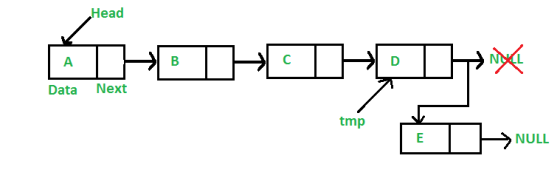
Following are the 6 steps to add node at the end.It is in the form of C code.
/* Given a reference (pointer to pointer) to the head
of a list and an int, appends a new node at the end */
void append(struct Node** head_ref, int new_data)
{
/* 1. allocate node */
struct Node* new_node = (struct Node*) malloc(sizeof(struct Node));
struct Node *last = *head_ref; /* used in step 5*/
/* 2. put in the data */
new_node->data = new_data;
/* 3. This new node is going to be the last node, so make next
of it as NULL*/
new_node->next = NULL;
/* 4. If the Linked List is empty, then make the new node as head */
if (*head_ref == NULL)
{
*head_ref = new_node;
return;
}
/* 5. Else traverse till the last node */
while (last->next != NULL)
last = last->next;
/* 6. Change the next of last node */
last->next = new_node;
return;
}
Time complexity of append is O(n) where n is the number of nodes
in linked list. Since there is a loop from head to end, the
function does O(n) work.
This method can also be optimized to work in O(1) by keeping an
extra pointer to tail of linked list/
Ans 4. Add node at front of empty link list .
Simply initalise head as the value to be added in link list .
Ans 5.
Add a node at the front: (A 4 steps
process)
The new node is always added before the head of the given Linked
List. And newly added node becomes the new head of the Linked List.
For example if the given Linked List is 10->15->20->25 and
we add an item 5 at the front, then the Linked List becomes
5->10->15->20->25. Let us call the function that adds
at the front of the list is push(). The push() must receive a
pointer to the head pointer, because push must change the head
pointer to point to the new node (See this)
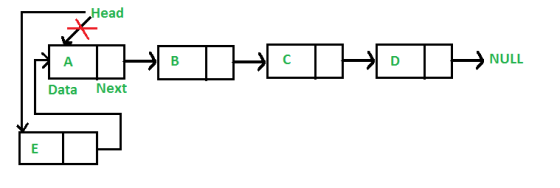
Following are the 4 steps to add node at the front in form of C code :
C
|
/* Given a reference (pointer to pointer) to the head of a list and an int, inserts a new node on the front of the list. */ void push(struct Node** head_ref, int new_data) { /* 1. allocate node */ struct Node* new_node = (struct Node*) malloc(sizeof(struct Node));
/* 2. put in the data */ new_node->data = new_data;
/* 3. Make next of new node as head */ new_node->next = (*head_ref);
/* 4. move the head to point to the new node */ (*head_ref) = new_node; } Time complexity of push() is O(1) as it does constant amount of work. Ans 6. To remove first node, we need to make second node as head and delete memory allocated for first node.
|
Add Answer to:
Please help me on all the questions !!!!!!!! Really need help!
Will give a thumb up...
Please help me on all the questions !!!!!!!! Really need help! Will give a thumb up...
Please help me on all the questions !!!!!!!! Really need help! Will give a thumb up for helping. True/False (13) Chapter 14 - A List Implementation that Links Data Adding a node to an empty chain is the same as adding a node to the beginning of a chain. Adding a node at the end of a chain of n nodes is the same as adding a node at position n. You need a temporary variable to reference nodes as...
Please help me on all the questions !!!!!!!! Really need help! Will give a thumb up...
Please help me on all the questions !!!!!!!! Really need help! Will give a thumb up for helping. True/False (11) Chapter 12 - Lists The ADT list only works for entries that are strings. The ADT list is more general than common lists and has entries that are objects of the same type. Adding entries to the end of a list does not change the positions of entries already in the list. The first entry is a list is at...
I need help with the Implementation of an Ordered List (Template Files) public interface Ordered...
I need help with the Implementation of an Ordered List (Template Files) public interface OrderedStructure { public abstract int size(); public abstract boolean add( Comparable obj ) throws IllegalArgumentException; public abstract Object get( int pos ) throws IndexOutOfBoundsException; public abstract void remove( int pos ) throws IndexOutOfBoundsException; public abstract void merge( OrderedList other ); } import java.util.NoSuchElementException; public class OrderedList implements OrderedStructure { // Implementation of the doubly linked nodes (nested-class) private static class Node { private Comparable value; private...
I need help with a c++ code, i am new learner on stack, please help me...
I need help with a c++ code, i am new learner on stack, please help me write Stack.cpp according to Stack.h provided, thanks(Notes: That data structure is a singly linked list in which pushed items are placed at the tail of the linked list. Similarly, popped items will be removed from the tail of the list.) Actually,I can write a regular one, but i'm not sure how to use the tail in the question. class Stack { private: // Desc:...
I need a python 3 help. Please help me with this question Part 2. Linked Lists...
I need a python 3 help. Please help me with this question Part 2. Linked Lists You start working with the class LinkNode that represents a single node of a linked list. It has two instance attributes: value and next. class LinkNode: def __init__(self,value,nxt=None): assert isinstance(nxt, LinkNode) or nxt is None self.value = value self.next = nxt Before you start with the coding questions, answer the following questions about the constructor Valid Constructor or Not? LinkNode(1, 3) LinkNode(1, None) LinkNode(1,...
Part I: Create a doubly linked circular list class named LinkedItemList that implements the following interface:...
Part I: Create a doubly linked circular list class named LinkedItemList that implements the following interface: /** * An ordered list of items. */ public interface ItemList<E> { /** * Append an item to the end of the list * * @param item – item to be appended */ public void append(E item); /** * Insert an item at a specified index position * * @param item – item to be...
plzzz help me. in java it should all be in one program. plz help 1.3.19 Give...
plzzz help me. in java it should all be in one program. plz help 1.3.19 Give a code fragment that removes the last node in a linked list whose first node is first. 1.3.21 Write a method find() that takes a linked list and a string key as arguments and returns true if some node in the list has key as its item field, false otherwise. 1.3.26 Write a method remove() that takes a linked list and a string key...
Complete P16.1 and P16.4 (Class Name: NewMethodDemo) Once complete, upload all .java files. For primary test...
Complete P16.1 and P16.4 (Class Name: NewMethodDemo) Once complete, upload all .java files. For primary test class: Remember your header with name, date, and assignment. Also include class names that will be tested. Psuedocode (level 0 or mixture of level 0 and algorithm [do not number steps]) is required if main() contains more than simple statements (for example, your program includes constructs for decisions (if/else), loops, and methods. For Secondary class(es): Include a JavaDoc comment that describes the purpose of...
Please answer the following Questions with A,B,C... and I will give a thumbs up If you...
Please answer the following Questions with A,B,C... and I will give a thumbs up If you can give a little context to why you chose that answer that'd be great too. Which of the following are the right steps to remove and return the linear node pointed to by current if it is not the first node in the list and previous points to the node before current. Question 1 previous.setNext(current.getNext()); return current; current.setNext(previous.getNext()); return previous; current.setPrevious(current.getNext()); return previous; previous.setNext(current.getPrevious());...
Modify Dlinkedlist.java so it includes a new method named getPriorNode that accepts the String value of...
Modify Dlinkedlist.java so it includes a new method named getPriorNode that accepts the String value of a potential element in the doubly linked list and returns the string value of the predecessor node (or an appriopriate message String if there is no such node or predecessor. class DLinkedList { /** The Node class stores a list element and a reference to the next node. */ private class Node { String value; // Value of a list element Node next; //...
Most questions answered within 3 hours.
-
Where is the error in this code sequence?
String s1 = "Hello";
String s2 = "ello";...
asked 10 months ago -
Financial data for Joel de Paris, Inc., for last year
follow:
Joel de Paris, Inc.
Balance...
asked 10 months ago -
Consider this reaction:
Al2(SO4)3 (aq)+ BaCl3
(aq) Al2Cl6 (aq)- +
3BaSO4(s) . What is the...
asked 10 months ago -
Suppose that Savneet is considering increasing her
recent random sample from 20 car rentals to 40...
asked 10 months ago -
Trucks arrive at an unloading terminal at an average rate of 120
per hour.
Trucks arrive...
asked 10 months ago -
Why are methanol and ethanol completely soluble in water while
octanol is not very little soluble....
asked 10 months ago -
A facilities manager at a university reads in a research report
that the mean amount of...
asked 10 months ago -
When the CuSO4 is rehydrated by adding water to the anhydrous
compound, is this an endothermic...
asked 10 months ago -
A ray of sunlight is passing from diamond into crown glass; the
angle of incidence is...
asked 10 months ago -
A block of mass 0.249 kg is placed on top of a light, vertical
spring of...
asked 10 months ago -
how do the kidneys compensate in the presences of acidosis
a) trigger hyperventilate
b) reserve acid...
asked 10 months ago -
Question 501 pts
The rental rate of capital to the firm increases. Which of the
following...
asked 10 months ago