1. Explain, in writing, how you would develop and maintain an asset register. What would be...
1. Explain, in writing, how you would develop and maintain an asset register. What would be your source information and what would be included in the register?
2.Explain what a general journal entry is and why journal entries are necessary.
3, Explain double‑entry principles and how and why they are used.
4. Explain a general ledger system.
Homework Answers
1. In order to develop and maintain an Asset Register, the major source of information shall be the purchase invoices of the assets. Firstly all the assets shall be recorded serially in the asset register. Then the same should be physically verified for their existence. After verification assign serial numbers to all the assets. Finally all the details relating to the asset are to be recorded in the register like asset description, serial number assigned to asset, invoice number, date of acquisition, amount paid, taxes paid, date of payment etc should be included in the asset register.
2. Journal entry is a method used to record accounting transactions in the records of the business.Journal entries can be recorded into a general ledger or in various sub-ledger. This is later on used to prepare financial statements. Journal entries are the first step of keeping accounting record. They are also used by auditors to analyze how financial transactions impact a business.
The following are the importance of journal entries:-
- Each transaction is recorded as soon as it takes place. So there is no possibility of any transaction being omitted from the books of account.
- Since the transactions are kept recorded in journal chronologically with narration, it can be easily ascertained when and why a transaction has taken place.
- For each and every transaction which of the two concerned accounts will be debited and which account credited, are clearly written in journal. So, there is no possibility of committing any mistake in writing the ledger.
- Since all the details of transactions are recorded in journal, it is not necessary to repeat them in ledger. As a result ledger is kept tidy and brief.
- Journal shows the complete story of a transaction in one entry.
- Any mistake in ledger can be easily detected with the help of journal.
3. Whenever you create an accounting transaction, at least two accounts are always impacted, with a debit entry being recorded against one account and a credit entry against the other account. In every transaction, the account receiving a benefit is debited and the account giving benefit is credited.
Principles of Double Entry System;
- Two parties: Every accounting entry involves two parties – debit and credit. According to the main principles of this system, every debit of some amount creates corresponding credit or every credit creates the corresponding debit for the same amount.
- Giver and receiver: Every transaction has one giver and one receiver.
- Exchange of equal amount: The amount of money the party gives in a transaction shall be equal to amount the party receives.
- Separate entity: Under this system business is treated as a separate entity from the owner. As a result business and its owners are separate entity.
- Dual aspects: Every transaction is divided into two aspects i.e. the left side of the transaction is debit and the right side is credit.
- Results: Under double entry system totality of debit is equal to the totality of credit. In it ascertainment of the result is easy.
- Complete accounting system: Double entry system is a scientific and complete accounting system.
The advantages of double entry system is:
1. Complete accounts of transactions: Since every transaction is recorded completely i.e. every outgoing part has a corresponding incoming part. As a result the entire transaction is recorded properly.
2. Verification of arithmetical accuracy: Arithmetical accuracy of accounting can be verified by preparing trial balance. Under the double entry system since every debit has a corresponding credit, any mismatch helps to identify errors.
3. Knowing asset and liabilities: Since all assets and liabilities are recorded thus when summarised, it shall help in knowing the assets and liabilities.
4. Future reference: Under this system as every transaction is permanently recorded properly and completely, any necessary information can be detected easily in future.
4. A general ledger system represents the record-keeping system of a company's financial data with debit and credit account records. The said data is validated by a trial balance. This ledger is used to provide a record of all the financial transactions that takes place. The transactions of the company are posted to individual sub-ledger accounts and then the transactions are closed or summarised to the general ledger. After summarising a trial balance is generated in which balance of each ledger account’s balance is reported. The trial balance is then checked for errors and adjusted by posting additional necessary entries. Later on the resultant adjusted trial balance is used to prepare the financial statements.
Add Answer to:
1. Explain, in writing, how you would develop and maintain an
asset register. What would be...
SHORT ANSWER REVIEW QUESTIONS Explain how to add a journal transaction in the Account Register that...
SHORT ANSWER REVIEW QUESTIONS Explain how to add a journal transaction in the Account Register that involves both a Balance Sheet and Income Statement account. Why is it often easier to complete General Journal entries by using the Make General Journal Entries form than it is to use the Register? Explain how to add a new General Ledger account while entering transaction information. How can an error in a General Journal entry be corrected after the entry is recorded? How...
If you could please explain HOW you got the answer, that would be super helpful, thank...
 If you could please explain HOW you got the answer, that would
be super helpful, thank you :)
At the beginning of the year, Young Company bought three used machines from Vince, Inc. The machines immediately were overhauled, were installed, and started operating. Because the machines were different, each was recorded separately in the accounts. Amount paid for asset Installation costs Renovation costs prior to use Repairs after production began Machine A $8,200 200 2,700 520 Machine B $26,800 600...
If you could please explain HOW you got the answer, that would
be super helpful, thank you :)
At the beginning of the year, Young Company bought three used machines from Vince, Inc. The machines immediately were overhauled, were installed, and started operating. Because the machines were different, each was recorded separately in the accounts. Amount paid for asset Installation costs Renovation costs prior to use Repairs after production began Machine A $8,200 200 2,700 520 Machine B $26,800 600...
Section B Directions: Complete each of the following statements by writing in the Answers column the letter of the word or words that correctly completes each statement or answers the question. (3 po...
 Section B Directions: Complete each of the following statements by writing in the Answers column the letter of the word or words that correctly completes each statement or answers the question. (3 points each) or Answers Scoring 1. The order of the flow of financial data accounting information systems is (A) journalize, post, analyze; (B) analyze, journalize, post; (C) journalize analyze, post; (D) analyze, post, journalize; (E) analyze, journalize, analyze, post 2. A chart of accounts doesn't include (A) account...
1. How are sales discounts computed? How are they recorded? Why are discounts offered? 2. What...
1. How are sales discounts computed? How are they recorded? Why are discounts offered? 2. What type of account is Sales, Returns and Allowances and how is it used? 3. What is the accounts receivable subsidiary ledger and how is it used? Why does a company keep a subsidiary ledger? Explain how a journal entry ends up in that subsidiary ledger? 4. What account is used to show that a company has collected sales tax but has not yet paid...
3-3 “Debit and credit are used as verbs, adjectives, or nouns." Give examples of how credit...
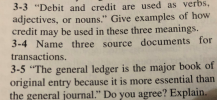 3-3 “Debit and credit are used as verbs, adjectives, or nouns." Give examples of how credit may be used in these three meanings. 3-4 Name three source documents for transactions. 3-5 “The general ledger is the major book of original entry because it is more essential than the general journal." Do you agree? Explain.
a)What is the relationship between the General Journal and the General Ledger? Define both and explain...
a)What is the relationship between the General Journal and the General Ledger? Define both and explain how they are used. b) What are the steps in processing and recording business transactions? c) Explain how a proper journal entry should be written. d) What is the purpose of posting? How is it used?
8. Explain the purpose of payment selection codes. 9. How do you print a pre-cheque register...
 8. Explain the purpose of payment selection codes. 9. How do you print a pre-cheque register for a system-generated payment batch? 10. Explain the purpose of the Control Payments icon. 11. What is the purpose of the Generate button on the bottom of the Create Payment Batch window? 12. Can a system-generated cheque batch be modified? If so,, how? 13. What information is listed on a cheque register?
Explain how the kidney and the respiratory system would act to maintain the normal pH of...
Explain how the kidney and the respiratory system would act to maintain the normal pH of the body if you had been vomiting for 2 days.
Module 1: Chapter 2: Review Questions Assignment 1. Provide the names of two (a) asset accounts,...
 Module 1: Chapter 2: Review Questions Assignment 1. Provide the names of two (a) asset accounts, (b) liability accounts, and (c) equity accounts. 2. What is the difference between a note payable and an account payable? 3. List the steps in processing business transactions. 4. What kinds of transactions can be recorded in the general journal? 5. Are debits or credits typically listed in general journal entries? Are the debits or credits indented? 6. Should a transaction be recorded first...
Briefly explain what is meant by transaction analysis. What are the two principles underlying transaction analysis?...
 Briefly explain what is meant by transaction analysis. What
are the two principles underlying transaction analysis?
1) You are one of the accountants for a landscaping service business. You notice a discrepancy between the general journal and the general ledger. How do you verify the dates and amounts in question? 2) A general ledger account provides a complete running history of the increases and decreases that affected the account during the accounting period. True or False?
Briefly explain what is meant by transaction analysis. What
are the two principles underlying transaction analysis?
1) You are one of the accountants for a landscaping service business. You notice a discrepancy between the general journal and the general ledger. How do you verify the dates and amounts in question? 2) A general ledger account provides a complete running history of the increases and decreases that affected the account during the accounting period. True or False?
 If you could please explain HOW you got the answer, that would
be super helpful, thank you :)
At the beginning of the year, Young Company bought three used machines from Vince, Inc. The machines immediately were overhauled, were installed, and started operating. Because the machines were different, each was recorded separately in the accounts. Amount paid for asset Installation costs Renovation costs prior to use Repairs after production began Machine A $8,200 200 2,700 520 Machine B $26,800 600...
If you could please explain HOW you got the answer, that would
be super helpful, thank you :)
At the beginning of the year, Young Company bought three used machines from Vince, Inc. The machines immediately were overhauled, were installed, and started operating. Because the machines were different, each was recorded separately in the accounts. Amount paid for asset Installation costs Renovation costs prior to use Repairs after production began Machine A $8,200 200 2,700 520 Machine B $26,800 600...
 Section B Directions: Complete each of the following statements by writing in the Answers column the letter of the word or words that correctly completes each statement or answers the question. (3 points each) or Answers Scoring 1. The order of the flow of financial data accounting information systems is (A) journalize, post, analyze; (B) analyze, journalize, post; (C) journalize analyze, post; (D) analyze, post, journalize; (E) analyze, journalize, analyze, post 2. A chart of accounts doesn't include (A) account...
 3-3 “Debit and credit are used as verbs, adjectives, or nouns." Give examples of how credit may be used in these three meanings. 3-4 Name three source documents for transactions. 3-5 “The general ledger is the major book of original entry because it is more essential than the general journal." Do you agree? Explain.
 8. Explain the purpose of payment selection codes. 9. How do you print a pre-cheque register for a system-generated payment batch? 10. Explain the purpose of the Control Payments icon. 11. What is the purpose of the Generate button on the bottom of the Create Payment Batch window? 12. Can a system-generated cheque batch be modified? If so,, how? 13. What information is listed on a cheque register?
 Module 1: Chapter 2: Review Questions Assignment 1. Provide the names of two (a) asset accounts, (b) liability accounts, and (c) equity accounts. 2. What is the difference between a note payable and an account payable? 3. List the steps in processing business transactions. 4. What kinds of transactions can be recorded in the general journal? 5. Are debits or credits typically listed in general journal entries? Are the debits or credits indented? 6. Should a transaction be recorded first...
 Briefly explain what is meant by transaction analysis. What
are the two principles underlying transaction analysis?
1) You are one of the accountants for a landscaping service business. You notice a discrepancy between the general journal and the general ledger. How do you verify the dates and amounts in question? 2) A general ledger account provides a complete running history of the increases and decreases that affected the account during the accounting period. True or False?
Briefly explain what is meant by transaction analysis. What
are the two principles underlying transaction analysis?
1) You are one of the accountants for a landscaping service business. You notice a discrepancy between the general journal and the general ledger. How do you verify the dates and amounts in question? 2) A general ledger account provides a complete running history of the increases and decreases that affected the account during the accounting period. True or False?
Most questions answered within 3 hours.
-
Where is the error in this code sequence?
String s1 = "Hello";
String s2 = "ello";...
asked 10 months ago -
Financial data for Joel de Paris, Inc., for last year
follow:
Joel de Paris, Inc.
Balance...
asked 10 months ago -
Consider this reaction:
Al2(SO4)3 (aq)+ BaCl3
(aq) Al2Cl6 (aq)- +
3BaSO4(s) . What is the...
asked 10 months ago -
Suppose that Savneet is considering increasing her
recent random sample from 20 car rentals to 40...
asked 10 months ago -
Trucks arrive at an unloading terminal at an average rate of 120
per hour.
Trucks arrive...
asked 10 months ago -
Why are methanol and ethanol completely soluble in water while
octanol is not very little soluble....
asked 10 months ago -
A facilities manager at a university reads in a research report
that the mean amount of...
asked 10 months ago -
When the CuSO4 is rehydrated by adding water to the anhydrous
compound, is this an endothermic...
asked 10 months ago -
A ray of sunlight is passing from diamond into crown glass; the
angle of incidence is...
asked 10 months ago -
A block of mass 0.249 kg is placed on top of a light, vertical
spring of...
asked 10 months ago -
how do the kidneys compensate in the presences of acidosis
a) trigger hyperventilate
b) reserve acid...
asked 10 months ago -
Question 501 pts
The rental rate of capital to the firm increases. Which of the
following...
asked 10 months ago