I am trying to understand what are the catalytic histidine residues acting as a base and...
I am trying to understand what are the catalytic histidine residues acting as a base and the histidine residue acting as an acid. For the Chymotrypsin mechanism. Please explain.
Homework Answers
There are 3 different proteases that have catalytic triad ,that are chymotrypsin ,trypsin and elastase. In chymotrypsin the catalytic triad is made from serine 195, histidine57 and aspatatae102.The side chain of serine is bonded with the imidazole ring of histidine residue.
Here histidine residue accept a proton from serine to from a strong alkoxide nucleophile, so the histidine acts as best proton accepter. Hence it act as a base.
Again after aspartate deprotonation ,deprotonation of histidine takes place, proton transfor from histidine to aspartate. So here histidine acts as an acid.
Add Answer to:
I am trying to understand what are the catalytic histidine
residues acting as a base and...
The chymotrypsin catalytic triad contains one Histidine and one Serine residue. Explain, in some detail and...
The chymotrypsin catalytic triad contains one Histidine and one Serine residue. Explain, in some detail and in chemical terms, how an a) a Histidine to Alanine mutation, and b) a Serine to Cysteine mutation in the chymotrypsin catalytic triad might affect catalytic activity of this enzyme.
33, 48 Depicted below are a peptide substrate and the three catalytic residues within the chymotrypsin...
 33, 48
Depicted below are a peptide substrate and the three catalytic residues within the chymotrypsin active site Note that the 2-dimensional geometry is only roughly shown. R1 represents a large hydrophobic amino acid and R represents other amino acids. The R groups of the catalytic triad of aspartate (Asp102), serine (Ser195), and histidine (His57) are shown. Select the atoms that act as nucleophiles and electrophiles in the acylation phase of the reaction Scroll down for more of this question...
33, 48
Depicted below are a peptide substrate and the three catalytic residues within the chymotrypsin active site Note that the 2-dimensional geometry is only roughly shown. R1 represents a large hydrophobic amino acid and R represents other amino acids. The R groups of the catalytic triad of aspartate (Asp102), serine (Ser195), and histidine (His57) are shown. Select the atoms that act as nucleophiles and electrophiles in the acylation phase of the reaction Scroll down for more of this question...
6 pts Let's consider a protein with two surface-exposed histidine residues. • Hisa is a “typical”...
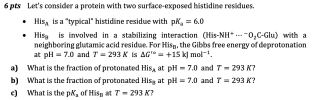 6 pts Let's consider a protein with two surface-exposed histidine residues. • Hisa is a “typical” histidine residue with pKa = 6.0 • His is involved in a stabilizing interaction (His-NH+ ... -0_C-Glu) with a neighboring glutamic acid residue. For Hisp, the Gibbs free energy of deprotonation at pH = 7.0 and T = 293 K is AG'° = +15 kJ mol-1. a) What is the fraction of protonated Hisa at pH = 7.0 and T = 293 K? b)...
I have the solution to this problem, and have posted it. I am trying to understand...
 I have the solution to this problem, and have posted it. I am
trying to understand why they did what they did. I do not
understand why they left out [A] in the steady state equation. I
also do not understand why they multiyply by Kf, or why they divide
Ia by If. If anyone could help me understand that would be
great.
I have the solution to this problem, and have posted it. I am
trying to understand why they did what they did. I do not
understand why they left out [A] in the steady state equation. I
also do not understand why they multiyply by Kf, or why they divide
Ia by If. If anyone could help me understand that would be
great.
7. Lysozyme has two key catalytic residues, Glu 35 with a pKa of 5.9 and Asp...
 7. Lysozyme has two key catalytic residues, Glu 35 with a pKa of 5.9 and Asp 52 with a pKa of 4.5. If the pH optimum for this enzyme is 5.0, what does this tell you about the mechanism? a. Glu 35 acts more likely a general acid than Asp 52. b. Glu 35 acts more likely a general base than Asp 52. c. Asp 52 acts more likely a general acid than Glu 35. d. None of the above...
Please show work as I am trying to understand this concept and am not getting the...
 Please show work as I am trying to understand this concept and
am not getting the correct answer that matches the book.
Given an infinitely long circular conductor with radius = 2 cm centered on the z-axis containing a current density J = 100p2 a within the conductor. a) Determine the magnetic field intensity outside the conductor b) Determine the magnetic flux density inside the conductor
Please show work as I am trying to understand this concept and
am not getting the correct answer that matches the book.
Given an infinitely long circular conductor with radius = 2 cm centered on the z-axis containing a current density J = 100p2 a within the conductor. a) Determine the magnetic field intensity outside the conductor b) Determine the magnetic flux density inside the conductor
I am taking evidence based practice course and I am trying to understand how to complete...
I am taking evidence based practice course and I am trying to understand how to complete Critical appraisal peer reviewed article.
D 8.5-10.5. 10.5 -12.5. 12.5. If you were trying to separate histidine with values of I...
 D 8.5-10.5. 10.5 -12.5. 12.5. If you were trying to separate histidine with values of I 80 (carboxyl group), 6.00 (R group 9.20 (amino group) and lysine with pk of 2.18 (carboxyl group), 10.53 group). 8.95 (amino group) on a cation ion-exchange column chromatography, which retains positively charged analyte molecules. What would be your preferred pll of solution? 1.5. 4.0 A. B C. D. E. 80. 11.0. None of the above. Determine the amino acid sequence of the following oligopeptide...
Please explain in great details. Don't skip intermediate steps. I am trying to really understand this....
 Please explain in great details. Don't skip intermediate steps.
I am trying to really understand this. Thank you
6) Let fand g be functions from Z to Z such that fx) -2x + 1 and g)- Is finvertible, and if so, what is its inverse? g invertible, and if so, what is its inverse? C. F Find fx)
Please explain in great details. Don't skip intermediate steps.
I am trying to really understand this. Thank you
6) Let fand g be functions from Z to Z such that fx) -2x + 1 and g)- Is finvertible, and if so, what is its inverse? g invertible, and if so, what is its inverse? C. F Find fx)
I am trying to understand, please write each step one line below the next and explain...
 I am trying to understand, please write each step one
line below the next and explain steps legibly. Thanks.
Question 1 (Give your power series Find a power series representation for the function f(a) = 1 representation centered at 3 0 .)
I am trying to understand, please write each step one
line below the next and explain steps legibly. Thanks.
Question 1 (Give your power series Find a power series representation for the function f(a) = 1 representation centered at 3 0 .)
 33, 48
Depicted below are a peptide substrate and the three catalytic residues within the chymotrypsin active site Note that the 2-dimensional geometry is only roughly shown. R1 represents a large hydrophobic amino acid and R represents other amino acids. The R groups of the catalytic triad of aspartate (Asp102), serine (Ser195), and histidine (His57) are shown. Select the atoms that act as nucleophiles and electrophiles in the acylation phase of the reaction Scroll down for more of this question...
33, 48
Depicted below are a peptide substrate and the three catalytic residues within the chymotrypsin active site Note that the 2-dimensional geometry is only roughly shown. R1 represents a large hydrophobic amino acid and R represents other amino acids. The R groups of the catalytic triad of aspartate (Asp102), serine (Ser195), and histidine (His57) are shown. Select the atoms that act as nucleophiles and electrophiles in the acylation phase of the reaction Scroll down for more of this question...
 6 pts Let's consider a protein with two surface-exposed histidine residues. • Hisa is a “typical” histidine residue with pKa = 6.0 • His is involved in a stabilizing interaction (His-NH+ ... -0_C-Glu) with a neighboring glutamic acid residue. For Hisp, the Gibbs free energy of deprotonation at pH = 7.0 and T = 293 K is AG'° = +15 kJ mol-1. a) What is the fraction of protonated Hisa at pH = 7.0 and T = 293 K? b)...
 I have the solution to this problem, and have posted it. I am
trying to understand why they did what they did. I do not
understand why they left out [A] in the steady state equation. I
also do not understand why they multiyply by Kf, or why they divide
Ia by If. If anyone could help me understand that would be
great.
I have the solution to this problem, and have posted it. I am
trying to understand why they did what they did. I do not
understand why they left out [A] in the steady state equation. I
also do not understand why they multiyply by Kf, or why they divide
Ia by If. If anyone could help me understand that would be
great.
 7. Lysozyme has two key catalytic residues, Glu 35 with a pKa of 5.9 and Asp 52 with a pKa of 4.5. If the pH optimum for this enzyme is 5.0, what does this tell you about the mechanism? a. Glu 35 acts more likely a general acid than Asp 52. b. Glu 35 acts more likely a general base than Asp 52. c. Asp 52 acts more likely a general acid than Glu 35. d. None of the above...
 Please show work as I am trying to understand this concept and
am not getting the correct answer that matches the book.
Given an infinitely long circular conductor with radius = 2 cm centered on the z-axis containing a current density J = 100p2 a within the conductor. a) Determine the magnetic field intensity outside the conductor b) Determine the magnetic flux density inside the conductor
Please show work as I am trying to understand this concept and
am not getting the correct answer that matches the book.
Given an infinitely long circular conductor with radius = 2 cm centered on the z-axis containing a current density J = 100p2 a within the conductor. a) Determine the magnetic field intensity outside the conductor b) Determine the magnetic flux density inside the conductor
 D 8.5-10.5. 10.5 -12.5. 12.5. If you were trying to separate histidine with values of I 80 (carboxyl group), 6.00 (R group 9.20 (amino group) and lysine with pk of 2.18 (carboxyl group), 10.53 group). 8.95 (amino group) on a cation ion-exchange column chromatography, which retains positively charged analyte molecules. What would be your preferred pll of solution? 1.5. 4.0 A. B C. D. E. 80. 11.0. None of the above. Determine the amino acid sequence of the following oligopeptide...
 Please explain in great details. Don't skip intermediate steps.
I am trying to really understand this. Thank you
6) Let fand g be functions from Z to Z such that fx) -2x + 1 and g)- Is finvertible, and if so, what is its inverse? g invertible, and if so, what is its inverse? C. F Find fx)
Please explain in great details. Don't skip intermediate steps.
I am trying to really understand this. Thank you
6) Let fand g be functions from Z to Z such that fx) -2x + 1 and g)- Is finvertible, and if so, what is its inverse? g invertible, and if so, what is its inverse? C. F Find fx)
 I am trying to understand, please write each step one
line below the next and explain steps legibly. Thanks.
Question 1 (Give your power series Find a power series representation for the function f(a) = 1 representation centered at 3 0 .)
I am trying to understand, please write each step one
line below the next and explain steps legibly. Thanks.
Question 1 (Give your power series Find a power series representation for the function f(a) = 1 representation centered at 3 0 .)
Most questions answered within 3 hours.
-
Where is the error in this code sequence?
String s1 = "Hello";
String s2 = "ello";...
asked 10 months ago -
Financial data for Joel de Paris, Inc., for last year
follow:
Joel de Paris, Inc.
Balance...
asked 10 months ago -
Consider this reaction:
Al2(SO4)3 (aq)+ BaCl3
(aq) Al2Cl6 (aq)- +
3BaSO4(s) . What is the...
asked 10 months ago -
Suppose that Savneet is considering increasing her
recent random sample from 20 car rentals to 40...
asked 10 months ago -
Trucks arrive at an unloading terminal at an average rate of 120
per hour.
Trucks arrive...
asked 10 months ago -
Why are methanol and ethanol completely soluble in water while
octanol is not very little soluble....
asked 10 months ago -
A facilities manager at a university reads in a research report
that the mean amount of...
asked 10 months ago -
When the CuSO4 is rehydrated by adding water to the anhydrous
compound, is this an endothermic...
asked 10 months ago -
A ray of sunlight is passing from diamond into crown glass; the
angle of incidence is...
asked 10 months ago -
A block of mass 0.249 kg is placed on top of a light, vertical
spring of...
asked 10 months ago -
how do the kidneys compensate in the presences of acidosis
a) trigger hyperventilate
b) reserve acid...
asked 10 months ago -
Question 501 pts
The rental rate of capital to the firm increases. Which of the
following...
asked 10 months ago