Consider the recurrence ti+2 = 6ti+1 - 8ti, for t0 = 0 and t1 = 1....
Consider the recurrence ti+2 = 6ti+1 - 8ti, for t0 = 0 and t1 = 1. For what values of i is ti of the form k(k + 1)/2 for some integer k? Show all work.
Homework Answers
Please don't forget to give me thumbs up for my hard work and trying to solve your problem
Thanks in Advance
If you still have any problem comment me I will reply
def function_t(n): if n ==0: return 0 elif n==1: return 1 else: return 6*function_t(n-1) -8*function_t(n-2) all=[] for i in range(40): all.append(function_t(i)) for i in range(10000000): k=i*(i+1)/2 if k in all: print(all.index(k))
I did coding in Google Collaboratory(Python)
and final output shows all values of ti are of form k(k+1)/2

Hope this code helps you and please give me thumbs up that really matters
Add Answer to:
Consider the recurrence ti+2 = 6ti+1 -
8ti, for t0 = 0 and t1 = 1....
Show all your work, I WILL RATE!! Consider the following code: li $t0, 99 li $t1,...
Show all your work, I WILL RATE!! Consider the following code: li $t0, 99 li $t1, 44 loop: addi $t0, $t0, -1 lw $t1, 0($t1) bne $t0, $zero, loop add $v0, $t0, $zero What is the static instruction count of this code? What is the dynamic instruction count? (Assume any pseudoinstructions are counted as 1 instruction). How many times is the instruction memory accessed? How many times is the data memory (i.e. lw/sw) accessed?
Consider the following MIPS machine code. bne $0, $0, 2 addi $t0, $0, 5 addi $t1,...
Consider the following MIPS machine code. bne $0, $0, 2 addi $t0, $0, 5 addi $t1, $0, 10 What will be in $t0 and $t1 after the above program is executed? a. $t0 = 5, $t1 is unknown because 3rd statement will not be executed b. $t1 = 10, $t0 is unknown because 2nd statement will not be executed c. $t0 = 5, $t1 = 10 d. $t0 = 0, $t1 = 0
Let Y = C+I+G C = 100+1/2(Y-T) T = t0+(t1 Y) I = 75 (a) Suppose...
Let Y = C+I+G C = 100+1/2(Y-T) T = t0+(t1 Y) I = 75 (a) Suppose that the initial values of the fiscal parameters are G = 100; t0 = 50 and t1 = 1/3 : Find the equilibrium levels of output, disposable income, consumption and the government budget deficit.
MULTIPLE CHOICE!! If register t0 contains 0 and t1 contains 4, what would the following instruction...
MULTIPLE CHOICE!! If register t0 contains 0 and t1 contains 4, what would the following instruction do? (MIPS) sw $t0, 0($t1) A. Load 4 into register t0 B. Load 0 into register t1 C. Copy the content at memory address, 4, into register t0. D. Copy the contents at memory address, 0, into register t1. E. Copy the contents of register t0 into the memory address, 4. F. Copy the contents of register t1 into the memory address, 0.
3. Consider the recurrence relation an = 80n/2 + n², where n=2", for some integer k....
 3. Consider the recurrence relation an = 80n/2 + n², where n=2", for some integer k. a) Give a big-O estimate for an. b) What is the recurrence relation for the sequence bk obtained from an by doing the substitution n= n=2k ?
Find the value for $t2 Assume the following register contents: $t0 = 0xAAAAAABA, $t1 = 0x82345678...
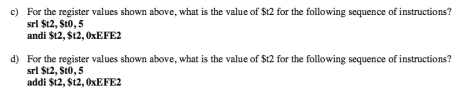 Find the value for $t2
Assume the following register contents: $t0 = 0xAAAAAABA, $t1 =
0x82345678
For the register values shown above, what is the value of $t2 for the following sequence of instructions? sr1 $t2, $t0,5 and i $t2, $t2, 0xEFE2 For the register values shown above, what is the value of $t2 for the following sequence of instructions? sr1 $t2, $t0, 5 add i $t2, $t2, 0xEFE2
Find the value for $t2
Assume the following register contents: $t0 = 0xAAAAAABA, $t1 =
0x82345678
For the register values shown above, what is the value of $t2 for the following sequence of instructions? sr1 $t2, $t0,5 and i $t2, $t2, 0xEFE2 For the register values shown above, what is the value of $t2 for the following sequence of instructions? sr1 $t2, $t0, 5 add i $t2, $t2, 0xEFE2
Circuit with figure EX. 5 : Consider the following circuit of figure 1. 1) At t0=...
 Circuit with figure
EX. 5 : Consider the following circuit of figure 1. 1) At t0= 0, the switch is closed, give the expression of Vs(t). 2) At t1 >> RC, the switch is re-open, give the expression of Vs(t). 3) Comment on the function of this circuit called a pulse generator with realistic values of emf , R and C.
Circuit with figure
EX. 5 : Consider the following circuit of figure 1. 1) At t0= 0, the switch is closed, give the expression of Vs(t). 2) At t1 >> RC, the switch is re-open, give the expression of Vs(t). 3) Comment on the function of this circuit called a pulse generator with realistic values of emf , R and C.
20. (4 pts) Consider the following recurrence. an = 2an-1 + 2an-2 ao = 0 Q1...
 20. (4 pts) Consider the following recurrence. an = 2an-1 + 2an-2 ao = 0 Q1 = 2V3 For what values of a and B is the following expression a solution of that recurrence? a;=a (1+ v3)*+B (1 - v3)' a = -1 and B 1 O a = = { and B :- O a = 2 and B = -2 the four other possible answers are incorrect O a = 1 and B = -1
Need answers for 1-5 Consider the following recurrence relation: H(n) = {0 if n lessthanorequalto 0...
 Need answers for 1-5
Consider the following recurrence relation: H(n) = {0 if n lessthanorequalto 0 1 if n = 1 or n = 2 H(n - 1) + H (n - 2)-H(n - 3) if n > 2. (a) Compute H(n) for n = 1, 2, ...., 10. (b) Using the pattern from part (a), guess what H(100) is. 2. Consider the recurrence relation defined in Example 3.3 (FROM TEXT BOOK, also discussed in class and shown in slides)...
Need answers for 1-5
Consider the following recurrence relation: H(n) = {0 if n lessthanorequalto 0 1 if n = 1 or n = 2 H(n - 1) + H (n - 2)-H(n - 3) if n > 2. (a) Compute H(n) for n = 1, 2, ...., 10. (b) Using the pattern from part (a), guess what H(100) is. 2. Consider the recurrence relation defined in Example 3.3 (FROM TEXT BOOK, also discussed in class and shown in slides)...
Consider recurrence T(n) = 2T () +n Ign. Assume T (1) = : 0(1) Draw its...
 Consider recurrence T(n) = 2T () +n Ign. Assume T (1) = : 0(1) Draw its recursion tree using your favorite tool. Follow the instructions (regarding the tree, step 1~3) to format your tree. Level Tree Node Per-Level Cost . 1 O Step 1: Draw the "head" of the tree. Step 2: Start at level 0, draw the tree downto level 2. 2 cn 1X CP = CP Tw/2 (wa), T(1/2) 1 cn/2 cn/2 28 cm/2 = 0 T( W22)...
 3. Consider the recurrence relation an = 80n/2 + n², where n=2", for some integer k. a) Give a big-O estimate for an. b) What is the recurrence relation for the sequence bk obtained from an by doing the substitution n= n=2k ?
 Find the value for $t2
Assume the following register contents: $t0 = 0xAAAAAABA, $t1 =
0x82345678
For the register values shown above, what is the value of $t2 for the following sequence of instructions? sr1 $t2, $t0,5 and i $t2, $t2, 0xEFE2 For the register values shown above, what is the value of $t2 for the following sequence of instructions? sr1 $t2, $t0, 5 add i $t2, $t2, 0xEFE2
Find the value for $t2
Assume the following register contents: $t0 = 0xAAAAAABA, $t1 =
0x82345678
For the register values shown above, what is the value of $t2 for the following sequence of instructions? sr1 $t2, $t0,5 and i $t2, $t2, 0xEFE2 For the register values shown above, what is the value of $t2 for the following sequence of instructions? sr1 $t2, $t0, 5 add i $t2, $t2, 0xEFE2
 Circuit with figure
EX. 5 : Consider the following circuit of figure 1. 1) At t0= 0, the switch is closed, give the expression of Vs(t). 2) At t1 >> RC, the switch is re-open, give the expression of Vs(t). 3) Comment on the function of this circuit called a pulse generator with realistic values of emf , R and C.
Circuit with figure
EX. 5 : Consider the following circuit of figure 1. 1) At t0= 0, the switch is closed, give the expression of Vs(t). 2) At t1 >> RC, the switch is re-open, give the expression of Vs(t). 3) Comment on the function of this circuit called a pulse generator with realistic values of emf , R and C.
 20. (4 pts) Consider the following recurrence. an = 2an-1 + 2an-2 ao = 0 Q1 = 2V3 For what values of a and B is the following expression a solution of that recurrence? a;=a (1+ v3)*+B (1 - v3)' a = -1 and B 1 O a = = { and B :- O a = 2 and B = -2 the four other possible answers are incorrect O a = 1 and B = -1
 Need answers for 1-5
Consider the following recurrence relation: H(n) = {0 if n lessthanorequalto 0 1 if n = 1 or n = 2 H(n - 1) + H (n - 2)-H(n - 3) if n > 2. (a) Compute H(n) for n = 1, 2, ...., 10. (b) Using the pattern from part (a), guess what H(100) is. 2. Consider the recurrence relation defined in Example 3.3 (FROM TEXT BOOK, also discussed in class and shown in slides)...
Need answers for 1-5
Consider the following recurrence relation: H(n) = {0 if n lessthanorequalto 0 1 if n = 1 or n = 2 H(n - 1) + H (n - 2)-H(n - 3) if n > 2. (a) Compute H(n) for n = 1, 2, ...., 10. (b) Using the pattern from part (a), guess what H(100) is. 2. Consider the recurrence relation defined in Example 3.3 (FROM TEXT BOOK, also discussed in class and shown in slides)...
 Consider recurrence T(n) = 2T () +n Ign. Assume T (1) = : 0(1) Draw its recursion tree using your favorite tool. Follow the instructions (regarding the tree, step 1~3) to format your tree. Level Tree Node Per-Level Cost . 1 O Step 1: Draw the "head" of the tree. Step 2: Start at level 0, draw the tree downto level 2. 2 cn 1X CP = CP Tw/2 (wa), T(1/2) 1 cn/2 cn/2 28 cm/2 = 0 T( W22)...
Most questions answered within 3 hours.
-
Where is the error in this code sequence?
String s1 = "Hello";
String s2 = "ello";...
asked 10 months ago -
Financial data for Joel de Paris, Inc., for last year
follow:
Joel de Paris, Inc.
Balance...
asked 10 months ago -
Consider this reaction:
Al2(SO4)3 (aq)+ BaCl3
(aq) Al2Cl6 (aq)- +
3BaSO4(s) . What is the...
asked 10 months ago -
Suppose that Savneet is considering increasing her
recent random sample from 20 car rentals to 40...
asked 10 months ago -
Trucks arrive at an unloading terminal at an average rate of 120
per hour.
Trucks arrive...
asked 10 months ago -
Why are methanol and ethanol completely soluble in water while
octanol is not very little soluble....
asked 10 months ago -
A facilities manager at a university reads in a research report
that the mean amount of...
asked 10 months ago -
When the CuSO4 is rehydrated by adding water to the anhydrous
compound, is this an endothermic...
asked 10 months ago -
A ray of sunlight is passing from diamond into crown glass; the
angle of incidence is...
asked 10 months ago -
A block of mass 0.249 kg is placed on top of a light, vertical
spring of...
asked 10 months ago -
how do the kidneys compensate in the presences of acidosis
a) trigger hyperventilate
b) reserve acid...
asked 10 months ago -
Question 501 pts
The rental rate of capital to the firm increases. Which of the
following...
asked 10 months ago