Calculate the equilibrium concentration of [FeSCN2+] in Part A if 1.0mL of 2.0x10⁻³M KSCN and 25.00mL...
Calculate the equilibrium concentration of [FeSCN2+] in Part A if 1.0mL of 2.0x10⁻³M KSCN and 25.00mL of 0.0020M Fe(NO3)2 are diluted to 100.0mL.
Hint: Answer includes 2 significant figures.
A student created a calibration curve for absorbance vs. [FeSCN2+], resulting in a line of best fit:
y = 3697x + 0.0154
If a solution of unknown concentration of FeSCN2+ has an absorbance of 0.86, what is its concentration?
Hint: Answer includes 2 significant figures.
Homework Answers

Add Answer to:
Calculate the equilibrium concentration of [FeSCN2+] in Part A
if 1.0mL of 2.0x10⁻³M KSCN and 25.00mL...
You begin preparation of the calibration curve to measure absorbance vs concentration of FeSCN2+. To do...
You begin preparation of the calibration curve to measure absorbance vs concentration of FeSCN2+. To do so, you add 4.614 mL of 0.200 M Fe(NO3)3 to a cuvette and then directly add 108 µL of 0.001 M KSCN. What is the resulting concentration of FeSCN2+, assuming complete conversion of SCN- to FeSCN2+? Enter your answer in units of mM to four digits after the decimal.
You begin preparation of the calibration curve to measure absorbance vs concentration of FeSCN2+. To do...
You begin preparation of the calibration curve to measure absorbance vs concentration of FeSCN2+. To do so, you add 4.614 mL of 0.200 M Fe(NO3)3 to a cuvette and then directly add 108 µL of 0.001 M KSCN. What is the resulting concentration of FeSCN2+, assuming complete conversion of SCN- to FeSCN2+? Enter your answer in units of mM to four digits after the decimal.
5.0 mL of 0.0020 M Fe(NO3)3 was mixed with 3.0 mL of 0.0020 M KSCN and...
5.0 mL of 0.0020 M Fe(NO3)3 was mixed with 3.0 mL of 0.0020 M KSCN and 2.0 mL of. The absorbance of this solution at 447 nm was measured as 0.35. A calibration curve was created using four standard solutions of Fe(SCN)2+. The equation for the best-fit line of [FeSCN2+] vs Abs was y = 5025x + 0.004. Using the data provided, calculate an equilibrium constant (Kc) for the formation of [Fe(SCN)2+]. For the above reaction, how were we able...
Determine the equilibrium concentration of FeSCN2+ in each solution. (Page below are the initial concentrations of...
 Determine the equilibrium concentration of FeSCN2+ in each
solution. (Page below are the initial concentrations of FE3+ and
scn- for each solution )
Secondly, use stoichiometry to determine equilibrium FE3+ and
SCN -. ( concentration used for FE and KSCN are both 0.002M )
the absorbance of each standard in the same test tube used to blank the spectrophoto standards from least to most concentrated, rinsing with a small amount of the next sta tilling the test tube. Record absorbance...
Determine the equilibrium concentration of FeSCN2+ in each
solution. (Page below are the initial concentrations of FE3+ and
scn- for each solution )
Secondly, use stoichiometry to determine equilibrium FE3+ and
SCN -. ( concentration used for FE and KSCN are both 0.002M )
the absorbance of each standard in the same test tube used to blank the spectrophoto standards from least to most concentrated, rinsing with a small amount of the next sta tilling the test tube. Record absorbance...
What's the concentration of [FeSCN2+] using limiting reactant theory and equation? For each test tube solution...
 What's the concentration of [FeSCN2+] using limiting
reactant theory and equation?
For each test tube solution enter the initial concentration of Fe+ and SCNthe equilibrium concentration of FeSCN2: into the ICE table given. Complete entries for the rest of the table and calculate the K value for each of the tables. The values of K should be confined to a narrow range to reflect constancy. Comment on the quality of your work in this regard and calculate the average K....
What's the concentration of [FeSCN2+] using limiting
reactant theory and equation?
For each test tube solution enter the initial concentration of Fe+ and SCNthe equilibrium concentration of FeSCN2: into the ICE table given. Complete entries for the rest of the table and calculate the K value for each of the tables. The values of K should be confined to a narrow range to reflect constancy. Comment on the quality of your work in this regard and calculate the average K....
Table A. Preparation of Standard solutions of FeSCN2+ 1.0 M HNO3 0.002 M 0.200 M Solution...
 Table A. Preparation of Standard solutions of FeSCN2+ 1.0 M HNO3 0.002 M 0.200 M Solution KSCN (mL) Fe(NO3)3 (mL) 0.5 5 [FeSCN2+] (mol/L)* 1 4.0x10^-5 Add 1.0 M 2 1.0 5 8.0x10^-5 HNO3 3 1.5 5 1.2x10^-10 4 2.0 5 1.6x10⁻⁴ to each to adjust the volume to 25 mL. 5 2.5 5 2.0x10⁻⁴ * Calculate the concentrations of FeSCN2+ in each beaker, assuming that all SCN-ions exist as FeSCN2+. In other words, [FeSCN2+] (in Soln 1) = [SCN-]...
A student created a Beer’s Law calibration curve by plotting absorbance vs. [CV]. The line of...
A student created a Beer’s Law calibration curve by plotting absorbance vs. [CV]. The line of best fit is y = 42871x + 0.0500. If the absorbance of an unknown was found to be 0.69, what is its concentration? Hint: Answer includes 3 significant figures. Calculate the absorbance if the % transmittance is 82.4%.
4. Given the calibration data in the table below, calculate the equilibrium concentration of (FeSCN2+1 if...
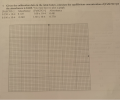 4. Given the calibration data in the table below, calculate the equilibrium concentration of (FeSCN2+1 if the absorbance is 0.460. You may have to plot a graph. [FeSCN2+] Absorbance [FeSCN2+] Absorbance 0.250 x 10⁻⁴ 0.120 1.00 x 10⁻⁴ 0.481 0.500 x 10⁻⁴ 0.240 1.60 x 10⁻⁴ 0.770 Part A Determine the value of the equilibrium constant, Kgoal, for the reaction N2(g) + H2O(g) = NO(g) +;N, H.(g). K =? by making use of the following information: Ki = 4.10 x...
 Determine the equilibrium concentration of FeSCN2+ in each
solution. (Page below are the initial concentrations of FE3+ and
scn- for each solution )
Secondly, use stoichiometry to determine equilibrium FE3+ and
SCN -. ( concentration used for FE and KSCN are both 0.002M )
the absorbance of each standard in the same test tube used to blank the spectrophoto standards from least to most concentrated, rinsing with a small amount of the next sta tilling the test tube. Record absorbance...
Determine the equilibrium concentration of FeSCN2+ in each
solution. (Page below are the initial concentrations of FE3+ and
scn- for each solution )
Secondly, use stoichiometry to determine equilibrium FE3+ and
SCN -. ( concentration used for FE and KSCN are both 0.002M )
the absorbance of each standard in the same test tube used to blank the spectrophoto standards from least to most concentrated, rinsing with a small amount of the next sta tilling the test tube. Record absorbance...
 What's the concentration of [FeSCN2+] using limiting
reactant theory and equation?
For each test tube solution enter the initial concentration of Fe+ and SCNthe equilibrium concentration of FeSCN2: into the ICE table given. Complete entries for the rest of the table and calculate the K value for each of the tables. The values of K should be confined to a narrow range to reflect constancy. Comment on the quality of your work in this regard and calculate the average K....
What's the concentration of [FeSCN2+] using limiting
reactant theory and equation?
For each test tube solution enter the initial concentration of Fe+ and SCNthe equilibrium concentration of FeSCN2: into the ICE table given. Complete entries for the rest of the table and calculate the K value for each of the tables. The values of K should be confined to a narrow range to reflect constancy. Comment on the quality of your work in this regard and calculate the average K....
 Table A. Preparation of Standard solutions of FeSCN2+ 1.0 M HNO3 0.002 M 0.200 M Solution KSCN (mL) Fe(NO3)3 (mL) 0.5 5 [FeSCN2+] (mol/L)* 1 4.0x10^-5 Add 1.0 M 2 1.0 5 8.0x10^-5 HNO3 3 1.5 5 1.2x10^-10 4 2.0 5 1.6x10⁻⁴ to each to adjust the volume to 25 mL. 5 2.5 5 2.0x10⁻⁴ * Calculate the concentrations of FeSCN2+ in each beaker, assuming that all SCN-ions exist as FeSCN2+. In other words, [FeSCN2+] (in Soln 1) = [SCN-]...
 4. Given the calibration data in the table below, calculate the equilibrium concentration of (FeSCN2+1 if the absorbance is 0.460. You may have to plot a graph. [FeSCN2+] Absorbance [FeSCN2+] Absorbance 0.250 x 10⁻⁴ 0.120 1.00 x 10⁻⁴ 0.481 0.500 x 10⁻⁴ 0.240 1.60 x 10⁻⁴ 0.770 Part A Determine the value of the equilibrium constant, Kgoal, for the reaction N2(g) + H2O(g) = NO(g) +;N, H.(g). K =? by making use of the following information: Ki = 4.10 x...
Most questions answered within 3 hours.
-
Where is the error in this code sequence?
String s1 = "Hello";
String s2 = "ello";...
asked 11 months ago -
Financial data for Joel de Paris, Inc., for last year
follow:
Joel de Paris, Inc.
Balance...
asked 11 months ago -
Consider this reaction:
Al2(SO4)3 (aq)+ BaCl3
(aq) Al2Cl6 (aq)- +
3BaSO4(s) . What is the...
asked 11 months ago -
Suppose that Savneet is considering increasing her
recent random sample from 20 car rentals to 40...
asked 11 months ago -
Trucks arrive at an unloading terminal at an average rate of 120
per hour.
Trucks arrive...
asked 11 months ago -
Why are methanol and ethanol completely soluble in water while
octanol is not very little soluble....
asked 11 months ago -
A facilities manager at a university reads in a research report
that the mean amount of...
asked 11 months ago -
When the CuSO4 is rehydrated by adding water to the anhydrous
compound, is this an endothermic...
asked 11 months ago -
A ray of sunlight is passing from diamond into crown glass; the
angle of incidence is...
asked 11 months ago -
A block of mass 0.249 kg is placed on top of a light, vertical
spring of...
asked 11 months ago -
how do the kidneys compensate in the presences of acidosis
a) trigger hyperventilate
b) reserve acid...
asked 11 months ago -
Question 501 pts
The rental rate of capital to the firm increases. Which of the
following...
asked 11 months ago