1) A regression was run to determine if there is a relationship between hours of TV...
1) A regression was run to determine if there is a relationship
between hours of TV watched per day (x) and number of situps a
person can do (y).
The results of the regression were:
y=ax+b
a=-0.867
b=23.731
r2=0.403225
r=-0.635
Use this to predict the number of situps a person who watches 3
hours of TV can do (to one decimal place)
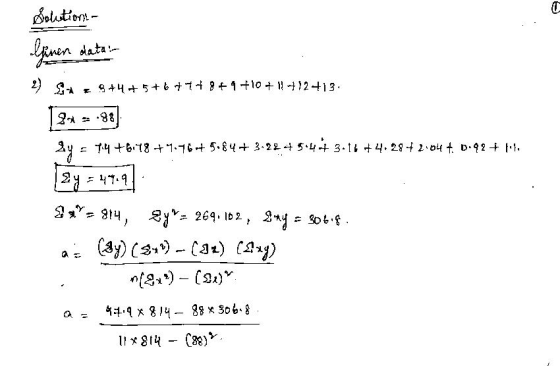
2)Based on the data shown below, calculate the regression line
(each value to two decimal places)
y = ____x + ____
| x | y |
|---|---|
| 3 | 7.4 |
| 4 | 6.78 |
| 5 | 7.76 |
| 6 | 5.84 |
| 7 | 3.22 |
| 8 | 5.4 |
| 9 | 4.28 |
| 10 | 3.16 |
| 11 | 2.04 |
| 12 | 0.92 |
| 13 | 1.1 |
3)Here is a bivariate data set.
| x | y |
|---|---|
| 32.6 | 75.7 |
| 31.7 | 56.8 |
| 46.1 | 69.1 |
| 41.8 | 57.6 |
| 33.4 | 60.6 |
| 26.6 | 70.6 |
| 39.5 | 72.5 |
| 47.5 | 62.4 |
| 22.8 | 85.4 |
| 35.3 | 55.2 |
| 54.2 | 52.5 |
| 29.7 | 61.1 |
| 37.3 | 80.2 |
| 55.5 | 44.2 |
| 36.8 | 54.2 |
| 47.8 | 60.6 |
| 33.8 | 74.7 |
Find the correlation coefficient and report it accurate to three
decimal places.
r =
4)Suppose you were to collect data for the following pair of variables, all elementary-school students: weight, score on a reading test. You want to make a scatterplot. Which variable would you use as the explanatory variable?
- weight
- score on a reading test
Which variable would you use as the response variable?
- weight
- score on a reading test
Would you expect to see a positive or negative association?
- positive
- negative
- neither
5)At the .05 significance level, does the data below show significant correlation?
| x | y |
|---|---|
| 4 | 29.1 |
| 5 | 20.5 |
| 6 | 28.1 |
| 7 | 29.3 |
| 8 | 32 |
| 9 | 33.1 |
| 10 | 33.3 |
| 11 | 36.5 |
- Yes, significant correlation OR
- No
Homework Answers
 Note:-
As per HomeworkLib rule, 2 questions are enough.If you want remaining questions also please upload them as separate question.
Thank you..
Add Answer to:
1) A regression was run to determine if there is a relationship
between hours of TV...
A regression was run to determine if there is a relationship between hours of TV watched...
A regression was run to determine if there is a relationship between hours of TV watched per day (x) and number of situps a person can do (y). The results of the regression were: y=ax+b a=-0.867 b=23.962 r2=0.702244 r=-0.838 Use this to predict the number of situps a person who watches 9.5 hours of TV can do (to one decimal place)
A regression was run to determine if there is a relationship between hours of TV watched...
A regression was run to determine if there is a relationship between hours of TV watched per day (x) and number of situps a person can do (y). The results of the regression were: y=ax+b a=-0.949 b=30.119 r2=0.597529 r=-0.773 Assume the correlation is significant, and use this to predict the number of situps a person who watches 10 hours of TV can do (to one decimal place)
A regression was run to determine if there is a relationship between hours of TV watched...
 A regression was run to determine if there is a relationship between hours of TV watched per day (x) and number of situps a person can do (y). The results of the regression were: y = ax+b a = -0.83 b = 26.507 r2 = 0.443556 r= (round to three decimal places) Predict the number of situps a person who watches 4.5 hours of TV can do (to one decimal place). > Next Question
A regression was run to determine if there is a relationship between hours of TV watched...
A regression was run to determine if there is a relationship between hours of TV watched per day (x) and number of situps a person can do (y). The results of the regression were: y=ax+b a=-1.179 b=22.006 r2=0.595984 r=-0.772 Use this to predict the number of situps a person who watches 5.5 hours of TV can do (to one decimal place)
A regression was run to determine if there is a relationship between hours of TV watched...
A regression was run to determine if there is a relationship between hours of TV watched per day (x) and number of situps a person can do (y). The results of the regression were: y=ax+b a=-1.263 b=21.291 r2=0.5776 r=-0.76 Use this to predict the number of situps a person who watches 5 hours of TV can do (to one decimal place)
A regression was run to determine if there is a relationship between hours of TV watched...
A regression was run to determine if there is a relationship between hours of TV watched per day (x) and number of situps a person can do (y). The results of the regression were: y=ax+b a=-0.622 b=30.666 r2=0.868624 r=-0.932 Use this to predict the number of situps a person who watches 6.5 hours of TV can do (to one decimal place)
A regression was run to determine if there is a relationship between hours of TV watched...
A regression was run to determine if there is a relationship between hours of TV watched per day (x) and number of situps a person can do (y). The results of the regression were: y=ax+b a=-1.193 b=28.861 r2=0.763876 r=-0.874 Use this to predict the number of situps a person who watches 3.5 hours of TV can do (to one decimal place)
A regression was run to determine if there is a relationship between hours of TV watched...
A regression was run to determine if there is a relationship between hours of TV watched per day (x) and number of situps a person can do (y). The results of the regression were: y=ax+b a=-0.659 b=32.254 r2=0.499849 r=-0.707 Use this to predict the number of situps a person who watches 11.5 hours of TV can do (to one decimal place)
A regression was run to determine if there is a relationship between hours of TV watched...
A regression was run to determine if there is a relationship between hours of TV watched per day (x) and number of situps a person can do (y). The results of the regression were: y=ax+b a=-0.609 b=35.322 r2=0.481636 r=-0.694 Use this to predict the number of situps a person who watches 7.5 hours of TV can do (to one decimal place)
A regression was run to determine if there is a relationship between hours of TV watched...
A regression was run to determine if there is a relationship between hours of TV watched per day (x) and number of situps a person can do (y). The results of the regression were: y = a x + b a = -0.835 b = 31.276 r2 = 0.488601 r = -0.699 Use this to predict the number of situps a person who watches 4 hours of TV can do. situps = [one decimal accuracy] Box 1: Enter your answer...
 A regression was run to determine if there is a relationship between hours of TV watched per day (x) and number of situps a person can do (y). The results of the regression were: y = ax+b a = -0.83 b = 26.507 r2 = 0.443556 r= (round to three decimal places) Predict the number of situps a person who watches 4.5 hours of TV can do (to one decimal place). > Next Question
Most questions answered within 3 hours.
-
Where is the error in this code sequence?
String s1 = "Hello";
String s2 = "ello";...
asked 10 months ago -
Financial data for Joel de Paris, Inc., for last year
follow:
Joel de Paris, Inc.
Balance...
asked 10 months ago -
Consider this reaction:
Al2(SO4)3 (aq)+ BaCl3
(aq) Al2Cl6 (aq)- +
3BaSO4(s) . What is the...
asked 10 months ago -
Suppose that Savneet is considering increasing her
recent random sample from 20 car rentals to 40...
asked 10 months ago -
Trucks arrive at an unloading terminal at an average rate of 120
per hour.
Trucks arrive...
asked 10 months ago -
Why are methanol and ethanol completely soluble in water while
octanol is not very little soluble....
asked 10 months ago -
A facilities manager at a university reads in a research report
that the mean amount of...
asked 10 months ago -
When the CuSO4 is rehydrated by adding water to the anhydrous
compound, is this an endothermic...
asked 10 months ago -
A ray of sunlight is passing from diamond into crown glass; the
angle of incidence is...
asked 10 months ago -
A block of mass 0.249 kg is placed on top of a light, vertical
spring of...
asked 10 months ago -
how do the kidneys compensate in the presences of acidosis
a) trigger hyperventilate
b) reserve acid...
asked 10 months ago -
Question 501 pts
The rental rate of capital to the firm increases. Which of the
following...
asked 10 months ago