List 3 functional groups that must be avoided during the formation of a Grignard reagent. For...
List 3 functional groups that must be avoided during the formation of a Grignard reagent. For each of the functional groups listed in your above answer, write chemical equations that demonstrate why those particular functional groups should be avoided.
Homework Answers
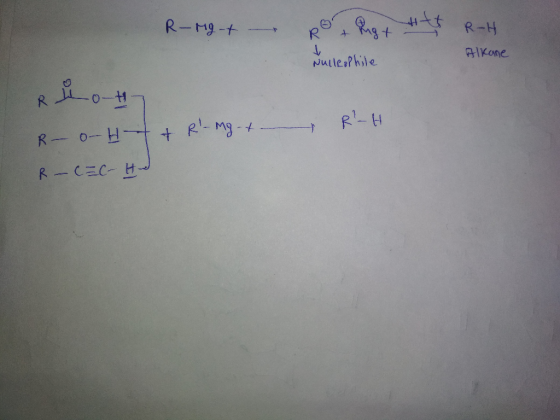
Groups with Acidic hydrogens are Grignard reagent sensitive sicne Grignard reagent is a good source for nucleophilie (Carbanion) which can easily attack the Electrophile (H+) of compounds with acidic hydrogens to form concerned alkanes
Examples include carboxylic acid , alcohols and Terinal alkynes
Add Answer to:
List 3 functional groups that must be avoided during the
formation of a Grignard reagent. For...
Please only answer 3 P Grignard 1. During the formation of the Grignard reagent, the solution...
 Please only answer 3
P
Grignard 1. During the formation of the Grignard reagent, the solution can boil without addition of external heat. Explain 2. Explain why acetone and water should be excluded from the reaction vessel during the formation of the Grignard reagent. 3. At what stage of the procedure can water be allowed to come into contact with the reaction solution? 4. Why is the dry ice crushed before use and why should you wait to crush the...
Please only answer 3
P
Grignard 1. During the formation of the Grignard reagent, the solution can boil without addition of external heat. Explain 2. Explain why acetone and water should be excluded from the reaction vessel during the formation of the Grignard reagent. 3. At what stage of the procedure can water be allowed to come into contact with the reaction solution? 4. Why is the dry ice crushed before use and why should you wait to crush the...
Grignard Reaction 1. Draw your complete reaction, including the formation of the Grignard reagent and the...
 Grignard Reaction 1. Draw your complete reaction, including the formation of the Grignard reagent and the reaction with your carbonyl compound. Below each reagent, write its molecular weight and density (if a liquid). Also write how much of each material you will use in ml (if liquid), grams, and moles. Also include the molecular weight and melting point of your final product. 2. How many moles of Grignard reagent are you synthesizing? What mass of water could fully react with...
Gnghare Reaction 1. Draw your complete reaction, including the formation of the Grignard reagent and the...
 Gnghare Reaction 1. Draw your complete reaction, including the formation of the Grignard reagent and the reaction with your carbonyl compound. Below each reagent, write its molecular weight and density (if a liquid). Also write how much of each material you will use in mL (if liquid), grams, and moles. Also include the molecular weight and melting point of your final product.
Grignard reagent THE GRIGNARD REAGENT-PREPARATION AND REACTION In this experiment, you will prepa...
 i need help with the prelab questions please
Grignard reagent THE GRIGNARD REAGENT-PREPARATION AND REACTION In this experiment, you will prepare a Grignard reagent, phenyl magnesium bromide, from bromobenzene and magnesium metal. The Grignard reagent will then react with methyl benzoate to form triphenylmethanol. Introduction Grignard reagents, such as organomagnesium halides, were discovered in 1910 by French chemist Victor Grignard. The Grignard reaction is one of the most general methods for carbon- carbon bond formation in all of organic chemistry....
i need help with the prelab questions please
Grignard reagent THE GRIGNARD REAGENT-PREPARATION AND REACTION In this experiment, you will prepare a Grignard reagent, phenyl magnesium bromide, from bromobenzene and magnesium metal. The Grignard reagent will then react with methyl benzoate to form triphenylmethanol. Introduction Grignard reagents, such as organomagnesium halides, were discovered in 1910 by French chemist Victor Grignard. The Grignard reaction is one of the most general methods for carbon- carbon bond formation in all of organic chemistry....
Label the boxed functional groups in the steroid molecule. 1) 2) 3) Label the boxed functional...
 Label the boxed functional groups in the steroid molecule.
1)
2)
3)
Label the boxed functional groups in the steroid molecule. In each reaction box, place the best reagent and conditions from the list below. In each reaction box, place the best reagent and conditions from the list below.
Label the boxed functional groups in the steroid molecule.
1)
2)
3)
Label the boxed functional groups in the steroid molecule. In each reaction box, place the best reagent and conditions from the list below. In each reaction box, place the best reagent and conditions from the list below.
Grignard reagent THE GRIGNARD REAGENT-PREPARATION AND REACTION In this experiment, you will prepa...
 i need help with the postlab questions please
Grignard reagent THE GRIGNARD REAGENT-PREPARATION AND REACTION In this experiment, you will prepare a Grignard reagent, phenyl magnesium bromide, from bromobenzene and magnesium metal. The Grignard reagent will then react with methyl benzoate to form triphenylmethanol. Introduction Grignard reagents, such as organomagnesium halides, were discovered in 1910 by French chemist Victor Grignard. The Grignard reaction is one of the most general methods for carbon- carbon bond formation in all of organic chemistry....
i need help with the postlab questions please
Grignard reagent THE GRIGNARD REAGENT-PREPARATION AND REACTION In this experiment, you will prepare a Grignard reagent, phenyl magnesium bromide, from bromobenzene and magnesium metal. The Grignard reagent will then react with methyl benzoate to form triphenylmethanol. Introduction Grignard reagents, such as organomagnesium halides, were discovered in 1910 by French chemist Victor Grignard. The Grignard reaction is one of the most general methods for carbon- carbon bond formation in all of organic chemistry....
synthesis of triphenylmethanol draw reaction equation for the formation of the grignard reagent Load Reagents The...
 synthesis of triphenylmethanol
draw reaction equation for the formation of the grignard
reagent
Load Reagents The left side of the arrow is for reactants, reagents (solvents etc.) must appear above or below the arrow, product(s) must be right of the arrow. You can use the "X" button to oneter a chemical formula. For further help see the help page. Note: only change a single atom into Mg using the X button, do NOT try to use the X as MgBr...
synthesis of triphenylmethanol
draw reaction equation for the formation of the grignard
reagent
Load Reagents The left side of the arrow is for reactants, reagents (solvents etc.) must appear above or below the arrow, product(s) must be right of the arrow. You can use the "X" button to oneter a chemical formula. For further help see the help page. Note: only change a single atom into Mg using the X button, do NOT try to use the X as MgBr...
Could you help with #2,4,3,6, please 1. Define the term "Nucleophile" and explain how a Grignard...
 Could you help with #2,4,3,6, please
1. Define the term "Nucleophile" and explain how a Grignard reagent acts as a nucleophile. Briefly explain using a chemical equation, why it is necessary to use dry apparatus and reagents during the synthesis of C6H5MgBr. phenylmagnesium bromide. 3. By referring to a textbook, write a mechanism for the reaction between phenylmagnesium bromide and the ketone butanone. In a reaction of phenylmagnesium bromide with butanone the Grignard reagent was prepared from 25 g of...
Could you help with #2,4,3,6, please
1. Define the term "Nucleophile" and explain how a Grignard reagent acts as a nucleophile. Briefly explain using a chemical equation, why it is necessary to use dry apparatus and reagents during the synthesis of C6H5MgBr. phenylmagnesium bromide. 3. By referring to a textbook, write a mechanism for the reaction between phenylmagnesium bromide and the ketone butanone. In a reaction of phenylmagnesium bromide with butanone the Grignard reagent was prepared from 25 g of...
Preparation of Benzoic Acid using a Grignard Reagent URGENT 1. During your Grignard formation, a small...
Preparation of Benzoic Acid using a Grignard Reagent URGENT 1. During your Grignard formation, a small amount of benzene is formed. Provide a brief explanation and mechanism to explain this observation. 2. During your Grignard formation, a small amount of biphenyl is formed. Provide a brief explanation and mechanism to explain this observation. 3. What mass of water would be required to destroy the phenylmagnesium bromide that you prepared in this experiment? What volume does this represent? 4. Why is...
1) List the most common organic functional groups that function as acids or bases. Write an equation of each with...
 1) List the most common organic functional groups that function as acids or bases. Write an equation of each with Hal or NaOH to show their behavior as acids or bases. (You will also enter these functional groups in the table in Question 2.) 2) Fill in the following table showing the general solubility behavior of the organic acids and bases you listed above. Assume that they are not small enough to have significant water solubility. Type of Organic Compound...
 Please only answer 3
P
Grignard 1. During the formation of the Grignard reagent, the solution can boil without addition of external heat. Explain 2. Explain why acetone and water should be excluded from the reaction vessel during the formation of the Grignard reagent. 3. At what stage of the procedure can water be allowed to come into contact with the reaction solution? 4. Why is the dry ice crushed before use and why should you wait to crush the...
Please only answer 3
P
Grignard 1. During the formation of the Grignard reagent, the solution can boil without addition of external heat. Explain 2. Explain why acetone and water should be excluded from the reaction vessel during the formation of the Grignard reagent. 3. At what stage of the procedure can water be allowed to come into contact with the reaction solution? 4. Why is the dry ice crushed before use and why should you wait to crush the...
 Grignard Reaction 1. Draw your complete reaction, including the formation of the Grignard reagent and the reaction with your carbonyl compound. Below each reagent, write its molecular weight and density (if a liquid). Also write how much of each material you will use in ml (if liquid), grams, and moles. Also include the molecular weight and melting point of your final product. 2. How many moles of Grignard reagent are you synthesizing? What mass of water could fully react with...
 Gnghare Reaction 1. Draw your complete reaction, including the formation of the Grignard reagent and the reaction with your carbonyl compound. Below each reagent, write its molecular weight and density (if a liquid). Also write how much of each material you will use in mL (if liquid), grams, and moles. Also include the molecular weight and melting point of your final product.
 i need help with the prelab questions please
Grignard reagent THE GRIGNARD REAGENT-PREPARATION AND REACTION In this experiment, you will prepare a Grignard reagent, phenyl magnesium bromide, from bromobenzene and magnesium metal. The Grignard reagent will then react with methyl benzoate to form triphenylmethanol. Introduction Grignard reagents, such as organomagnesium halides, were discovered in 1910 by French chemist Victor Grignard. The Grignard reaction is one of the most general methods for carbon- carbon bond formation in all of organic chemistry....
i need help with the prelab questions please
Grignard reagent THE GRIGNARD REAGENT-PREPARATION AND REACTION In this experiment, you will prepare a Grignard reagent, phenyl magnesium bromide, from bromobenzene and magnesium metal. The Grignard reagent will then react with methyl benzoate to form triphenylmethanol. Introduction Grignard reagents, such as organomagnesium halides, were discovered in 1910 by French chemist Victor Grignard. The Grignard reaction is one of the most general methods for carbon- carbon bond formation in all of organic chemistry....
 Label the boxed functional groups in the steroid molecule.
1)
2)
3)
Label the boxed functional groups in the steroid molecule. In each reaction box, place the best reagent and conditions from the list below. In each reaction box, place the best reagent and conditions from the list below.
Label the boxed functional groups in the steroid molecule.
1)
2)
3)
Label the boxed functional groups in the steroid molecule. In each reaction box, place the best reagent and conditions from the list below. In each reaction box, place the best reagent and conditions from the list below.
 i need help with the postlab questions please
Grignard reagent THE GRIGNARD REAGENT-PREPARATION AND REACTION In this experiment, you will prepare a Grignard reagent, phenyl magnesium bromide, from bromobenzene and magnesium metal. The Grignard reagent will then react with methyl benzoate to form triphenylmethanol. Introduction Grignard reagents, such as organomagnesium halides, were discovered in 1910 by French chemist Victor Grignard. The Grignard reaction is one of the most general methods for carbon- carbon bond formation in all of organic chemistry....
i need help with the postlab questions please
Grignard reagent THE GRIGNARD REAGENT-PREPARATION AND REACTION In this experiment, you will prepare a Grignard reagent, phenyl magnesium bromide, from bromobenzene and magnesium metal. The Grignard reagent will then react with methyl benzoate to form triphenylmethanol. Introduction Grignard reagents, such as organomagnesium halides, were discovered in 1910 by French chemist Victor Grignard. The Grignard reaction is one of the most general methods for carbon- carbon bond formation in all of organic chemistry....
 synthesis of triphenylmethanol
draw reaction equation for the formation of the grignard
reagent
Load Reagents The left side of the arrow is for reactants, reagents (solvents etc.) must appear above or below the arrow, product(s) must be right of the arrow. You can use the "X" button to oneter a chemical formula. For further help see the help page. Note: only change a single atom into Mg using the X button, do NOT try to use the X as MgBr...
synthesis of triphenylmethanol
draw reaction equation for the formation of the grignard
reagent
Load Reagents The left side of the arrow is for reactants, reagents (solvents etc.) must appear above or below the arrow, product(s) must be right of the arrow. You can use the "X" button to oneter a chemical formula. For further help see the help page. Note: only change a single atom into Mg using the X button, do NOT try to use the X as MgBr...
 Could you help with #2,4,3,6, please
1. Define the term "Nucleophile" and explain how a Grignard reagent acts as a nucleophile. Briefly explain using a chemical equation, why it is necessary to use dry apparatus and reagents during the synthesis of C6H5MgBr. phenylmagnesium bromide. 3. By referring to a textbook, write a mechanism for the reaction between phenylmagnesium bromide and the ketone butanone. In a reaction of phenylmagnesium bromide with butanone the Grignard reagent was prepared from 25 g of...
Could you help with #2,4,3,6, please
1. Define the term "Nucleophile" and explain how a Grignard reagent acts as a nucleophile. Briefly explain using a chemical equation, why it is necessary to use dry apparatus and reagents during the synthesis of C6H5MgBr. phenylmagnesium bromide. 3. By referring to a textbook, write a mechanism for the reaction between phenylmagnesium bromide and the ketone butanone. In a reaction of phenylmagnesium bromide with butanone the Grignard reagent was prepared from 25 g of...
 1) List the most common organic functional groups that function as acids or bases. Write an equation of each with Hal or NaOH to show their behavior as acids or bases. (You will also enter these functional groups in the table in Question 2.) 2) Fill in the following table showing the general solubility behavior of the organic acids and bases you listed above. Assume that they are not small enough to have significant water solubility. Type of Organic Compound...
Most questions answered within 3 hours.
-
Where is the error in this code sequence?
String s1 = "Hello";
String s2 = "ello";...
asked 10 months ago -
Financial data for Joel de Paris, Inc., for last year
follow:
Joel de Paris, Inc.
Balance...
asked 10 months ago -
Consider this reaction:
Al2(SO4)3 (aq)+ BaCl3
(aq) Al2Cl6 (aq)- +
3BaSO4(s) . What is the...
asked 10 months ago -
Suppose that Savneet is considering increasing her
recent random sample from 20 car rentals to 40...
asked 10 months ago -
Trucks arrive at an unloading terminal at an average rate of 120
per hour.
Trucks arrive...
asked 10 months ago -
Why are methanol and ethanol completely soluble in water while
octanol is not very little soluble....
asked 10 months ago -
A facilities manager at a university reads in a research report
that the mean amount of...
asked 10 months ago -
When the CuSO4 is rehydrated by adding water to the anhydrous
compound, is this an endothermic...
asked 10 months ago -
A ray of sunlight is passing from diamond into crown glass; the
angle of incidence is...
asked 10 months ago -
A block of mass 0.249 kg is placed on top of a light, vertical
spring of...
asked 10 months ago -
how do the kidneys compensate in the presences of acidosis
a) trigger hyperventilate
b) reserve acid...
asked 10 months ago -
Question 501 pts
The rental rate of capital to the firm increases. Which of the
following...
asked 10 months ago