A 90 kg man stands in a very strong wind moving at 12 m/s at torso...
A 90 kg man stands in a very strong wind moving at 12 m/s at torso height. As you know, he will need to lean in to the wind, and we can model the situation to see why. Assume that the man has a mass of 90 kg, with a center of gravity 1.0 m above the ground. The action of the wind on his torso, which we approximate as a cylinder 50 cm wide and 90 cm long centered 1.2 m above the ground, produces a force that tries to tip him over backward. To keep from falling over, he must lean forward.
Part A: What is the magnitude of the torque provided by the wind force? Take the pivot point at his feet. Assume that he is standing vertically. Assume that the air is at standard temperature and pressure.
Part B: At what angle to the vertical must the man lean to provide a gravitational torque that is equal to this torque due to the wind force?
Homework Answers
A)
Force, F = 0.5 p v^2 A
F = 0.5 x 1.229 x 12^2 x (0.9 x 0.5) = 39.82 N
Torque, T = F x r
T = 39.82 x 1.2 = 47.78 Nm
B)
Tan(theta) = (39.82 x 1.2)/(90 x 9.8)
Theta = 3.10 degree
Comment in case any doubt please rate my answer..
Add Answer to:
A 90 kg man stands in a very strong wind moving at 12 m/s at
torso...
An 80 kg man stands in a very strong wind moving at 17 m/s at torso...
An 80 kg man stands in a very strong wind moving at 17 m/s at torso height. As you know, he will need to lean in to the wind, and we can model the situation to see why. Assume that the man has a mass of 80 kg, with a center of gravity 1.0 m above the ground. The action of the wind on his torso, which we approximate as a cylinder 50 cm wide and 90 cm long centered...
When a man stands near the edge of an empty drainage ditch of depth 2.80 m,...
 When a man stands near the edge of an empty drainage ditch of depth 2.80 m, he can barely see the boundary between the opposite wall and bottom of the ditch as in Figure (a) shown below. The distance from his eyes to the ground is h-1.99 m. (Assume θ-29.70.) トd 2.80 m (a) What is the horizontal distance d from the man to the edge of the drainage ditch? d= (b) After the drainage ditch is filled with water...
A 60 kg stunt man is falling at 15 m/s when he comes into contact with...
A 60 kg stunt man is falling at 15 m/s when he comes into contact with a large safety air bag. In coming to a stop, the air bag exerts a force of -1200 N on the man. How long was the air mattress being used to slow his fall? (please provide me with the equation to solve and the steps to get to the answer)
2 out of 3 attempts A man is trying to lift 67.2 kg off the floor...
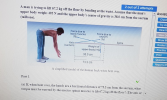 2 out of 3 attempts A man is trying to lift 67.2 kg off the floor by bending at the waist. Assume that the man's Assist upper body weighs 495 N and the upper body's center of gravity is 38.0 cm from the sacrum (tailbone) Checi Try An View H View Q Show M Guided Practice Force due to back muscles Force due to sacrum (Fs) Spine Axis (sacrum) Weight of upper body (mg Print 38.0 cm 73.3 cm A...
A man is holding a 19-kg child using both hands with his elbows bent in a...
A man is holding a 19-kg child using both hands with his elbows bent in a 90∘ angle. The biceps muscle provides the positive torque he needs to support the child. Determine the force that each of his biceps muscles must exert on the forearm in order to hold the child safely in this position. Ignore the triceps muscle and the mass of the arm. Let the child be l = 0.35 m from the elbow joint, and the biceps...
4. A 90 kg rocket stuntman steps off of a platform that is 50 m above...
4. A 90 kg rocket stuntman steps off of a platform that is 50 m above the ground (and he therefore starts at rest). While he is descending, his rocket pack exerts a steady upward force of 800 N. Ignore air resistance. (a) What is the magnitude and direction of the net force on the stuntman? (b) What is his acceleration? (c) How long does it take him to reach the ground? (d) What is his speed when he reaches...
A 100 kg man is three-fourth of the way up a 12 m long ladder (mass=5kg)...
A 100 kg man is three-fourth of the way up a 12 m long ladder (mass=5kg) that is resting aganist a smooth, frictionless wall as shown in the picture. What is the magnitude of the force of friction of the ground acting on the foot of the ladder? A) Draw all the forces acting on the ladder on the picture, providing a different label for each force (ex: F1, F2) B) Label the pivot point in your diagram using a...
A 76 kg man drops to a concrete patio from a window only 0.55 m above...
A 76 kg man drops to a concrete patio from a window only 0.55 m above the patio. He neglects to bend his knees on landing, taking 2.0 cm to stop. (a) What is his average acceleration from when his feet first touch the patio to when he stops? m/s2 (b) What is the magnitude of the average stopping force? kN
A man of mass 86 kg drops to a concrete patio from a window 0.43 m...
A man of mass 86 kg drops to a concrete patio from a window 0.43 m above the patio. He neglects to bend his knees on landing, taking 2.5 cm to stop. (a) What is his average acceleration from when his feet first touch the patio to when he stops? (b) What is the magnitude of the average stopping force exerted on him by the patio?
3. 1072 4 m/s 26 A 80 kg Prof. Sukanek wearing ice skates stands motionless on...
 3. 1072 4 m/s 26 A 80 kg Prof. Sukanek wearing ice skates stands motionless on the ice when he throws a 8 kg block with a velocity as shown in the figure. Assume he keeps his legs rigid during the throw and neglect friction and the motion of his arms. Use right and up as the positive directions. NOTES IMAGES DISCUSS UNITS STATS HELP PREFERENCES Part Description Answer Chk History A. 6.82 pts. 75% Assume he completes the throw...
 When a man stands near the edge of an empty drainage ditch of depth 2.80 m, he can barely see the boundary between the opposite wall and bottom of the ditch as in Figure (a) shown below. The distance from his eyes to the ground is h-1.99 m. (Assume θ-29.70.) トd 2.80 m (a) What is the horizontal distance d from the man to the edge of the drainage ditch? d= (b) After the drainage ditch is filled with water...
 2 out of 3 attempts A man is trying to lift 67.2 kg off the floor by bending at the waist. Assume that the man's Assist upper body weighs 495 N and the upper body's center of gravity is 38.0 cm from the sacrum (tailbone) Checi Try An View H View Q Show M Guided Practice Force due to back muscles Force due to sacrum (Fs) Spine Axis (sacrum) Weight of upper body (mg Print 38.0 cm 73.3 cm A...
 3. 1072 4 m/s 26 A 80 kg Prof. Sukanek wearing ice skates stands motionless on the ice when he throws a 8 kg block with a velocity as shown in the figure. Assume he keeps his legs rigid during the throw and neglect friction and the motion of his arms. Use right and up as the positive directions. NOTES IMAGES DISCUSS UNITS STATS HELP PREFERENCES Part Description Answer Chk History A. 6.82 pts. 75% Assume he completes the throw...
Most questions answered within 3 hours.
-
Where is the error in this code sequence?
String s1 = "Hello";
String s2 = "ello";...
asked 11 months ago -
Financial data for Joel de Paris, Inc., for last year
follow:
Joel de Paris, Inc.
Balance...
asked 11 months ago -
Consider this reaction:
Al2(SO4)3 (aq)+ BaCl3
(aq) Al2Cl6 (aq)- +
3BaSO4(s) . What is the...
asked 11 months ago -
Suppose that Savneet is considering increasing her
recent random sample from 20 car rentals to 40...
asked 11 months ago -
Trucks arrive at an unloading terminal at an average rate of 120
per hour.
Trucks arrive...
asked 11 months ago -
Why are methanol and ethanol completely soluble in water while
octanol is not very little soluble....
asked 11 months ago -
A facilities manager at a university reads in a research report
that the mean amount of...
asked 11 months ago -
When the CuSO4 is rehydrated by adding water to the anhydrous
compound, is this an endothermic...
asked 11 months ago -
A ray of sunlight is passing from diamond into crown glass; the
angle of incidence is...
asked 11 months ago -
A block of mass 0.249 kg is placed on top of a light, vertical
spring of...
asked 11 months ago -
how do the kidneys compensate in the presences of acidosis
a) trigger hyperventilate
b) reserve acid...
asked 11 months ago -
Question 501 pts
The rental rate of capital to the firm increases. Which of the
following...
asked 11 months ago