An asteroid has an momentum of 5.6E6 kg·m/s in the +x direction and a momentum of...
-
An asteroid has an momentum of 5.6E6 kg·m/s in the +x direction and a momentum of 3.7E6 kg·m/s in the +y direction. What is the angle, in degrees, of the resulting momentum?
-
A 4.0 kg ball with a velocity of 1.4 m/s and a 2.5 kg ball with a velocity of -1.0 m/s collide. If the collision was perfectly elastic and the velocity of the 4.0 kg ball was -0.44615 m/s (extra digits kept to avoid round-off error in the final answer) after the collision, what was the velocity of the 2.5 kg ball? Hint: Since the velocity of one of the balls after the collision is provided, Conservation of Momentum (p = po) may be applied directly. Assume one-dimensional motion, i.e., all vectors and movements occur along a line. Assume no external forces.
Homework Answers
3.
x = arctan (3.7 /5.6)
x = 33.435
=====
4.
using momentum conservation
m1 u1 + m2 u2 = m1 v1 + m2 v2
4* 1.4 - 2.5* 1 = 4*(-0.44615) + 2.5 v2
v2 = 1.90584 m/s
=====
Comment before rate in case any doubt, will reply for sure.. goodluck
Add Answer to:
An asteroid has an momentum of 5.6E6 kg·m/s in the +x direction
and a momentum of...
1. Two asteroids collide head-on and stick together. Before the collision, asteroid A (mass 1,000 kg)...
 1. Two asteroids collide head-on and stick together. Before the
collision, asteroid A (mass 1,000 kg) moved at 100 m/s and asteroid
B (mass 2,000 kg) moved at 80 m/s in the opposite direction. Use
momentum conservation (make a complete Momentum chart) to find the
velocity of the asteroids after the collision.
2. Two asteroids identical to those in (1) collide at right
angles and stick together. "Collide at right angles" means that
their initial velocities were perpendicular to each...
1. Two asteroids collide head-on and stick together. Before the
collision, asteroid A (mass 1,000 kg) moved at 100 m/s and asteroid
B (mass 2,000 kg) moved at 80 m/s in the opposite direction. Use
momentum conservation (make a complete Momentum chart) to find the
velocity of the asteroids after the collision.
2. Two asteroids identical to those in (1) collide at right
angles and stick together. "Collide at right angles" means that
their initial velocities were perpendicular to each...
2. A 0.060 kg tennis ball, moving with a speed of 5.28 m/s , has a...
 2. A 0.060 kg tennis ball, moving with a speed of 5.28 m/s , has a head-on collision with a 0.080 kg ball initially moving in the same direction at a speed of 3.00 m/s . Assume that the collision is perfectly elastic. Determine the velocity (speed and direction) of both the balls after the collision.
2. A 0.060 kg tennis ball, moving with a speed of 5.28 m/s, has a head-on...
 2. A 0.060 kg tennis ball, moving with a speed of 5.28 m/s, has a head-on collision with a 0.080 kg ball initially moving in the same direction at a speed of 3.00 m/s. Assume that the collision is perfectly elastic. Determine the velocity (speed and direction) of both the balls after the collision.
A ball of mass 0.442 kg moving east (+x direction) with a speed of 3.72 m/s...
A ball of mass 0.442 kg moving east (+x direction) with a speed of 3.72 m/s collides head-on with a 0.221 kg ball at rest. Assume that the collision is perfectly elastic. a) What is be the speed of the 0.442-kg ball after the collision? b) What is be the direction of the velocity of the 0.442-kg ball after the collision? to the east or to the west c)What is the speed of the 0.221-kg ball after the collision? d)What...
Two balls collide head-on. The initial velocity of the first ball is 3 m/s, while that...
 Two balls collide head-on. The initial velocity of the first ball is 3 m/s, while that of the second is -0.45 m/s. The mass of the first ball is 33 kg and the mass of the second ball is 80 kg. If the collision is perfectly elastic, what is the final velocity (magnitude and direction) of each ball?
7.25 A ball of mass 0.608 kg moving east (+x direction) with a speed of 3.78...
7.25 A ball of mass 0.608 kg moving east (+x direction) with a speed of 3.78 m/s collides head-on with a 0.304 kg ball at rest. Assume that the collision is perfectly elastic. What is be the speed of the 0.608-kg ball after the collision? What is be the direction of the velocity of the 0.608-kg ball after the collision?
A ball of mass 2.00 kg is traveling east at 5.00 m/s. Another ball of mass...
A ball of mass 2.00 kg is traveling east at 5.00 m/s. Another ball of mass 4.00kg is traveling west at 2.00 m/s. The two balls meet in a head-on-perfectly elastic collision. If the collision is perfectly (completely) elastic, what is the velocity (magnitude and direction) of each ball after the collision?
A ball of mass 0.480 kg moving east (+x direction) with a speed of 3.70 m/s...
A ball of mass 0.480 kg moving east (+x direction) with a speed of 3.70 m/s collides head-on with a 0.240 kg ball at rest. Assume that the collision is perfectly elastic. A. What is be the speed of the 0.480-kg ball after the collision? (Express your answer to three significant figures and include the appropriate units) B. What is be the direction of the velocity of the 0.480-kg ball after the collision? to the east or to the west...
A ball of mass 0.590 kg moving east (+x direction) with a speed of 3.86 m/s...
A ball of mass 0.590 kg moving east (+x direction) with a speed of 3.86 m/s collides head-on with a 0.295 kg ball at rest. Assume that the collision is perfectly elastic. A) What is be the speed of the 0.590-kg ball after the collision? Express your answer to three significant figures and include the appropriate units. B) What is be the direction of the velocity of the 0.590-kg ball after the collision? To the East or West C) What...
sorry these statements follow up with whats stated for 35.3 Thinkabout 35.3 Determine the decrease in...
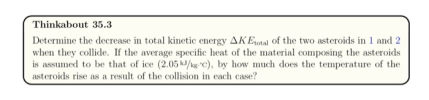 sorry these statements follow up with whats stated for
35.3
Thinkabout 35.3 Determine the decrease in total kinetic energy ΔΚΕ,otal of the two asteroids in 1 and 2 when they collide. If the average specific heat of the material composing the asteroids is assumed to be that of ice 2.05 ), by how much does the temperature of the asteroids rise as a result of the collision in each case? Thinkabout 35.1 Two asteroids collide head-on and stick together. Before...
sorry these statements follow up with whats stated for
35.3
Thinkabout 35.3 Determine the decrease in total kinetic energy ΔΚΕ,otal of the two asteroids in 1 and 2 when they collide. If the average specific heat of the material composing the asteroids is assumed to be that of ice 2.05 ), by how much does the temperature of the asteroids rise as a result of the collision in each case? Thinkabout 35.1 Two asteroids collide head-on and stick together. Before...
 1. Two asteroids collide head-on and stick together. Before the
collision, asteroid A (mass 1,000 kg) moved at 100 m/s and asteroid
B (mass 2,000 kg) moved at 80 m/s in the opposite direction. Use
momentum conservation (make a complete Momentum chart) to find the
velocity of the asteroids after the collision.
2. Two asteroids identical to those in (1) collide at right
angles and stick together. "Collide at right angles" means that
their initial velocities were perpendicular to each...
1. Two asteroids collide head-on and stick together. Before the
collision, asteroid A (mass 1,000 kg) moved at 100 m/s and asteroid
B (mass 2,000 kg) moved at 80 m/s in the opposite direction. Use
momentum conservation (make a complete Momentum chart) to find the
velocity of the asteroids after the collision.
2. Two asteroids identical to those in (1) collide at right
angles and stick together. "Collide at right angles" means that
their initial velocities were perpendicular to each...
 2. A 0.060 kg tennis ball, moving with a speed of 5.28 m/s , has a head-on collision with a 0.080 kg ball initially moving in the same direction at a speed of 3.00 m/s . Assume that the collision is perfectly elastic. Determine the velocity (speed and direction) of both the balls after the collision.
 2. A 0.060 kg tennis ball, moving with a speed of 5.28 m/s, has a head-on collision with a 0.080 kg ball initially moving in the same direction at a speed of 3.00 m/s. Assume that the collision is perfectly elastic. Determine the velocity (speed and direction) of both the balls after the collision.
 Two balls collide head-on. The initial velocity of the first ball is 3 m/s, while that of the second is -0.45 m/s. The mass of the first ball is 33 kg and the mass of the second ball is 80 kg. If the collision is perfectly elastic, what is the final velocity (magnitude and direction) of each ball?
 sorry these statements follow up with whats stated for
35.3
Thinkabout 35.3 Determine the decrease in total kinetic energy ΔΚΕ,otal of the two asteroids in 1 and 2 when they collide. If the average specific heat of the material composing the asteroids is assumed to be that of ice 2.05 ), by how much does the temperature of the asteroids rise as a result of the collision in each case? Thinkabout 35.1 Two asteroids collide head-on and stick together. Before...
sorry these statements follow up with whats stated for
35.3
Thinkabout 35.3 Determine the decrease in total kinetic energy ΔΚΕ,otal of the two asteroids in 1 and 2 when they collide. If the average specific heat of the material composing the asteroids is assumed to be that of ice 2.05 ), by how much does the temperature of the asteroids rise as a result of the collision in each case? Thinkabout 35.1 Two asteroids collide head-on and stick together. Before...
Most questions answered within 3 hours.
-
Where is the error in this code sequence?
String s1 = "Hello";
String s2 = "ello";...
asked 11 months ago -
Financial data for Joel de Paris, Inc., for last year
follow:
Joel de Paris, Inc.
Balance...
asked 11 months ago -
Consider this reaction:
Al2(SO4)3 (aq)+ BaCl3
(aq) Al2Cl6 (aq)- +
3BaSO4(s) . What is the...
asked 11 months ago -
Suppose that Savneet is considering increasing her
recent random sample from 20 car rentals to 40...
asked 11 months ago -
Trucks arrive at an unloading terminal at an average rate of 120
per hour.
Trucks arrive...
asked 11 months ago -
Why are methanol and ethanol completely soluble in water while
octanol is not very little soluble....
asked 11 months ago -
A facilities manager at a university reads in a research report
that the mean amount of...
asked 11 months ago -
When the CuSO4 is rehydrated by adding water to the anhydrous
compound, is this an endothermic...
asked 11 months ago -
A ray of sunlight is passing from diamond into crown glass; the
angle of incidence is...
asked 11 months ago -
A block of mass 0.249 kg is placed on top of a light, vertical
spring of...
asked 11 months ago -
how do the kidneys compensate in the presences of acidosis
a) trigger hyperventilate
b) reserve acid...
asked 11 months ago -
Question 501 pts
The rental rate of capital to the firm increases. Which of the
following...
asked 11 months ago