A professor's office door is 0.95 m wide, 2.2 m high, 4.2 cm thick; has a...
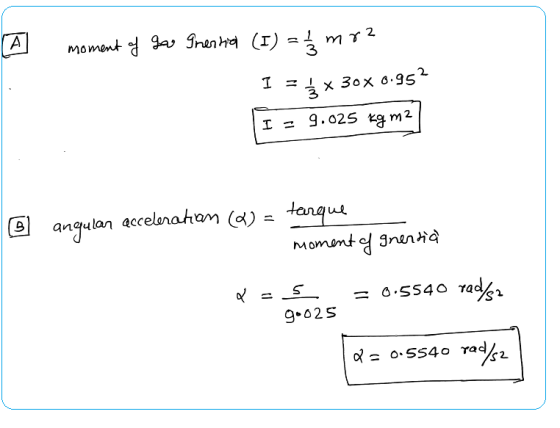
A professor's office door is 0.95 m wide, 2.2 m high, 4.2 cm thick; has a mass of 30 kg , and pivots on frictionless hinges. A "door closer" is attached to door and the top of the door frame. When the door is open and at rest, the door closer exerts a torque of 5.0 N⋅m .
Part A: What is the moment of inertia of the door?
Part B:
If you let go of the open door, what is its angular acceleration immediately afterward?
Homework Answers
Please rate
if any mistake in this answer please comment i will clarify your
doubt . thank you
Add Answer to:
A professor's office door is 0.95 m wide, 2.2 m high, 4.2 cm
thick; has a...
A professor's office door is 0.94 m wide, 2.0 m high, 4.0 cm thick; has a...
A professor's office door is 0.94 m wide, 2.0 m high, 4.0 cm thick; has a mass of 25 kg , and pivots on frictionless hinges. A "door closer" is attached to door and the top of the door frame. When the door is open and at rest, the door closer exerts a torque of 5.1 N⋅m . If you let go of the open door, what is its angular acceleration immediately afterward? What is the moment of inertia of...
A professor's office door is 0.94 m wide, 2.2 m high, 4.0 cm thick; has a mass of 30 kg , and pivots on frictionless hi...
A professor's office door is 0.94 m wide, 2.2 m high, 4.0 cm thick; has a mass of 30 kg , and pivots on frictionless hinges. A "door closer" is attached to door and the top of the door frame. When the door is open and at rest, the door closer exerts a torque of 5.8 N⋅m .
Josh's office door is 0.82 m wide, 6.0 cm thick, and 2.10 m high. The door has...
Josh's office door is 0.82 m wide, 6.0 cm thick, and 2.10 m high. The door has a mass m = 15.0 kg and pivots on frictionless hinges. A door closer is attached to the door and the top of the door frame. When the door is open and at rest, the door closer exerts a torque Γ = 4.50 N m. What is the smallest force that you need to apply to the door to hold it open? Enter your...
A 0.00600 kg bullet traveling horizontally with speed 1.00 103 m/s strikes a 20.8 kg door, embedding itself 11.0 cm from the side opposite the hinges. The 1.00 m wide door is free to swing on its frictionless hinges.
 A 0.00600 kg bullet traveling horizontally with speed 1.00 103 m/s strikes a 20.8 kg door, embedding itself 11.0 cm from the side opposite the hinges as shown in the figure below. The 1.00 m wide door is free to swing on its frictionless hinges.What is the angular momentum? At what angular speed (rad/s) does the door swing open immediately after the collision? Calculate the total energy of the bullet-door system and determine whether it is less than or equal...
A 0.00600-kg bullet traveling horizontally with a speed of 1.00 103 m/s enters a 17.5-kg door,...
A 0.00600-kg bullet traveling horizontally with a speed of 1.00 103 m/s enters a 17.5-kg door, embedding itself 20.0 cm from the side opposite the hinges as in the figure below. The 1.00-m-wide door is free to swing on its hinges. A) At what angular speed does the door swing open immediately after the collision? (The door has the same moment of inertia as a rod with axis at one end.) B) Calculate the energy of the door-bullet system and...
A solid wood door 1.00 m wide and 2.00 m high is hinged along one side...
 A solid wood door 1.00 m wide and 2.00 m high is hinged along one side and has a total mass of 41.0 kg. Initially open and at rest, the door is struck at its center by a handful of sticky mud with mass 0.300 kg, travel ing perpendicular to the door at 12.0 m/s just before impact. Part A Find the final angular speed of the door. VOA rad/s Submit Request Answer Part B Does the mud make a...
A solid wood door 1.00 m wide and 2.00 m high is hinged along one side...
 A solid wood door 1.00 m wide and 2.00 m high is hinged along one side and has a total mass of 45.0 kg. Initially open and at rest, the door is struck at its center by a handful of sticky mud with mass 0.300 kg, traveling perpendicular to the door at 11.0 m/s just before impact. Part A Find the final angular speed of the door. Express your answer in radians per second. | ΑΣφ ? rad/s Submit Request...
A solid wood door 1.00 m wide and 2.00 m high is hinged along one side...
A solid wood door 1.00 m wide and 2.00 m high is hinged along one side and has a total mass of 40.0 kg. Initially open and at rest, the door is struck at its center by a handful of sticky mud with mass 0.500 kg, traveling perpendicular to the door at 12.0 m/s just before impact. Find the final angular speed of the door. Does the mud make a significant contribution to the moment of inertia?
A solid wood door 1.00 m wide and 2.00 m high is hinged along one side...
A solid wood door 1.00 m wide and 2.00 m high is hinged along one side and has a total mass of 41.0 kg . Initially open and at rest, the door is struck at its center by a handful of sticky mud with mass 0.500 kg , traveling perpendicular to the door at 13.0 m/s just before impact. A)Find the final angular speed of the door. B)Does the mud make a significant contribution to the moment of inertia?
A solid wood door 1.00 m wide and 2.00 m high is hinged along one side and has a total mass of 40.0 kg . Initially open...
A solid wood door 1.00 m wide and 2.00 m high is hinged along one side and has a total mass of 40.0 kg . Initially open and at rest, the door is struck at its center by a handful of sticky mud with mass 0.300 kg , traveling perpendicular to the door at 14.0 m/s just before impact. 1.Find the final angular speed of the door. 2.Does the mud make a significant contribution to the moment of inertia?
 A solid wood door 1.00 m wide and 2.00 m high is hinged along one side and has a total mass of 41.0 kg. Initially open and at rest, the door is struck at its center by a handful of sticky mud with mass 0.300 kg, travel ing perpendicular to the door at 12.0 m/s just before impact. Part A Find the final angular speed of the door. VOA rad/s Submit Request Answer Part B Does the mud make a...
 A solid wood door 1.00 m wide and 2.00 m high is hinged along one side and has a total mass of 45.0 kg. Initially open and at rest, the door is struck at its center by a handful of sticky mud with mass 0.300 kg, traveling perpendicular to the door at 11.0 m/s just before impact. Part A Find the final angular speed of the door. Express your answer in radians per second. | ΑΣφ ? rad/s Submit Request...
Most questions answered within 3 hours.
-
Where is the error in this code sequence?
String s1 = "Hello";
String s2 = "ello";...
asked 10 months ago -
Financial data for Joel de Paris, Inc., for last year
follow:
Joel de Paris, Inc.
Balance...
asked 10 months ago -
Consider this reaction:
Al2(SO4)3 (aq)+ BaCl3
(aq) Al2Cl6 (aq)- +
3BaSO4(s) . What is the...
asked 10 months ago -
Suppose that Savneet is considering increasing her
recent random sample from 20 car rentals to 40...
asked 10 months ago -
Trucks arrive at an unloading terminal at an average rate of 120
per hour.
Trucks arrive...
asked 10 months ago -
Why are methanol and ethanol completely soluble in water while
octanol is not very little soluble....
asked 10 months ago -
A facilities manager at a university reads in a research report
that the mean amount of...
asked 10 months ago -
When the CuSO4 is rehydrated by adding water to the anhydrous
compound, is this an endothermic...
asked 10 months ago -
A ray of sunlight is passing from diamond into crown glass; the
angle of incidence is...
asked 10 months ago -
A block of mass 0.249 kg is placed on top of a light, vertical
spring of...
asked 10 months ago -
how do the kidneys compensate in the presences of acidosis
a) trigger hyperventilate
b) reserve acid...
asked 10 months ago -
Question 501 pts
The rental rate of capital to the firm increases. Which of the
following...
asked 10 months ago