Consider the following information for a country: Consumption Function: C = 8585 + 0.50.5Upper Y Subscript...
Consider the following information for a country:
Consumption Function: C =
8585
+
0.50.5Upper Y Subscript dYd
Investment Function: I = 8585
Government
Spending:
G = 150150
Net Taxes: T =
minus−5050
+0.250.25Y
Disposable Income:
Upper Y Subscript dYd
=
Yminus−T
Equilibrium: Y = C + I + G
The level of equilibrium income, Y, =
$nothing.
(Enter your response rounded to two decimal places.)
The amount of taxes collected by the government at equilibrium, T, =
$nothing.
(Enter your response rounded to two decimal places.)
The budget deficit at equilibrium,
(Gminus−T),
=
$nothing.
(Enter your response rounded to two decimal places and include a minus sign if necessary.)
Homework Answers

Add Answer to:
Consider the following information for a country:
Consumption Function: C =
8585
+
0.50.5Upper Y Subscript...
Consider the following information for a country:
Consider the following information for a country:Consumption Function: C=100+0.5YdInvestment Function: I=100Government Spending: G=150Net Taxes: T = -40 + 0.25YDisposable Income: Yd=Y-TEquilibrium: Y=C+I+GThe level of equilibrium income, Y,=$ _______ (Enter your response rounded to two decimal places.)
Assume the following for the economy of a country: bullet Consumption function: Upper C equals 60...
Assume the following for the economy of a country: bullet Consumption function: Upper C equals 60 plus 0.75 Upper Y Subscript d bullet Investment: I = 90 bullet Government spending: G = 56 bullet Net taxes: Upper T equals 0.2 Upper Y minus 25 bullet Disposable income: Upper Y Subscript d Baseline equals Upper Y minus Upper T bullet Equilibrium: Y = C + I + G What is equilibrium income?
Suppose that the economy is characterized by the following behavioral equations: C = 150150 + 0.800.80YD...
Suppose that the economy is characterized by the following behavioral equations: C = 150150 + 0.800.80YD I = 160160 G = 160160 T = 130130 Equilibrium GDP (Y) = nothing. (Round your response to two decimal places.)
For the data in the following table, the consumption function is C = 150 + 0.6(Y-T)....
 For the data in the following table, the consumption function is C = 150 + 0.6(Y-T). Fill in the columns in the table: PLANNED PLANNED UNPLANNED NET DISPOSABLE CONSUMPTION INVESTMENT GOVERNMENT AGGREGATE INVENTORY OUTPUT TAXES INCOME SPENDING SAVING SPENDING PURCHASES EXPENDITURES CHANGE 1,050 50 150 200 1,550 50 200 2,050 50 150 200 150 Use your answers in the previous problem to answer the following questions: 1) How much of an increase in spending would be required to generate an...
Consider the economy of Wiknam. The consumption function is given by C = 250+ 0.6(Y-T). a....
 Consider the economy of Wiknam. The consumption function is given by C = 250+ 0.6(Y-T). a. Government purchases and taxes are both 100. In the accompanying diagram, graph the IS curve for r ranging from 0 to 8 by dragging and dropping the end points to the correct locations b. The money supply M is 2,875 and the price level Pis 5. In the accompanying diagram, graph the LM curve for r ranging from 0 to 8 by dragging and...
You are given the following data concerning Freedonia, a legendary country: Consumption Function: Investment: C 200...
 You are given the following data concerning Freedonia, a legendary country: Consumption Function: Investment: C 200 0.9Y 300 Aggregate Expenditure Function: Equilibrium: АЕ 3D С +1 AE Y Calculate the following: a. The level of equilibrium income, Y = (Enter your response as an integer.) b. The value of the investment multiplier (Enter your response rounded to one decimal place.) c. The change in the level of equilibrium income if investment increases by 10. AY= (Enter your response as an...
Consider the following table for a? household's consumption expenditures and disposable income. To the nearest? dollar,...
Consider the following table for a? household's consumption expenditures and disposable income. To the nearest? dollar, compute desired saving at each level of disposable income. ?(Enter your responses as whole numbers and include a minus sign where? appropriate.) Income Consumption Savings ?$0 ?$100 ?$ ?$100 ?$150 ?$ ?$200 ?$200 ?$ ?$300 ?$250 ?$ ?$400 ?$300 ?$ ?$500 ?$350 ?$ The marginal propensity to save is ____. ?(Enter your response rounded to two decimal? places.) The marginal propensity to save ____...
Assume that in 2015, the following prevails in the Republic of Nurd: Government spending (G) =...
 Assume that in 2015, the following prevails in the Republic of Nurd: Government spending (G) = $0 Net taxes (T) = $0 Planned investment (I) = $30 Assume that households in Nurd consume 80 percent of their income; they save 20 percent of their income. Thus, the consumption function and saving function of Nurd are: C = 0.80Yg and S = 0.20Yd, where disposable income Yo = Y-T Determine the equilibrium level of income. Equilibrium income = $ . (Enter...
Let Y = C+I+G C = 100+1/2(Y-T) T = t0+(t1 Y) I = 75 (a) Suppose...
Let Y = C+I+G C = 100+1/2(Y-T) T = t0+(t1 Y) I = 75 (a) Suppose that the initial values of the fiscal parameters are G = 100; t0 = 50 and t1 = 1/3 : Find the equilibrium levels of output, disposable income, consumption and the government budget deficit.
Assume there are no taxes. The equation for the consumption function is given to be: C...
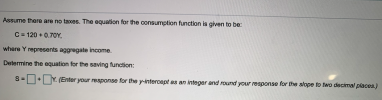 Assume there are no taxes. The equation for the consumption function is given to be: C = 120 + 0.70Y, where Y represents aggregate income. Determine the equation for the saving function: S= + Y. (Enter your response for the y-intercept as an integer and round your response for the slope to two decimal places.)
 For the data in the following table, the consumption function is C = 150 + 0.6(Y-T). Fill in the columns in the table: PLANNED PLANNED UNPLANNED NET DISPOSABLE CONSUMPTION INVESTMENT GOVERNMENT AGGREGATE INVENTORY OUTPUT TAXES INCOME SPENDING SAVING SPENDING PURCHASES EXPENDITURES CHANGE 1,050 50 150 200 1,550 50 200 2,050 50 150 200 150 Use your answers in the previous problem to answer the following questions: 1) How much of an increase in spending would be required to generate an...
 Consider the economy of Wiknam. The consumption function is given by C = 250+ 0.6(Y-T). a. Government purchases and taxes are both 100. In the accompanying diagram, graph the IS curve for r ranging from 0 to 8 by dragging and dropping the end points to the correct locations b. The money supply M is 2,875 and the price level Pis 5. In the accompanying diagram, graph the LM curve for r ranging from 0 to 8 by dragging and...
 You are given the following data concerning Freedonia, a legendary country: Consumption Function: Investment: C 200 0.9Y 300 Aggregate Expenditure Function: Equilibrium: АЕ 3D С +1 AE Y Calculate the following: a. The level of equilibrium income, Y = (Enter your response as an integer.) b. The value of the investment multiplier (Enter your response rounded to one decimal place.) c. The change in the level of equilibrium income if investment increases by 10. AY= (Enter your response as an...
 Assume that in 2015, the following prevails in the Republic of Nurd: Government spending (G) = $0 Net taxes (T) = $0 Planned investment (I) = $30 Assume that households in Nurd consume 80 percent of their income; they save 20 percent of their income. Thus, the consumption function and saving function of Nurd are: C = 0.80Yg and S = 0.20Yd, where disposable income Yo = Y-T Determine the equilibrium level of income. Equilibrium income = $ . (Enter...
 Assume there are no taxes. The equation for the consumption function is given to be: C = 120 + 0.70Y, where Y represents aggregate income. Determine the equation for the saving function: S= + Y. (Enter your response for the y-intercept as an integer and round your response for the slope to two decimal places.)
Most questions answered within 3 hours.
-
Where is the error in this code sequence?
String s1 = "Hello";
String s2 = "ello";...
asked 10 months ago -
Financial data for Joel de Paris, Inc., for last year
follow:
Joel de Paris, Inc.
Balance...
asked 10 months ago -
Consider this reaction:
Al2(SO4)3 (aq)+ BaCl3
(aq) Al2Cl6 (aq)- +
3BaSO4(s) . What is the...
asked 10 months ago -
Suppose that Savneet is considering increasing her
recent random sample from 20 car rentals to 40...
asked 10 months ago -
Trucks arrive at an unloading terminal at an average rate of 120
per hour.
Trucks arrive...
asked 10 months ago -
Why are methanol and ethanol completely soluble in water while
octanol is not very little soluble....
asked 10 months ago -
A facilities manager at a university reads in a research report
that the mean amount of...
asked 10 months ago -
When the CuSO4 is rehydrated by adding water to the anhydrous
compound, is this an endothermic...
asked 10 months ago -
A ray of sunlight is passing from diamond into crown glass; the
angle of incidence is...
asked 10 months ago -
A block of mass 0.249 kg is placed on top of a light, vertical
spring of...
asked 10 months ago -
how do the kidneys compensate in the presences of acidosis
a) trigger hyperventilate
b) reserve acid...
asked 10 months ago -
Question 501 pts
The rental rate of capital to the firm increases. Which of the
following...
asked 10 months ago