Explain how each of the following events affects the M1 money supply of a country. e....
Explain how each of the following events affects the M1 money supply of a
country.
e. You transfer some of your funds from your checking account to a savings
account.
Homework Answers
Transferring the funds to the saving account will decrease the M1 funds in the market and increase the M2 as saving accounts are part of M2. M1 money supply will decrease.
Add Answer to:
Explain how each of the following events affects the M1 money
supply of a
country.
e....
Please show all work Monetary aggregates II. For each of the following transactions identify by how...
 Please show all work
Monetary aggregates II. For each of the following transactions identify by how much M1 and M2 change. (a) (3 points) You receive a check for $2,500 from your employer. You deposit the check into your checking account. You then withdraw $500 as cash and transfer $1,000 into your savings account, and use the remainder to purchase shares of a stock market mutual fund (b) (3 points) Umut has $4 million of funds in a savings account....
Please show all work
Monetary aggregates II. For each of the following transactions identify by how much M1 and M2 change. (a) (3 points) You receive a check for $2,500 from your employer. You deposit the check into your checking account. You then withdraw $500 as cash and transfer $1,000 into your savings account, and use the remainder to purchase shares of a stock market mutual fund (b) (3 points) Umut has $4 million of funds in a savings account....
1. For each of the following, describe the effect (increase or decrease) on M1 and on...
1. For each of the following, describe the effect (increase or decrease) on M1 and on M2. a) Your grandmother gives you a check for your birthday which you deposit into your savings account. b) Your grandmother gives you a check for your birthday which you deposit into your checking account. c) You transfer money from your checking account to your savings account. d) You find a ten dollar bill on the sidewalk and deposit it into your checking account.
1. Explain how each of the following events affects the monetary base, the money multiplier, and...
 1. Explain how each of the following events affects the monetary base, the money multiplier, and the money supply. a. The Fed increases the interest rate it pays banks for holding reserves. When the Fed increases the interest rate, it pays banks to hold reserves. b. The Fed flies a helicopter over 5th Avenue in New York and drops newly printed $100 bills. c. Rumors about a computer virus attack on ATM machines increase the amount of money people hold...
sho the 13. Th 6. Explain how each of these events affects the amount of M1...
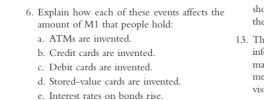 sho the 13. Th 6. Explain how each of these events affects the amount of M1 that people hold: a. ATMs are invented. b. Credit cards are invented. c. Debit cards are invented. d. Stored-value cards are invented. e. Interest rates on bonds rise. inf ma me vis
Using the information below compute the M1 money supply.
Using the information below compute the M1 money supply. CategoryAmountCurrency and coin held by the public$1,000Checking account balances$1,200Traveler's checks$10Savings account balances$3,100Small denomination time deposits$5,000Money market deposit accounts in banks$1,000Noninstitutional money market fund shares$2,000The M1 money supply is equal to: $_______
M1 and M2 are two definiions of money supply. Determine if the items listed are included...
 M1 and M2 are two definiions of money supply. Determine if the items listed are included in the money supply under each of these definitions and place them in the appropriate category. M1 only M2 only M1 and M2 Neither M1 nor M2 Answer Bank credit cards balances in checking accounts traveler's checks balances in savings accounts common stock currency certificates of deposit gold money market account balances
really money supply, monetary base, nominal GDP, real GDPprice level and M1 21. If the capital...
 really money supply, monetary base, nominal GDP, real GDPprice
level and M1
21. If the capital stock in the country for #19 was 1000 at the end of the previous year, then what was the value for the capital stock at the end of this year? 22. Calculate the value for M1 using the data given below. ANS: M1 = traveler's vault Savings Checking account balances = 2000 checks = 100 Currency in circulation - 1000 cash = 200 Money...
really money supply, monetary base, nominal GDP, real GDPprice
level and M1
21. If the capital stock in the country for #19 was 1000 at the end of the previous year, then what was the value for the capital stock at the end of this year? 22. Calculate the value for M1 using the data given below. ANS: M1 = traveler's vault Savings Checking account balances = 2000 checks = 100 Currency in circulation - 1000 cash = 200 Money...
Using the information below compute the M1 money supply. Category Currency and coin held by the...
 Using the information below compute the M1 money supply. Category Currency and coin held by the public Checking account balances Traveler's checks Savings account balances Small denomination time deposits Money market deposit accounts in banks Noninstitutional money market fund shares Amount $100 $1,000 $10 $3,100 $5,000 $1,000 $2,000 The M1 money supply is equal to: $
Here are several facts which may be necessary to calculate the money supply (M1) for the...
Here are several facts which may be necessary to calculate the money supply (M1) for the U.S. as of May 1st. 2019: 1. Currency $1.5 trillion. 2. Checking Accounts at U.S. Banks $2.5 trillion 3. Credit Card balances $3 trillion 4. Savings Accounts $5 trillion Do the following as your answer: A. Calculate M1 B. Write a sentence comparing the M1 you calculate to m1 of $3.1 trillion in February 2016. C. Write a second sentence indicating how the FED...
1. Indicate whether each of the following is part of M1, M2, or neither. a. $95...
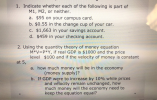 1. Indicate whether each of the following is part of M1, M2, or neither. a. $95 on your campus card. b. $0.55 in the change cup of your car. C. $1,663 in your savings account. d. $459 in your checking account. 2. Using the quantity theory of money equation M*V=P*Y, if real GDP is $1000 and the price level $100 and if the velocity of money is constant at 5, a. how much money will be in the economy (money...
 Please show all work
Monetary aggregates II. For each of the following transactions identify by how much M1 and M2 change. (a) (3 points) You receive a check for $2,500 from your employer. You deposit the check into your checking account. You then withdraw $500 as cash and transfer $1,000 into your savings account, and use the remainder to purchase shares of a stock market mutual fund (b) (3 points) Umut has $4 million of funds in a savings account....
Please show all work
Monetary aggregates II. For each of the following transactions identify by how much M1 and M2 change. (a) (3 points) You receive a check for $2,500 from your employer. You deposit the check into your checking account. You then withdraw $500 as cash and transfer $1,000 into your savings account, and use the remainder to purchase shares of a stock market mutual fund (b) (3 points) Umut has $4 million of funds in a savings account....
 1. Explain how each of the following events affects the monetary base, the money multiplier, and the money supply. a. The Fed increases the interest rate it pays banks for holding reserves. When the Fed increases the interest rate, it pays banks to hold reserves. b. The Fed flies a helicopter over 5th Avenue in New York and drops newly printed $100 bills. c. Rumors about a computer virus attack on ATM machines increase the amount of money people hold...
 sho the 13. Th 6. Explain how each of these events affects the amount of M1 that people hold: a. ATMs are invented. b. Credit cards are invented. c. Debit cards are invented. d. Stored-value cards are invented. e. Interest rates on bonds rise. inf ma me vis
 M1 and M2 are two definiions of money supply. Determine if the items listed are included in the money supply under each of these definitions and place them in the appropriate category. M1 only M2 only M1 and M2 Neither M1 nor M2 Answer Bank credit cards balances in checking accounts traveler's checks balances in savings accounts common stock currency certificates of deposit gold money market account balances
 really money supply, monetary base, nominal GDP, real GDPprice
level and M1
21. If the capital stock in the country for #19 was 1000 at the end of the previous year, then what was the value for the capital stock at the end of this year? 22. Calculate the value for M1 using the data given below. ANS: M1 = traveler's vault Savings Checking account balances = 2000 checks = 100 Currency in circulation - 1000 cash = 200 Money...
really money supply, monetary base, nominal GDP, real GDPprice
level and M1
21. If the capital stock in the country for #19 was 1000 at the end of the previous year, then what was the value for the capital stock at the end of this year? 22. Calculate the value for M1 using the data given below. ANS: M1 = traveler's vault Savings Checking account balances = 2000 checks = 100 Currency in circulation - 1000 cash = 200 Money...
 Using the information below compute the M1 money supply. Category Currency and coin held by the public Checking account balances Traveler's checks Savings account balances Small denomination time deposits Money market deposit accounts in banks Noninstitutional money market fund shares Amount $100 $1,000 $10 $3,100 $5,000 $1,000 $2,000 The M1 money supply is equal to: $
 1. Indicate whether each of the following is part of M1, M2, or neither. a. $95 on your campus card. b. $0.55 in the change cup of your car. C. $1,663 in your savings account. d. $459 in your checking account. 2. Using the quantity theory of money equation M*V=P*Y, if real GDP is $1000 and the price level $100 and if the velocity of money is constant at 5, a. how much money will be in the economy (money...
Most questions answered within 3 hours.
-
Where is the error in this code sequence?
String s1 = "Hello";
String s2 = "ello";...
asked 10 months ago -
Financial data for Joel de Paris, Inc., for last year
follow:
Joel de Paris, Inc.
Balance...
asked 10 months ago -
Consider this reaction:
Al2(SO4)3 (aq)+ BaCl3
(aq) Al2Cl6 (aq)- +
3BaSO4(s) . What is the...
asked 10 months ago -
Suppose that Savneet is considering increasing her
recent random sample from 20 car rentals to 40...
asked 10 months ago -
Trucks arrive at an unloading terminal at an average rate of 120
per hour.
Trucks arrive...
asked 10 months ago -
Why are methanol and ethanol completely soluble in water while
octanol is not very little soluble....
asked 10 months ago -
A facilities manager at a university reads in a research report
that the mean amount of...
asked 10 months ago -
When the CuSO4 is rehydrated by adding water to the anhydrous
compound, is this an endothermic...
asked 10 months ago -
A ray of sunlight is passing from diamond into crown glass; the
angle of incidence is...
asked 10 months ago -
A block of mass 0.249 kg is placed on top of a light, vertical
spring of...
asked 10 months ago -
how do the kidneys compensate in the presences of acidosis
a) trigger hyperventilate
b) reserve acid...
asked 10 months ago -
Question 501 pts
The rental rate of capital to the firm increases. Which of the
following...
asked 10 months ago