1) The factorial function (!) says to multiply all whole numbers from a chosen number down...
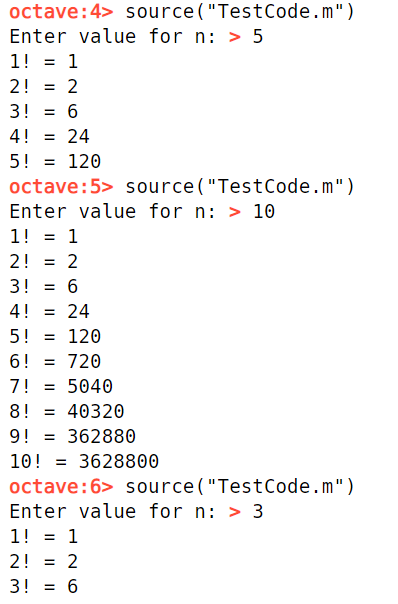
1) The factorial function (!) says to multiply all whole numbers from a chosen number down to 1. For example: 4! = 4 * 3 * 2 * 1 = 24 7! = 7 * 6 * 5 * 4 * 3 * 2 * 1 = 5040 Write a MATLAB script to calculate and display factorials from 1 to a user-specified value. Specifically, prompt the user to enter a positive integer n. Calculate and display the factorials from 1! through n! using a nested for-loop construct. For example, if the user enters 5, the program will display this: 1! = 1 2! = 2 3! = 6 4! = 24 5! = 120 Test the program, and show your output for 3 test runs with different user-input
Homework Answers
n = input("Enter value for n: ");
fact = 1;
for i=1:n
    fact = fact * i;
    fprintf("%d! = %d\n",i,fact);
end

Add Answer to:
1) The factorial function (!) says to multiply all whole numbers
from a chosen number down...
4.25 Lab9d: Factorials This program will output the factorial of numbers 1 through 10. Recall that...
4.25 Lab9d: Factorials This program will output the factorial of numbers 1 through 10. Recall that 10! = 10 * 9 * 8 * 7 * … * 2 * 1. Calculating the factorial will require two loops. The outer loop will iterate from the number 1 up to and including the number n. n will be based on a number the user entered (an int value). The inner loop will calculate the factorial of the number the first loop...
Calculating the Factorial of a Number - PSEUDOCODE In mathematics, the notation n! represents the factorial...
Calculating the Factorial of a Number - PSEUDOCODE In mathematics, the notation n! represents the factorial of the nonnegative integer n. The factorial of n is the product of all the nonnegative integers from 1 up through n. For example: 7! = 1 × 2 × 3 × 4 × 5 × 6 × 7 = 5,040 and 4! = 1 × 2 × 3 × 4 = 24 Design a program that asks the user to enter a nonnegative...
383 ng Assignments FACTORIAL CALCULATOR document and a Use Case Definition document and design a ...
 383 ng Assignments FACTORIAL CALCULATOR document and a Use Case Definition document and design a Windows application based on project shown in Figure 6-122 calculators have an operation called a factorial," which is shown on a calculator key as an idamation point. For example, 5! (5 factorial) multiplies 5 43'21 to calculate the resuls f120. Request that the user select a number from 1 to 12 and display all the factorials up to the valuc, including that value. Using loops...
Special Problem: Automated Factorial Create a MATLAB function called xfact that uses a loop to calculate...
Special Problem: Automated Factorial Create a MATLAB function called xfact that uses a loop to calculate the factorial of an integer. Your function should take a single integer input. Your function should compute the factorials of every integer from 1 to the integer provided by the input. Test your function by prompting the user to enter an integer N and, using a loop create an array named X of length N that contains the factorials of the numbers 1 to...
IN MATLAB RECURSIVE FUNCTION 1. Sum of Factorials. The Recursive Function: A series that sums up...
 IN MATLAB
RECURSIVE FUNCTION 1. Sum of Factorials. The Recursive Function: A series that sums up the factorial of the natural numbers from 1 to N can be expressed as The recursive algorithm: N-1 N-2 N-3 Write independent matlab code to solve the above problem with the following methods: 1. 2. 3. A monolithic program (with no functions) A standard (non-recursive) user defined function (an a program to call it) A recursive function (an a program to call it) Test...
IN MATLAB
RECURSIVE FUNCTION 1. Sum of Factorials. The Recursive Function: A series that sums up the factorial of the natural numbers from 1 to N can be expressed as The recursive algorithm: N-1 N-2 N-3 Write independent matlab code to solve the above problem with the following methods: 1. 2. 3. A monolithic program (with no functions) A standard (non-recursive) user defined function (an a program to call it) A recursive function (an a program to call it) Test...
C++ only Implement a program that prompts a user to enter a number N where N...
C++ only Implement a program that prompts a user to enter a number N where N is a positive number. The program must validate a user input and ask a user to re-enter until an input is valid. Implement a function that pass N as an argument and return a result of calculates N! (N-factorial): The function must use loop for the implementation. Hint: Factorial: N! = N * (N-1) * (N-2) * …. * 1 ( This is only...
In C: Write a program that will compute and print a table of the factorials from...
In C: Write a program that will compute and print a table of the factorials from 1 to 12. The program should define a function called fact to compute the factorial, use loops where appropriate, and produce the following output: 1 1 2 2 3 6 4 24 5 120 6 720 7 5040 8 40320 9 362880 10 3628800 11 39916800 12 479001600
C++ //Write prototype for function factorial that accepts an int num and returns an int /*...
C++ //Write prototype for function factorial that accepts an int num and returns an int /* WITH LOOP OF YOUR CHOICE: Write code for function factorial that accepts an int num and returns the num's factorial factorial(5); 1*2*3*4*5 returns 120 DON'T FORGET TO WRITE TEST CASE. */ //write includes statements //write using statements for cin and cout /* Use a do while loop to prompt the user for a number, call the factorial function, and display the number's factorial. Also,...
N! ("N factorial) is used to represent the product of N * N-1 * N-2 *...
N! ("N factorial) is used to represent the product of N * N-1 * N-2 * ... * 3 * 2 * 1 For example, 4! = 4 * 3 * 2 * 1 = 24 Write a method that uses recursion to calculate factorials. Then write a method that does the same without using recursion. Discuss the pros and cons of each method (briefly).
If n is an integer greater than 0, n factorial (n!) is the product: n* (n-1)...
If n is an integer greater than 0, n factorial (n!) is the product: n* (n-1) * (n-2) * ( n-3)… * By convention, 0! = 1. You must write a program that allows a user to enter an integer between 1 and 7. Your program must then compute the factorial of the number entered by the user. Your solution MUST actually perform a computation (i.e., you may not simply print “5040” to the screen as a literal value if...
 383 ng Assignments FACTORIAL CALCULATOR document and a Use Case Definition document and design a Windows application based on project shown in Figure 6-122 calculators have an operation called a factorial," which is shown on a calculator key as an idamation point. For example, 5! (5 factorial) multiplies 5 43'21 to calculate the resuls f120. Request that the user select a number from 1 to 12 and display all the factorials up to the valuc, including that value. Using loops...
 IN MATLAB
RECURSIVE FUNCTION 1. Sum of Factorials. The Recursive Function: A series that sums up the factorial of the natural numbers from 1 to N can be expressed as The recursive algorithm: N-1 N-2 N-3 Write independent matlab code to solve the above problem with the following methods: 1. 2. 3. A monolithic program (with no functions) A standard (non-recursive) user defined function (an a program to call it) A recursive function (an a program to call it) Test...
IN MATLAB
RECURSIVE FUNCTION 1. Sum of Factorials. The Recursive Function: A series that sums up the factorial of the natural numbers from 1 to N can be expressed as The recursive algorithm: N-1 N-2 N-3 Write independent matlab code to solve the above problem with the following methods: 1. 2. 3. A monolithic program (with no functions) A standard (non-recursive) user defined function (an a program to call it) A recursive function (an a program to call it) Test...
Most questions answered within 3 hours.
-
Where is the error in this code sequence?
String s1 = "Hello";
String s2 = "ello";...
asked 11 months ago -
Financial data for Joel de Paris, Inc., for last year
follow:
Joel de Paris, Inc.
Balance...
asked 11 months ago -
Consider this reaction:
Al2(SO4)3 (aq)+ BaCl3
(aq) Al2Cl6 (aq)- +
3BaSO4(s) . What is the...
asked 11 months ago -
Suppose that Savneet is considering increasing her
recent random sample from 20 car rentals to 40...
asked 11 months ago -
Trucks arrive at an unloading terminal at an average rate of 120
per hour.
Trucks arrive...
asked 11 months ago -
Why are methanol and ethanol completely soluble in water while
octanol is not very little soluble....
asked 11 months ago -
A facilities manager at a university reads in a research report
that the mean amount of...
asked 11 months ago -
When the CuSO4 is rehydrated by adding water to the anhydrous
compound, is this an endothermic...
asked 11 months ago -
A ray of sunlight is passing from diamond into crown glass; the
angle of incidence is...
asked 11 months ago -
A block of mass 0.249 kg is placed on top of a light, vertical
spring of...
asked 11 months ago -
how do the kidneys compensate in the presences of acidosis
a) trigger hyperventilate
b) reserve acid...
asked 11 months ago -
Question 501 pts
The rental rate of capital to the firm increases. Which of the
following...
asked 11 months ago