Explain the experimental reason you used the following samples to transfect cells: 1. no DNA (Genejammer...
Explain the experimental reason you used the following samples to transfect cells:
1. no DNA (Genejammer without plasmid)
2. 1 mg pSV b-gal 1 mg VHSV NVMH
3. 1 mg pSV b -gal + 0.5mg VHSV PMH (this plasmid expresses a yellow fluorescent protein tagged splicing factor)
4. 1 mg pSV b -gal + 2.5 mg VHSV PMH
Is this a properly set up experiment? Explain why or why not?
Homework Answers
Yes, this experiment is properly planned with positive and negative controls along with plasmid which encodes for the enzyme beta-Galactosidase.
1. no DNA (Genejammer without plasmid): Its a high transfection agent which helps in transfecting the plasmid into the cell which we want to express the desired gene.
2. 1 mg pSV b-gal 1 mg VHSV NVMH: This is the plasmid which expresses the enzyme Beta-Galactosidase is a glycoside hydrolase enzyme that catalyzes the hydrolysis ofβ-galactosides into monosaccharides through the breaking of a glycosidic bond.
3.1 mg pSV b -gal + 0.5mg VHSV PMH (this plasmid expresses a yellow fluorescent protein-tagged splicing factor) Its a positive control .
4.1 mg pSV b -gal + 2.5 mg VHSV PMH: Its expresses a yellow fluorescent protein without splicing factor and acts as a negative control.
So This experiment has properly set up with appropriate transfection agent, enzyme coding plasmid along with positive and negative control which is an ideal setup for successful transfection process.
Add Answer to:
Explain the experimental reason you used the following samples
to transfect cells:
1. no DNA (Genejammer...
4. Describe a reason why there is a constraint on cell size. 1 pt In that...
 4. Describe a reason why there is a constraint on cell size. 1 pt In that context, explain how eukaryotic cells are able to be 10Xlarger than prokaryotic cells. 1 pt 5. Consider a eukaryotic cell making two different proteins: one protein functions within the mitochondria and the other is secreted outside of the cell. The genes encoding the two proteins are transcribed and the two types of mRNA are released into the cytoplasm for translation How will the production...
Please help 15. During our paper lab experiment, we compared the tumor cells from one patient...
 Please help
15. During our paper lab experiment, we compared the tumor cells from one patient to the normal cells of the same patient. If we wanted to do a larger study to give a larger picture of what is going on in colon cancer cells which of the following would be a better way to set up the experiment? A. Collect cancer cells and normal cells from 1000 patients and run 1000 different microarrays (one for each person) and...
Please help
15. During our paper lab experiment, we compared the tumor cells from one patient to the normal cells of the same patient. If we wanted to do a larger study to give a larger picture of what is going on in colon cancer cells which of the following would be a better way to set up the experiment? A. Collect cancer cells and normal cells from 1000 patients and run 1000 different microarrays (one for each person) and...
POST-LAB QUESTIONS 1. Based on the results of the three tests, how do you kno the fruit was DNA and not protein? Explai...
 POST-LAB QUESTIONS 1. Based on the results of the three tests, how do you kno the fruit was DNA and not protein? Explain. 2. What happened to the egg white sample, containing mostly protein, when you heated it or oered the pH? Explain what you saw and what you think was happening at the molecular level. 3. Why does the DNA double helix unravel when exposed to high temperatures or acidic conditions? If you tried to run this experiment with...
For the four reasons listed below, please explain a solution for each reason. Thank you in...
 For the four reasons listed below, please explain a solution for
each reason.
Thank you in advance!
QUESTION 8 In the production of iPSCs, proteins that regulate transcription are injected into differentiated cells to revert them back to stem cells However, the efficiency of de-differentiation ie: returning to a stem cell like state is typically less than 1%. Give 4 reasons why in ecting the transcription factor proteins into the cell may not be enough to lead to change the...
For the four reasons listed below, please explain a solution for
each reason.
Thank you in advance!
QUESTION 8 In the production of iPSCs, proteins that regulate transcription are injected into differentiated cells to revert them back to stem cells However, the efficiency of de-differentiation ie: returning to a stem cell like state is typically less than 1%. Give 4 reasons why in ecting the transcription factor proteins into the cell may not be enough to lead to change the...
1) You have two human liver cells (A and B) and you hypothesize that the insulin...
1) You have two human liver cells (A and B) and you hypothesize that the insulin receptor gene in Cell A has a mutation in exon 1 and Cell B contains the wild type sequence. You extract genomic DNA from each of the cells. Of the following, what would be the most efficient (quick, precise and relatively cheap) way to test your hypothesis. a. Isolate protein from both cells, purify the insulin receptor, and determine the amino acid content. b. Sequence the...
1. You are a new undergraduate researcher in the Ruohola-Baker lab. Your job is work with...
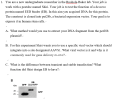 1. You are a new undergraduate researcher in the Ruohola-Baker lab. Your job is work with a postdoc named Shiri. Your job is to test the function of a de novo protein named EED binder (EB). In this aim you acquired DNA for this protein. The construct is cloned into pet28b, a bacterial expression vector. Your goal is to express it in human stem cells. A. What method would you use to extract your DNA fragment from the pet28b plasmid?...
This is what we did in the experiment .First of all,1 µl of plasmid DNA was...
 This is what we did in the experiment .First of all,1 µl of
plasmid DNA was added into the tube which contains competent cells
and the tube was tapped gently to mix DNA and the competent
bacteria. After that it was placed on ice for 30 minutes. Then, the
tube with the competent bacteria and plasmid were transferred to
heating block at 42 °C and the tube was leaved in there exactly 90
seconds. 0.25 ml of LB broth was...
This is what we did in the experiment .First of all,1 µl of
plasmid DNA was added into the tube which contains competent cells
and the tube was tapped gently to mix DNA and the competent
bacteria. After that it was placed on ice for 30 minutes. Then, the
tube with the competent bacteria and plasmid were transferred to
heating block at 42 °C and the tube was leaved in there exactly 90
seconds. 0.25 ml of LB broth was...
Experimental Procedure, Part B.1. What is the purpose of adding NaHCO, to the reaction mixture? Explain....
 Experimental Procedure, Part B.1. What is the purpose of adding NaHCO, to the reaction mixture? Explain. Write a balanced equation for its reaction. a. Experimental Procedure, Part C. What is the oxidizing agent in the titration? b. What is the color change of the starch indicator that signals the stoichiometric point in Part C? (1. Vitamin C is a reducing agent and antioxidant. What ion does it reduce in this experiment? Explain. Desk No. IOS- Experimental Procedure, Part A.1. Determine...
This is what we did in the experiment .First of all,1 µl of plasmid DNA was...
 This is what we did in the experiment .First of all,1 µl of
plasmid DNA was added into the tube which contains competent cells
and the tube was tapped gently to mix DNA and the competent
bacteria. After that it was placed on ice for 30 minutes. Then, the
tube with the competent bacteria and plasmid were transferred to
heating block at 42 °C and the tube was leaved in there exactly 90
seconds. 0.25 ml of LB broth was...
This is what we did in the experiment .First of all,1 µl of
plasmid DNA was added into the tube which contains competent cells
and the tube was tapped gently to mix DNA and the competent
bacteria. After that it was placed on ice for 30 minutes. Then, the
tube with the competent bacteria and plasmid were transferred to
heating block at 42 °C and the tube was leaved in there exactly 90
seconds. 0.25 ml of LB broth was...
molecular biology Section C (40 marks) Answer ALL questions from this Section 5. You have isolated total RNA from muscle cells and constructeda muscle cDNA library. You wish to study the regulatory r...
 molecular biology
Section C (40 marks) Answer ALL questions from this Section 5. You have isolated total RNA from muscle cells and constructeda muscle cDNA library. You wish to study the regulatory region of a muscle-specific cDNA gene (gene M) that you have previously identified. 6 (a) For your study, you need to isolate a genomic clone of gene M. Why isa cDNA clone of gene M not appropriate for your study? (2 marks) (b) Outline the steps you would...
molecular biology
Section C (40 marks) Answer ALL questions from this Section 5. You have isolated total RNA from muscle cells and constructeda muscle cDNA library. You wish to study the regulatory region of a muscle-specific cDNA gene (gene M) that you have previously identified. 6 (a) For your study, you need to isolate a genomic clone of gene M. Why isa cDNA clone of gene M not appropriate for your study? (2 marks) (b) Outline the steps you would...
 4. Describe a reason why there is a constraint on cell size. 1 pt In that context, explain how eukaryotic cells are able to be 10Xlarger than prokaryotic cells. 1 pt 5. Consider a eukaryotic cell making two different proteins: one protein functions within the mitochondria and the other is secreted outside of the cell. The genes encoding the two proteins are transcribed and the two types of mRNA are released into the cytoplasm for translation How will the production...
 Please help
15. During our paper lab experiment, we compared the tumor cells from one patient to the normal cells of the same patient. If we wanted to do a larger study to give a larger picture of what is going on in colon cancer cells which of the following would be a better way to set up the experiment? A. Collect cancer cells and normal cells from 1000 patients and run 1000 different microarrays (one for each person) and...
Please help
15. During our paper lab experiment, we compared the tumor cells from one patient to the normal cells of the same patient. If we wanted to do a larger study to give a larger picture of what is going on in colon cancer cells which of the following would be a better way to set up the experiment? A. Collect cancer cells and normal cells from 1000 patients and run 1000 different microarrays (one for each person) and...
 POST-LAB QUESTIONS 1. Based on the results of the three tests, how do you kno the fruit was DNA and not protein? Explain. 2. What happened to the egg white sample, containing mostly protein, when you heated it or oered the pH? Explain what you saw and what you think was happening at the molecular level. 3. Why does the DNA double helix unravel when exposed to high temperatures or acidic conditions? If you tried to run this experiment with...
 For the four reasons listed below, please explain a solution for
each reason.
Thank you in advance!
QUESTION 8 In the production of iPSCs, proteins that regulate transcription are injected into differentiated cells to revert them back to stem cells However, the efficiency of de-differentiation ie: returning to a stem cell like state is typically less than 1%. Give 4 reasons why in ecting the transcription factor proteins into the cell may not be enough to lead to change the...
For the four reasons listed below, please explain a solution for
each reason.
Thank you in advance!
QUESTION 8 In the production of iPSCs, proteins that regulate transcription are injected into differentiated cells to revert them back to stem cells However, the efficiency of de-differentiation ie: returning to a stem cell like state is typically less than 1%. Give 4 reasons why in ecting the transcription factor proteins into the cell may not be enough to lead to change the...
 1. You are a new undergraduate researcher in the Ruohola-Baker lab. Your job is work with a postdoc named Shiri. Your job is to test the function of a de novo protein named EED binder (EB). In this aim you acquired DNA for this protein. The construct is cloned into pet28b, a bacterial expression vector. Your goal is to express it in human stem cells. A. What method would you use to extract your DNA fragment from the pet28b plasmid?...
 This is what we did in the experiment .First of all,1 µl of
plasmid DNA was added into the tube which contains competent cells
and the tube was tapped gently to mix DNA and the competent
bacteria. After that it was placed on ice for 30 minutes. Then, the
tube with the competent bacteria and plasmid were transferred to
heating block at 42 °C and the tube was leaved in there exactly 90
seconds. 0.25 ml of LB broth was...
This is what we did in the experiment .First of all,1 µl of
plasmid DNA was added into the tube which contains competent cells
and the tube was tapped gently to mix DNA and the competent
bacteria. After that it was placed on ice for 30 minutes. Then, the
tube with the competent bacteria and plasmid were transferred to
heating block at 42 °C and the tube was leaved in there exactly 90
seconds. 0.25 ml of LB broth was...
 Experimental Procedure, Part B.1. What is the purpose of adding NaHCO, to the reaction mixture? Explain. Write a balanced equation for its reaction. a. Experimental Procedure, Part C. What is the oxidizing agent in the titration? b. What is the color change of the starch indicator that signals the stoichiometric point in Part C? (1. Vitamin C is a reducing agent and antioxidant. What ion does it reduce in this experiment? Explain. Desk No. IOS- Experimental Procedure, Part A.1. Determine...
 This is what we did in the experiment .First of all,1 µl of
plasmid DNA was added into the tube which contains competent cells
and the tube was tapped gently to mix DNA and the competent
bacteria. After that it was placed on ice for 30 minutes. Then, the
tube with the competent bacteria and plasmid were transferred to
heating block at 42 °C and the tube was leaved in there exactly 90
seconds. 0.25 ml of LB broth was...
This is what we did in the experiment .First of all,1 µl of
plasmid DNA was added into the tube which contains competent cells
and the tube was tapped gently to mix DNA and the competent
bacteria. After that it was placed on ice for 30 minutes. Then, the
tube with the competent bacteria and plasmid were transferred to
heating block at 42 °C and the tube was leaved in there exactly 90
seconds. 0.25 ml of LB broth was...
 molecular biology
Section C (40 marks) Answer ALL questions from this Section 5. You have isolated total RNA from muscle cells and constructeda muscle cDNA library. You wish to study the regulatory region of a muscle-specific cDNA gene (gene M) that you have previously identified. 6 (a) For your study, you need to isolate a genomic clone of gene M. Why isa cDNA clone of gene M not appropriate for your study? (2 marks) (b) Outline the steps you would...
molecular biology
Section C (40 marks) Answer ALL questions from this Section 5. You have isolated total RNA from muscle cells and constructeda muscle cDNA library. You wish to study the regulatory region of a muscle-specific cDNA gene (gene M) that you have previously identified. 6 (a) For your study, you need to isolate a genomic clone of gene M. Why isa cDNA clone of gene M not appropriate for your study? (2 marks) (b) Outline the steps you would...
Most questions answered within 3 hours.
-
Where is the error in this code sequence?
String s1 = "Hello";
String s2 = "ello";...
asked 10 months ago -
Financial data for Joel de Paris, Inc., for last year
follow:
Joel de Paris, Inc.
Balance...
asked 10 months ago -
Consider this reaction:
Al2(SO4)3 (aq)+ BaCl3
(aq) Al2Cl6 (aq)- +
3BaSO4(s) . What is the...
asked 10 months ago -
Suppose that Savneet is considering increasing her
recent random sample from 20 car rentals to 40...
asked 10 months ago -
Trucks arrive at an unloading terminal at an average rate of 120
per hour.
Trucks arrive...
asked 10 months ago -
Why are methanol and ethanol completely soluble in water while
octanol is not very little soluble....
asked 10 months ago -
A facilities manager at a university reads in a research report
that the mean amount of...
asked 10 months ago -
When the CuSO4 is rehydrated by adding water to the anhydrous
compound, is this an endothermic...
asked 10 months ago -
A ray of sunlight is passing from diamond into crown glass; the
angle of incidence is...
asked 10 months ago -
A block of mass 0.249 kg is placed on top of a light, vertical
spring of...
asked 10 months ago -
how do the kidneys compensate in the presences of acidosis
a) trigger hyperventilate
b) reserve acid...
asked 10 months ago -
Question 501 pts
The rental rate of capital to the firm increases. Which of the
following...
asked 10 months ago