True of False: a: The tails of the normal distribution extend to the positive and negative...
True of False:
a: The tails of the normal distribution extend to the positive and negative infinity
b: The mean of a normal distribution is always 0
c: The total area under the normal distribution is 1
Homework Answers

Add Answer to:
True of False:
a: The tails of the normal distribution extend to the positive
and negative...
Respond True or False to each of these statements. The total area under the normal distribution...
Respond True or False to each of these statements. The total area under the normal distribution is equal to 1. As the sample size increases, the distribution of the sample statistics becomes more consistent. Sampling variability refer to a variability of parameters. A sampling distribution describes a distribution of sample statistics. All variables that are approximately normally distributed can be transformed to standard z-scores. The z-value corresponding to a datum below the mean is always negative. The area under the...
Which of the following is not a characteristic of the normal distribution? a) The total area...
Which of the following is not a characteristic of the normal distribution? a) The total area under the curve is 1.0 b) The curve is symmetric about the mean c) The value of the mean is always greater than the value of the standard deviation d) The two tails of the curve extend indefinitely
1 point For a normal random variable X, which of the following is FALSE* O The...
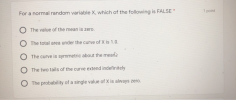 1 point For a normal random variable X, which of the following is FALSE* O The value of the mean is zero. O The total area under the curve of X is 1.0. O The curve is symmetric about the mearle O The two tails of the curve extend indefinitely O The probability of a single value of X is always zero.
(10) 12. Which of the following characteristics are true for a normal probability distribution? (CIRCLE ALL...
 (10) 12. Which of the following characteristics are true for a normal probability distribution? (CIRCLE ALL THAT ARE TRUE) A) The area under the curve is 1. B) It is symmetrical. C) The midpoint is also the mean. D) The total sample space for the normal distribution is all positive integers E) 95% of the area under the Normal PDF curve is within One Standard Deviation from the Mean.
Is the following statement true or false? The t distribution has more probability in the tails...
Is the following statement true or false? The t distribution has more probability in the tails than the N(0, 1) distribution because the fixed parameter σ has been replaced by the random variable s. This statement is true. This statement is false because σ is a variable, not s. This statement is false because the t distribution puts less probability in the tails than the N(0, 1) distribution does. This statement is false because σ and s are both fixed...
In the normal distribution the area to the right of the mean is always 50%. True...
In the normal distribution the area to the right of the mean is always 50%. True False
If I has a normal distribution, then 7 always has a normal distribution. True False Under...
 If I has a normal distribution, then 7 always has a normal distribution. True False Under what condition does the sample mean ī not have a normal distribution? Population is not normal but the sample size n > 30. Population is not normal and sample size n <30. Population is normal. The Central Limit Theorem for a sample mean (@) is very important in Statistics because it states that for large sample sizes, the population distribution is approximately normal. for...
If the original population is normal or nearly normal, then the distribution of the sample means...
If the original population is normal or nearly normal, then the distribution of the sample means will be normal for any size sample. Group of answer choices True False The total area under the normal distribution curve depends on the value of the mean. Group of answer choices True False
Assume Z is a random variable with a standard normal distribution and c is a positive...
 Assume Z is a random variable with a standard normal distribution and c is a positive number. If P(Z > c) = 0.25, then PC – c< < c) = 0.5. O True OFalse Exactly 50% of the area under the normal curve lies to the left of the mean. O True OFalse If X represents a random variable coming from a normal distribution and P(X < 5.2) = 0.5, then P(X > 5.2) = 0.5. O True O False
1 Identify each of the following statements as either TRUE or FALSE. a) Click for List...
 1
Identify each of the following statements as either TRUE or FALSE. a) Click for List The t distribution tends toward the standard normal distribution as the degrees of freedom increase. b) Click for List The t distribution has more area in the tails than the standard normal distribution. Click for List If I is a random variable with a t distribution, then P(T<0) = 0.5. Click for List If we wish to carry out inference procedures on the mean...
1
Identify each of the following statements as either TRUE or FALSE. a) Click for List The t distribution tends toward the standard normal distribution as the degrees of freedom increase. b) Click for List The t distribution has more area in the tails than the standard normal distribution. Click for List If I is a random variable with a t distribution, then P(T<0) = 0.5. Click for List If we wish to carry out inference procedures on the mean...
 1 point For a normal random variable X, which of the following is FALSE* O The value of the mean is zero. O The total area under the curve of X is 1.0. O The curve is symmetric about the mearle O The two tails of the curve extend indefinitely O The probability of a single value of X is always zero.
 (10) 12. Which of the following characteristics are true for a normal probability distribution? (CIRCLE ALL THAT ARE TRUE) A) The area under the curve is 1. B) It is symmetrical. C) The midpoint is also the mean. D) The total sample space for the normal distribution is all positive integers E) 95% of the area under the Normal PDF curve is within One Standard Deviation from the Mean.
 If I has a normal distribution, then 7 always has a normal distribution. True False Under what condition does the sample mean ī not have a normal distribution? Population is not normal but the sample size n > 30. Population is not normal and sample size n <30. Population is normal. The Central Limit Theorem for a sample mean (@) is very important in Statistics because it states that for large sample sizes, the population distribution is approximately normal. for...
 Assume Z is a random variable with a standard normal distribution and c is a positive number. If P(Z > c) = 0.25, then PC – c< < c) = 0.5. O True OFalse Exactly 50% of the area under the normal curve lies to the left of the mean. O True OFalse If X represents a random variable coming from a normal distribution and P(X < 5.2) = 0.5, then P(X > 5.2) = 0.5. O True O False
 1
Identify each of the following statements as either TRUE or FALSE. a) Click for List The t distribution tends toward the standard normal distribution as the degrees of freedom increase. b) Click for List The t distribution has more area in the tails than the standard normal distribution. Click for List If I is a random variable with a t distribution, then P(T<0) = 0.5. Click for List If we wish to carry out inference procedures on the mean...
1
Identify each of the following statements as either TRUE or FALSE. a) Click for List The t distribution tends toward the standard normal distribution as the degrees of freedom increase. b) Click for List The t distribution has more area in the tails than the standard normal distribution. Click for List If I is a random variable with a t distribution, then P(T<0) = 0.5. Click for List If we wish to carry out inference procedures on the mean...
Most questions answered within 3 hours.
-
Where is the error in this code sequence?
String s1 = "Hello";
String s2 = "ello";...
asked 11 months ago -
Financial data for Joel de Paris, Inc., for last year
follow:
Joel de Paris, Inc.
Balance...
asked 11 months ago -
Consider this reaction:
Al2(SO4)3 (aq)+ BaCl3
(aq) Al2Cl6 (aq)- +
3BaSO4(s) . What is the...
asked 11 months ago -
Suppose that Savneet is considering increasing her
recent random sample from 20 car rentals to 40...
asked 11 months ago -
Trucks arrive at an unloading terminal at an average rate of 120
per hour.
Trucks arrive...
asked 11 months ago -
Why are methanol and ethanol completely soluble in water while
octanol is not very little soluble....
asked 11 months ago -
A facilities manager at a university reads in a research report
that the mean amount of...
asked 11 months ago -
When the CuSO4 is rehydrated by adding water to the anhydrous
compound, is this an endothermic...
asked 11 months ago -
A ray of sunlight is passing from diamond into crown glass; the
angle of incidence is...
asked 11 months ago -
A block of mass 0.249 kg is placed on top of a light, vertical
spring of...
asked 11 months ago -
how do the kidneys compensate in the presences of acidosis
a) trigger hyperventilate
b) reserve acid...
asked 11 months ago -
Question 501 pts
The rental rate of capital to the firm increases. Which of the
following...
asked 11 months ago