Why was it necessary to use a protecting group (CBZ) removable by hydrogenation? Why not use...
Why was it necessary to use a protecting group (CBZ) removable by hydrogenation? Why not use a simple carbamate such as methyl (CH3O2CNH-) and then remove it with a strong acid or base?
Homework Answers
 If you have any query, please
comment.
If you have any query, please
comment.Add Answer to:
Why was it necessary to use a protecting group (CBZ) removable
by hydrogenation? Why not use...
Answer all of them please! E4postlab2 You have successfully placed a protecting group on the sugar....
 Answer all of them please!
E4postlab2 You have successfully placed a protecting group on the sugar. How would you remove the protecting group? O A Use LiAIH4 and H30+ O BUse H20 and acid O CUse H20 and base O D Use H20 and CH30H
Answer all of them please!
E4postlab2 You have successfully placed a protecting group on the sugar. How would you remove the protecting group? O A Use LiAIH4 and H30+ O BUse H20 and acid O CUse H20 and base O D Use H20 and CH30H
Amino acids are useful building blocks for peptide synthesis. However, due to several reactive sites, protecting...
 Amino acids are useful building blocks for peptide synthesis. However, due to several reactive sites, protecting groups are used to direct regioselective synthesis. Below is the structure of an amino acid with a protecting group. H2N COOH Identify the protecting group. Which reagent was used to install this protecting group? Which reagent is used to remove this protecting group? Fmoc Benzyl chloroformate Boc 9-Fluorenylmethyl chloroformate amide 0 O O O TFA Piperidine DCC H2, Pd/C acetal Di-tert-butyl dicarbonate Acetic anhydride...
2) Amines are often protected with the tert-butyloxycarbonyl BOC) group. Show the mechanism of fo...
 2) Amines are often protected with the tert-butyloxycarbonyl BOC) group. Show the mechanism of fomation of the BOC protected amine (a carbamate). Be sure to show all bonds formed broken and inclade all intermediates including the appropriate formal charge BOOO Do you expect that the carbamate functional group is more or less reactive than an amide towards nacleophilic addition? Bricfly explain your reasoning The BOC protecting group can be removed under acidic conditions, such as treatment with tnifloroacetic acid (TFA)...
Which best explains why an acetal can be used as a protecting group for carbonyls during...
 Which best explains why an acetal can be used as a protecting group for carbonyls during a Grignard readion (A) The acetal is stable in acid. (B) The acetal prevents reaction of the carbonyl with a strong nucleophile. (C) The reaction is reversible and the acid helps to generate more product (D) To increase the electrophilic nature of the ketone since the Grignard is a weak nucleophile 0909 Select the reagents needed for the synthesis of pentyl butanoate by Fischer...
Protecting groups are essential in peptide synthesis to prevent the polymerization of amino acids. The protecting group 2-(4-biphenyl)isopropoxycarbonyl (Bpoc), identified below, is designed to prote...
 Protecting groups are essential in peptide synthesis to prevent the polymerization of amino acids. The protecting group 2-(4-biphenyl)isopropoxycarbonyl (Bpoc), identified below, is designed to protect amine groups and is cleavable under mildly acidic conditions (0.2 0.5% trifluoroacetic acid) oNOH Bpoc-glycine он 2-(4-biphenyl)isopropoxycarbonyl (Bpoc) group Based on your knowledge of related protecting groups, propose a mechanism for the deprotection of the Bpoc group from Bpoc-glycine (shown above) under acidic conditions, and explain why the Bpoc group is cleavable under such mild...
Answer the questions below succinctly and provide minimal figures where necessary. a. Explain why the strongest...
 Answer the questions below succinctly and provide minimal figures where necessary. a. Explain why the strongest base in a polar protic solvent like MeOH can only be as strong as Meo. b. What is the strongest base in a solution of H2SO, in EtOH? Why? C. Considering the information above, will a good leaving group ever act as a base in a polar protic solvent? d. What is the strongest base that can exist in pentane? e. What is the...
When should you use a protecting group, such as an acetal? A-When the most reactive functional...
 When should you use a protecting group, such as an acetal? A-When the most reactive functional group is not the one you want to modify. B-When an alcohol is present in your molecule. C-When a functional group is not reactive enough on its own. D-Whenever you need to use a Grignard reagent.
Explain why amino acid functional groups that participate in acid-base chemistry have perturbed pKa values from sim...
 Explain why amino acid functional groups that participate in acid-base chemistry have perturbed pKa values from simple methyl substituted amino and carboxyl groups. (3 points)
Explain why amino acid functional groups that participate in acid-base chemistry have perturbed pKa values from simple methyl substituted amino and carboxyl groups. (3 points)
Explain why amino acid functional groups that participate in acid-base chemistry have perturbed pKa values from simple methyl substituted amino and carboxyl groups. (3 points)
8. Extra (4 points) Show how you would use a protecting group to covert the following...
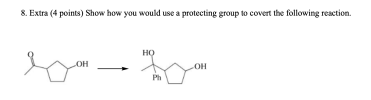 8. Extra (4 points) Show how you would use a protecting group to covert the following reaction. НО ОН ОН Ph
1) Give the products or reagents for the reaction pathways below. 2) Give the methods and reagents to synthesize will need to use a protecting group.) the given product.(You Homework week 1...
 1) Give the products or reagents for the reaction pathways below. 2) Give the methods and reagents to synthesize will need to use a protecting group.) the given product.(You Homework week 12H Name Group 1) Give the products or reagents for the reaction pathways below NH2CHs Na CHyO 2) Give the methods and reagents to synthesize the given product. (You will need to use a protecting group.) CH, но
1) Give the products or reagents for the reaction pathways below....
1) Give the products or reagents for the reaction pathways below. 2) Give the methods and reagents to synthesize will need to use a protecting group.) the given product.(You Homework week 12H Name Group 1) Give the products or reagents for the reaction pathways below NH2CHs Na CHyO 2) Give the methods and reagents to synthesize the given product. (You will need to use a protecting group.) CH, но
1) Give the products or reagents for the reaction pathways below....
 Answer all of them please!
E4postlab2 You have successfully placed a protecting group on the sugar. How would you remove the protecting group? O A Use LiAIH4 and H30+ O BUse H20 and acid O CUse H20 and base O D Use H20 and CH30H
Answer all of them please!
E4postlab2 You have successfully placed a protecting group on the sugar. How would you remove the protecting group? O A Use LiAIH4 and H30+ O BUse H20 and acid O CUse H20 and base O D Use H20 and CH30H
 Amino acids are useful building blocks for peptide synthesis. However, due to several reactive sites, protecting groups are used to direct regioselective synthesis. Below is the structure of an amino acid with a protecting group. H2N COOH Identify the protecting group. Which reagent was used to install this protecting group? Which reagent is used to remove this protecting group? Fmoc Benzyl chloroformate Boc 9-Fluorenylmethyl chloroformate amide 0 O O O TFA Piperidine DCC H2, Pd/C acetal Di-tert-butyl dicarbonate Acetic anhydride...
 2) Amines are often protected with the tert-butyloxycarbonyl BOC) group. Show the mechanism of fomation of the BOC protected amine (a carbamate). Be sure to show all bonds formed broken and inclade all intermediates including the appropriate formal charge BOOO Do you expect that the carbamate functional group is more or less reactive than an amide towards nacleophilic addition? Bricfly explain your reasoning The BOC protecting group can be removed under acidic conditions, such as treatment with tnifloroacetic acid (TFA)...
 Which best explains why an acetal can be used as a protecting group for carbonyls during a Grignard readion (A) The acetal is stable in acid. (B) The acetal prevents reaction of the carbonyl with a strong nucleophile. (C) The reaction is reversible and the acid helps to generate more product (D) To increase the electrophilic nature of the ketone since the Grignard is a weak nucleophile 0909 Select the reagents needed for the synthesis of pentyl butanoate by Fischer...
 Protecting groups are essential in peptide synthesis to prevent the polymerization of amino acids. The protecting group 2-(4-biphenyl)isopropoxycarbonyl (Bpoc), identified below, is designed to protect amine groups and is cleavable under mildly acidic conditions (0.2 0.5% trifluoroacetic acid) oNOH Bpoc-glycine он 2-(4-biphenyl)isopropoxycarbonyl (Bpoc) group Based on your knowledge of related protecting groups, propose a mechanism for the deprotection of the Bpoc group from Bpoc-glycine (shown above) under acidic conditions, and explain why the Bpoc group is cleavable under such mild...
 Answer the questions below succinctly and provide minimal figures where necessary. a. Explain why the strongest base in a polar protic solvent like MeOH can only be as strong as Meo. b. What is the strongest base in a solution of H2SO, in EtOH? Why? C. Considering the information above, will a good leaving group ever act as a base in a polar protic solvent? d. What is the strongest base that can exist in pentane? e. What is the...
 When should you use a protecting group, such as an acetal? A-When the most reactive functional group is not the one you want to modify. B-When an alcohol is present in your molecule. C-When a functional group is not reactive enough on its own. D-Whenever you need to use a Grignard reagent.
 Explain why amino acid functional groups that participate in acid-base chemistry have perturbed pKa values from simple methyl substituted amino and carboxyl groups. (3 points)
Explain why amino acid functional groups that participate in acid-base chemistry have perturbed pKa values from simple methyl substituted amino and carboxyl groups. (3 points)
Explain why amino acid functional groups that participate in acid-base chemistry have perturbed pKa values from simple methyl substituted amino and carboxyl groups. (3 points)
 8. Extra (4 points) Show how you would use a protecting group to covert the following reaction. НО ОН ОН Ph
 1) Give the products or reagents for the reaction pathways below. 2) Give the methods and reagents to synthesize will need to use a protecting group.) the given product.(You Homework week 12H Name Group 1) Give the products or reagents for the reaction pathways below NH2CHs Na CHyO 2) Give the methods and reagents to synthesize the given product. (You will need to use a protecting group.) CH, но
1) Give the products or reagents for the reaction pathways below....
1) Give the products or reagents for the reaction pathways below. 2) Give the methods and reagents to synthesize will need to use a protecting group.) the given product.(You Homework week 12H Name Group 1) Give the products or reagents for the reaction pathways below NH2CHs Na CHyO 2) Give the methods and reagents to synthesize the given product. (You will need to use a protecting group.) CH, но
1) Give the products or reagents for the reaction pathways below....
Most questions answered within 3 hours.
-
Where is the error in this code sequence?
String s1 = "Hello";
String s2 = "ello";...
asked 10 months ago -
Financial data for Joel de Paris, Inc., for last year
follow:
Joel de Paris, Inc.
Balance...
asked 10 months ago -
Consider this reaction:
Al2(SO4)3 (aq)+ BaCl3
(aq) Al2Cl6 (aq)- +
3BaSO4(s) . What is the...
asked 10 months ago -
Suppose that Savneet is considering increasing her
recent random sample from 20 car rentals to 40...
asked 10 months ago -
Trucks arrive at an unloading terminal at an average rate of 120
per hour.
Trucks arrive...
asked 10 months ago -
Why are methanol and ethanol completely soluble in water while
octanol is not very little soluble....
asked 10 months ago -
A facilities manager at a university reads in a research report
that the mean amount of...
asked 10 months ago -
When the CuSO4 is rehydrated by adding water to the anhydrous
compound, is this an endothermic...
asked 10 months ago -
A ray of sunlight is passing from diamond into crown glass; the
angle of incidence is...
asked 10 months ago -
A block of mass 0.249 kg is placed on top of a light, vertical
spring of...
asked 10 months ago -
how do the kidneys compensate in the presences of acidosis
a) trigger hyperventilate
b) reserve acid...
asked 10 months ago -
Question 501 pts
The rental rate of capital to the firm increases. Which of the
following...
asked 10 months ago