Sanger sequencing is based on the order in which ddNTPs are added to a growing polynucleotide....
Homework Answers
a)They do not have a 3-OH group,which does not allow the extension of polynucleotide.
3-OH is required for phosphodiester bond formation between nucleotides.
Add Answer to:
Sanger sequencing is based on the order in which ddNTPs are
added to a growing polynucleotide....
Why do ddNTPs in Sanger sequencing serve as terminators of the polymerase reaction? O because they...
 Why do ddNTPs in Sanger sequencing serve as terminators of the polymerase reaction? O because they have an extra oxygen in Carbon 3 and no peptide bond can occur with the following nucleotide. O because they lack an oxygen in Carbon 3 and no phosphodiester bond can occur with the following nucleotide. O because they lack an oxygen in Carbon 5 and the polymerase detects that as a termination signal Because they lack a phosphate group in Carbon 5 and...
The Sanger method of DNA sequencing uses which chain-terminating ingredient to separate fragments differing by a...
The Sanger method of DNA sequencing uses which chain-terminating ingredient to separate fragments differing by a single nucleotide a. Magnesium b. Heat c. ddNTPs d. restriction enzymes e. none of the above
Which of the following make(s) sequencing by the Sanger chain-termination method possible? (Selec...
Which of the following make(s) sequencing by the Sanger chain-termination method possible? (Select all that apply.)12.17 a. Complementary single-stranded nucleic acid sequences can come together to form a duplex molecule. b. Single-stranded nucleic acid molecules can be immobilized on certain types of filter paper. c. A DNA strand whose 3' end terminates in a dideoxynucleotide cannot be elongated. d. Duplex nucleic acid molecules can be separated by size by means of electrophoresis. e. New nucleotides are added only to the...
Sanger sequencing allows the identification of the bases and their order in a target piece of...
 Sanger sequencing allows the identification of the bases and their order in a target piece of DNA. This technique exploits the way DNA is transcribed by using a primer and allowing new DNA to be created from its 3' end. In this technique, DNA is manufactured in vitro, which means that enzymes and molecules are combined in a test tube to allow the reactions to occur. In the original technique, four tubes were prepared, each containing the same reactants, but...
Which of the following is true regarding DNA sequencing? (multiple answers possible) a. Next generation sequencing...
Which of the following is true regarding DNA sequencing? (multiple answers possible) a. Next generation sequencing is limited to simultaneous sequencing of 23 different nucleotide chains at a time b. Next generation sequencing or “sequencing by synthesis”, requires ddNTPs c. DNA fragments generated by the Sanger sequencing reaction each contain a primer incorporated at the 5’ end of the nucleotide chain. d. Primers are labeled with different flurophores allowing all 4 chain termination reactions for Sanger sequencing to be combined...
Sanger sequencing utilizes flourochrome tagged ddNTP's that O allows for polymerization and identification of base sequences....
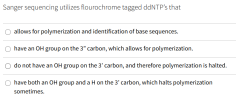 Sanger sequencing utilizes flourochrome tagged ddNTP's that O allows for polymerization and identification of base sequences. have an OH group on the 3” carbon, which allows for polymerization. do not have an OH group on the 3' carbon, and therefore polymerization is halted. have both an OH group and a H on the 3' carbon, which halts polymerization sometimes.
In automated DNA sequencing reaction by the Sanger method, which of the following is NOT a...
In automated DNA sequencing reaction by the Sanger method, which of the following is NOT a component of the reaction? A) fluorescently-labeled deoxynucleotides B) DNA polymerase C) a DNA primer D) the DNA to be sequenced E) none of the above (i.e. all the above are required in the reaction)
24. Which three of the following six features are common to Illumina and Sanger sequencing technologies...
24. Which three of the following six features are common to Illumina and Sanger sequencing technologies (you will get 1/3 for each correct answer and minus 1/3 for each incorrect answer): Select one or more: a. Both technologies use terminators b. Both methods require PCR amplification c. Both methods require a ligation step d. Both methods require a restriction endonuclease e. Both methods require primers f. Both methods were developed by scientists while under the influence of strong hallucinogenic drugs...
O The Sanger method of DNA sequencing requires which of the following to be in the...
 O The Sanger method of DNA sequencing requires which of the following to be in the reaction tube? Choose one: O A. template DNA O B. deoxyribonucleotides O C. dideoxyribonucleotides O D. A, B, and C are correct. O E. Only A and B are correct. O F. Only A and Care correct. O O O
How do ddNTPs differ from dNTPs? A. They do not have a 3'-hydroxyl group on the...
How do ddNTPs differ from dNTPs? A. They do not have a 3'-hydroxyl group on the sugar. B. They have only one phosphate group on the sugar. C. They do have a 3'-hydroxyl group on the sugar. D. They do not have a 2'-hydroxyl group on the sugar. E. They do not have any phosphate groups on the sugar.
 Why do ddNTPs in Sanger sequencing serve as terminators of the polymerase reaction? O because they have an extra oxygen in Carbon 3 and no peptide bond can occur with the following nucleotide. O because they lack an oxygen in Carbon 3 and no phosphodiester bond can occur with the following nucleotide. O because they lack an oxygen in Carbon 5 and the polymerase detects that as a termination signal Because they lack a phosphate group in Carbon 5 and...
 Sanger sequencing allows the identification of the bases and their order in a target piece of DNA. This technique exploits the way DNA is transcribed by using a primer and allowing new DNA to be created from its 3' end. In this technique, DNA is manufactured in vitro, which means that enzymes and molecules are combined in a test tube to allow the reactions to occur. In the original technique, four tubes were prepared, each containing the same reactants, but...
 Sanger sequencing utilizes flourochrome tagged ddNTP's that O allows for polymerization and identification of base sequences. have an OH group on the 3” carbon, which allows for polymerization. do not have an OH group on the 3' carbon, and therefore polymerization is halted. have both an OH group and a H on the 3' carbon, which halts polymerization sometimes.
 O The Sanger method of DNA sequencing requires which of the following to be in the reaction tube? Choose one: O A. template DNA O B. deoxyribonucleotides O C. dideoxyribonucleotides O D. A, B, and C are correct. O E. Only A and B are correct. O F. Only A and Care correct. O O O
Most questions answered within 3 hours.
-
Where is the error in this code sequence?
String s1 = "Hello";
String s2 = "ello";...
asked 10 months ago -
Financial data for Joel de Paris, Inc., for last year
follow:
Joel de Paris, Inc.
Balance...
asked 10 months ago -
Consider this reaction:
Al2(SO4)3 (aq)+ BaCl3
(aq) Al2Cl6 (aq)- +
3BaSO4(s) . What is the...
asked 10 months ago -
Suppose that Savneet is considering increasing her
recent random sample from 20 car rentals to 40...
asked 10 months ago -
Trucks arrive at an unloading terminal at an average rate of 120
per hour.
Trucks arrive...
asked 10 months ago -
Why are methanol and ethanol completely soluble in water while
octanol is not very little soluble....
asked 10 months ago -
A facilities manager at a university reads in a research report
that the mean amount of...
asked 10 months ago -
When the CuSO4 is rehydrated by adding water to the anhydrous
compound, is this an endothermic...
asked 10 months ago -
A ray of sunlight is passing from diamond into crown glass; the
angle of incidence is...
asked 10 months ago -
A block of mass 0.249 kg is placed on top of a light, vertical
spring of...
asked 10 months ago -
how do the kidneys compensate in the presences of acidosis
a) trigger hyperventilate
b) reserve acid...
asked 10 months ago -
Question 501 pts
The rental rate of capital to the firm increases. Which of the
following...
asked 10 months ago