A. what is chemolithotropy? cite an example of an organism that practices chemolithotropy? (B) what is...
A. what is chemolithotropy? cite an example of an organism that practices chemolithotropy? (B) what is the ecological and evolutionary significance of such organisms. (C) discuss challenges for higher organisms in practicing chemolithotropy (D) what are superbugs? cite an example and state ways to combat your cited superbug.
Homework Answers
A) Chemolithotrophy is the process of energy production /ATP production by oxidising inorganic materials through aerobic or anaerobic respiration. Example: Nitrobacter.
B) Chemolithotrophs play an important role in biogeochemical cycle ( Nitrobacter and Nitrosomonas) and soil formation (cynobcyanobac).
Chemolithotrophs can be used to study evolution of life on earth. How life has survived on early earth and how organism started using organic compounds for energy production.
Add Answer to:
A. what is chemolithotropy? cite an example of an
organism that practices chemolithotropy? (B) what is...
diagram indicate the a. return of chemical substances to the environment b. order of importance of...
 diagram indicate the a. return of chemical substances to the environment b. order of importance of the various organisms c. direction in which organisms move in the environment d. the flow of energy from heterotrophs to autotrophs e. direction of energy flow through a series of organisms 17. The diagram represents a food chain. The arrows in the serious threat to many forested areas. Which would probably be the most ecologically sound method of gypsy moth control? a. increased application...
?/27/2018 28. The fat that both Anacardium occidentale and Mangiera sequence position 3 is an example...
 ?/27/2018 28. The fat that both Anacardium occidentale and Mangiera sequence position 3 is an example of: indico both hove DNA nucleotid a) homoplasy b) paraphyly c) convergence. d) homology e) symplesiomorphy 29. What is the significance of the fact that both sequence and C DNA nucleotide? itions 1 and 2 involve changes between a G occurrence of G and C in the respective terminal taxa arose via convergence. b) The changes involve c) Nucleotide base C is mor d)...
1) Egg coloration that acts as camouflage is an example of: a. artifical selection. b. a...
1) Egg coloration that acts as camouflage is an example of: a. artifical selection. b. a bottle effect. c. the founder effect d. an adaption. e. sexual selection. 2) In order for nutural selection to occur, organisms must ( select all that apply ) a. have variation that can be passed from one generation to the next. b. have differential reproductive success. c. survive longer than another organism. d. compete for resources. e. have adaptations to their environment
Not sure what the correct answer is and an explanation to go along with it would...
 Not sure what the correct answer is and an explanation to go
along with it would be very nice! Thank you!
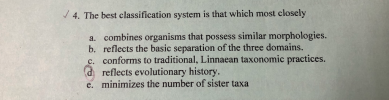
4. The best classification system is that which most closely a. combines organisms that possess similar morphologies. b. reflects the basic separation of the three domains. c. conforms to traditional, Linnaean taxonomic practices. d reflects evolutionary history. e. minimizes the number of sister taxa
Not sure what the correct answer is and an explanation to go
along with it would be very nice! Thank you!
4. The best classification system is that which most closely a. combines organisms that possess similar morphologies. b. reflects the basic separation of the three domains. c. conforms to traditional, Linnaean taxonomic practices. d reflects evolutionary history. e. minimizes the number of sister taxa
Exercise 22 Evolution 287 Box 222 Major Evolutionary Organisms Organism mya (millions of years ago) or...
 Exercise 22 Evolution 287 Box 222 Major Evolutionary Organisms Organism mya (millions of years ago) or bya (billions of years ago) a. Eggsperm Major Evolutionary Features b. Arthropoid c. Eukaryotic cell d. Modern human e. Vertebrate-fish f. Hominoid 8. Early human h. Invertebrate-jellyfish i. Early mammal j. Ape k. Prokaryotic cell the newlieet vertebrates? f Whet dit: 1 c. What are features of the earliest vertebrates? f. What distinguishes the earliest humans (hominids) from apes? d. What distinguishes early mammals...
20. Phenotypic plasticity A. is when an organism survives but not does not reproduce. B. only...
 20. Phenotypic plasticity A. is when an organism survives but not does not reproduce. B. only happens for animals, not plants C. is the altered phenotype of organism based on variation in genotype. D. none of the above 21. Commensalism is when A. for example, there is colonization by a gastrointestinal bacterial species that provides neither a benefit nor an ailment for the host B. there is an exaptation due to hybridization C. there is a mixture of chromosomes as...
Fungi 44. What type of organism is this? A. yeast B. mold 45. What type of...
 Fungi 44. What type of organism is this? A. yeast B. mold 45. What type of spore do you see? A. sporangiospore B. microconidia C. macroconidia D. arthrospore 18
38. What is the significance of evolutionary biology to the treatment of disease with antibiotics? A....
38. What is the significance of evolutionary biology to the treatment of disease with antibiotics? A. An understanding that, as patients die, the human genome evolves resistance, has led evolutionary biologists to intentionally spread illnesses. B. An understanding of evolution has led to new and effective treatments of incurable diseases, such as tuberculosis. C. Evolutionary biologists came up with drugs called protease inhibitors, which are used to treat HIV. D. An understanding of evolution provides insight into the origin, spread,...
1a. What happens to the hippocampus of aged organisms, that impacts glucocorticoid levels? b. Why do...
1a. What happens to the hippocampus of aged organisms, that impacts glucocorticoid levels? b. Why do "mild to moderate short-term stressors enhance memory"? c. Explain how and what type of memory is most affected by prolonged severe stress. d. Discusses 5 ways that stress damages the hippocampus in lab animals. List and describe each of these 5 ways. e.What is the conclusion regarding the current state of knowledge regarding stress and the human hippocampus.
please answer just 90-93. thanks! R6.What do "fimbriae" of bacteria do? A) catch food B) absorbing...
 please answer just 90-93. thanks!
R6.What do "fimbriae" of bacteria do? A) catch food B) absorbing liquid food. c) sticking to a substrate D) help in sexual reproduction. E) all of the above t is the evolutionary advantage of closed circulatory system over an open circulatory system? A) open circulatory system are subject to contamination from the environment. B) blood pressure is higher in an open circulatory system. ci blood in a closed circulatory system can be shunted where it...
please answer just 90-93. thanks!
R6.What do "fimbriae" of bacteria do? A) catch food B) absorbing liquid food. c) sticking to a substrate D) help in sexual reproduction. E) all of the above t is the evolutionary advantage of closed circulatory system over an open circulatory system? A) open circulatory system are subject to contamination from the environment. B) blood pressure is higher in an open circulatory system. ci blood in a closed circulatory system can be shunted where it...
 diagram indicate the a. return of chemical substances to the environment b. order of importance of the various organisms c. direction in which organisms move in the environment d. the flow of energy from heterotrophs to autotrophs e. direction of energy flow through a series of organisms 17. The diagram represents a food chain. The arrows in the serious threat to many forested areas. Which would probably be the most ecologically sound method of gypsy moth control? a. increased application...
 ?/27/2018 28. The fat that both Anacardium occidentale and Mangiera sequence position 3 is an example of: indico both hove DNA nucleotid a) homoplasy b) paraphyly c) convergence. d) homology e) symplesiomorphy 29. What is the significance of the fact that both sequence and C DNA nucleotide? itions 1 and 2 involve changes between a G occurrence of G and C in the respective terminal taxa arose via convergence. b) The changes involve c) Nucleotide base C is mor d)...
 Not sure what the correct answer is and an explanation to go
along with it would be very nice! Thank you!
4. The best classification system is that which most closely a. combines organisms that possess similar morphologies. b. reflects the basic separation of the three domains. c. conforms to traditional, Linnaean taxonomic practices. d reflects evolutionary history. e. minimizes the number of sister taxa
Not sure what the correct answer is and an explanation to go
along with it would be very nice! Thank you!
4. The best classification system is that which most closely a. combines organisms that possess similar morphologies. b. reflects the basic separation of the three domains. c. conforms to traditional, Linnaean taxonomic practices. d reflects evolutionary history. e. minimizes the number of sister taxa
 Exercise 22 Evolution 287 Box 222 Major Evolutionary Organisms Organism mya (millions of years ago) or bya (billions of years ago) a. Eggsperm Major Evolutionary Features b. Arthropoid c. Eukaryotic cell d. Modern human e. Vertebrate-fish f. Hominoid 8. Early human h. Invertebrate-jellyfish i. Early mammal j. Ape k. Prokaryotic cell the newlieet vertebrates? f Whet dit: 1 c. What are features of the earliest vertebrates? f. What distinguishes the earliest humans (hominids) from apes? d. What distinguishes early mammals...
 20. Phenotypic plasticity A. is when an organism survives but not does not reproduce. B. only happens for animals, not plants C. is the altered phenotype of organism based on variation in genotype. D. none of the above 21. Commensalism is when A. for example, there is colonization by a gastrointestinal bacterial species that provides neither a benefit nor an ailment for the host B. there is an exaptation due to hybridization C. there is a mixture of chromosomes as...
 Fungi 44. What type of organism is this? A. yeast B. mold 45. What type of spore do you see? A. sporangiospore B. microconidia C. macroconidia D. arthrospore 18
 please answer just 90-93. thanks!
R6.What do "fimbriae" of bacteria do? A) catch food B) absorbing liquid food. c) sticking to a substrate D) help in sexual reproduction. E) all of the above t is the evolutionary advantage of closed circulatory system over an open circulatory system? A) open circulatory system are subject to contamination from the environment. B) blood pressure is higher in an open circulatory system. ci blood in a closed circulatory system can be shunted where it...
please answer just 90-93. thanks!
R6.What do "fimbriae" of bacteria do? A) catch food B) absorbing liquid food. c) sticking to a substrate D) help in sexual reproduction. E) all of the above t is the evolutionary advantage of closed circulatory system over an open circulatory system? A) open circulatory system are subject to contamination from the environment. B) blood pressure is higher in an open circulatory system. ci blood in a closed circulatory system can be shunted where it...
Most questions answered within 3 hours.
-
Where is the error in this code sequence?
String s1 = "Hello";
String s2 = "ello";...
asked 11 months ago -
Financial data for Joel de Paris, Inc., for last year
follow:
Joel de Paris, Inc.
Balance...
asked 11 months ago -
Consider this reaction:
Al2(SO4)3 (aq)+ BaCl3
(aq) Al2Cl6 (aq)- +
3BaSO4(s) . What is the...
asked 11 months ago -
Suppose that Savneet is considering increasing her
recent random sample from 20 car rentals to 40...
asked 11 months ago -
Trucks arrive at an unloading terminal at an average rate of 120
per hour.
Trucks arrive...
asked 11 months ago -
Why are methanol and ethanol completely soluble in water while
octanol is not very little soluble....
asked 11 months ago -
A facilities manager at a university reads in a research report
that the mean amount of...
asked 11 months ago -
When the CuSO4 is rehydrated by adding water to the anhydrous
compound, is this an endothermic...
asked 11 months ago -
A ray of sunlight is passing from diamond into crown glass; the
angle of incidence is...
asked 11 months ago -
A block of mass 0.249 kg is placed on top of a light, vertical
spring of...
asked 11 months ago -
how do the kidneys compensate in the presences of acidosis
a) trigger hyperventilate
b) reserve acid...
asked 11 months ago -
Question 501 pts
The rental rate of capital to the firm increases. Which of the
following...
asked 11 months ago