(Optics) When we see the image that is projected through the lens or reflected by mirrors,...
(Optics)
When we see the image that is projected through the lens or reflected by mirrors, why are the edges of the image blurry??
Homework Answers
This is due to diffraction. Light (ray) bends when reflected though edge of mirror. So We will observe a blury image.
Add Answer to:
(Optics)
When we see the image that is projected through the lens or
reflected by mirrors,...
complete the ray tracings of the objects reflected by the mirrors We were unable to transcribe...
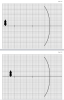 complete the ray tracings of the objects reflected by the mirrors
We were unable to transcribe this image1 6 4
complete the ray tracings of the objects reflected by the mirrors
We were unable to transcribe this image1 6 4
complete the ray tracings of the objects reflected by rhe mirrors We were unable to transcribe...
 complete the ray tracings of the objects reflected by rhe mirrors
We were unable to transcribe this imagePape of Page of
complete the ray tracings of the objects reflected by rhe mirrors
We were unable to transcribe this imagePape of Page of
3-5 Lenses and Mirrors lens look through from here lens 2 0 2 2 - what...
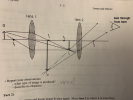 3-5 Lenses and Mirrors lens look through from here lens 2 0 2 2 - what type of image is produced? tia - describe its character . Report your observations: Part 2) reen and locate image Ii once again. Move lens 2 to where it is more than
Following will be two mirrors and two lenses. We are going to find the image distance...
Following will be two mirrors and two lenses. We are going to find the image distance and the image height for each object. 1. Draw the ray diagrams for each situation properly as accurate as possible. 2. Calculate the image distance with the following data, and compare with drawing. f=4.0 cm d_o=12.0 cm h_o=3.0 cm Remember the sign of f depends on the mirror/lens type. 3. Calculate the magnification and image height, and compare with your drawing. Do this for...
Ray Optics 4 Problem Statement A thin converging lens is found to form an image of...
 Ray Optics 4 Problem Statement A thin converging lens is found to form an image of a distant building 24 cm from the lens. If an insect is now placed 16 cm from this lens, how far FROM THE INSECT will its image be formed? Visual Representation • Draw an optical axis with the lens centered on the axis. • Represent the object at the correct distance from the lens • Draw the three "special rays" from the top of...
Ray Optics 4 Problem Statement A thin converging lens is found to form an image of...
 Ray Optics 4 Problem Statement A thin converging lens is found to form an image of a distant building 24 cm from the lens. If an insect is now placed 16 cm from this lens, how far FROM THE INSECT will its image be formed? Visual Representation • Draw an optical axis with the lens centered on the axis. Represent the object at the correct distance from the lens • Draw the three "special rays" from the top of the...
Optics physics question! 84. ...A lens of focal length + 15.0 cm is 10.0 cm to...
 Optics physics question!
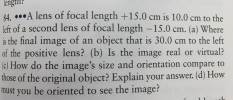
84. ...A lens of focal length + 15.0 cm is 10.0 cm to the left of a second lens of focal length -15.0 cm. (a) Where is the final image of an object that is 30.0 cm to the left of the positive lens? (b) Is the image real or virtual? (c) How do the image?s size and orientation compare to those of the original object? Explain your answer. (d) How must you be oriented to see...
Optics physics question!
84. ...A lens of focal length + 15.0 cm is 10.0 cm to the left of a second lens of focal length -15.0 cm. (a) Where is the final image of an object that is 30.0 cm to the left of the positive lens? (b) Is the image real or virtual? (c) How do the image?s size and orientation compare to those of the original object? Explain your answer. (d) How must you be oriented to see...
You could not see the image of the text when the lens to object-distance was less...
You could not see the image of the text when the lens to object-distance was less than the focal length, but you could see it when it was equal to or greater than the focal length. What does this tell you about the eyes ability to process diverging rays, parallel rays, and converging rays?
Optics and Converging & Diverging Lenses 1. What is the relationship between the curvature of a...
Optics and Converging & Diverging Lenses 1. What is the relationship between the curvature of a lens (thick vs thinner converging lenses) and its light-bending power? 2. Focal length: is there a trend in the image distances vis a vis focal lengths as the object distance gets larger? What happens to the thin lens formula when object distance is very large? 3. In the compound lens formula, 1/fcomp = 1/f1 + 1/f2, why does a longer focal lens will not...
I posted this previously, but the answer I received was unclear and a concept we have...
I posted this previously, but the answer I received was unclear and a concept we have yet to talk about in my physics class. Can someone else give me a more clear explanation? For part of our lab we drew an arrow on the face of a flashlight (that did not have a curved lens). We then shined the flashlight onto the wall and observed that the image was very blurry. the question asks "You may see a shadow of...
 complete the ray tracings of the objects reflected by the mirrors
We were unable to transcribe this image1 6 4
complete the ray tracings of the objects reflected by the mirrors
We were unable to transcribe this image1 6 4
 complete the ray tracings of the objects reflected by rhe mirrors
We were unable to transcribe this imagePape of Page of
complete the ray tracings of the objects reflected by rhe mirrors
We were unable to transcribe this imagePape of Page of
 3-5 Lenses and Mirrors lens look through from here lens 2 0 2 2 - what type of image is produced? tia - describe its character . Report your observations: Part 2) reen and locate image Ii once again. Move lens 2 to where it is more than
 Ray Optics 4 Problem Statement A thin converging lens is found to form an image of a distant building 24 cm from the lens. If an insect is now placed 16 cm from this lens, how far FROM THE INSECT will its image be formed? Visual Representation • Draw an optical axis with the lens centered on the axis. • Represent the object at the correct distance from the lens • Draw the three "special rays" from the top of...
 Ray Optics 4 Problem Statement A thin converging lens is found to form an image of a distant building 24 cm from the lens. If an insect is now placed 16 cm from this lens, how far FROM THE INSECT will its image be formed? Visual Representation • Draw an optical axis with the lens centered on the axis. Represent the object at the correct distance from the lens • Draw the three "special rays" from the top of the...
 Optics physics question!
84. ...A lens of focal length + 15.0 cm is 10.0 cm to the left of a second lens of focal length -15.0 cm. (a) Where is the final image of an object that is 30.0 cm to the left of the positive lens? (b) Is the image real or virtual? (c) How do the image?s size and orientation compare to those of the original object? Explain your answer. (d) How must you be oriented to see...
Optics physics question!
84. ...A lens of focal length + 15.0 cm is 10.0 cm to the left of a second lens of focal length -15.0 cm. (a) Where is the final image of an object that is 30.0 cm to the left of the positive lens? (b) Is the image real or virtual? (c) How do the image?s size and orientation compare to those of the original object? Explain your answer. (d) How must you be oriented to see...
Most questions answered within 3 hours.
-
Where is the error in this code sequence?
String s1 = "Hello";
String s2 = "ello";...
asked 10 months ago -
Financial data for Joel de Paris, Inc., for last year
follow:
Joel de Paris, Inc.
Balance...
asked 10 months ago -
Consider this reaction:
Al2(SO4)3 (aq)+ BaCl3
(aq) Al2Cl6 (aq)- +
3BaSO4(s) . What is the...
asked 10 months ago -
Suppose that Savneet is considering increasing her
recent random sample from 20 car rentals to 40...
asked 10 months ago -
Trucks arrive at an unloading terminal at an average rate of 120
per hour.
Trucks arrive...
asked 10 months ago -
Why are methanol and ethanol completely soluble in water while
octanol is not very little soluble....
asked 10 months ago -
A facilities manager at a university reads in a research report
that the mean amount of...
asked 10 months ago -
When the CuSO4 is rehydrated by adding water to the anhydrous
compound, is this an endothermic...
asked 10 months ago -
A ray of sunlight is passing from diamond into crown glass; the
angle of incidence is...
asked 10 months ago -
A block of mass 0.249 kg is placed on top of a light, vertical
spring of...
asked 10 months ago -
how do the kidneys compensate in the presences of acidosis
a) trigger hyperventilate
b) reserve acid...
asked 10 months ago -
Question 501 pts
The rental rate of capital to the firm increases. Which of the
following...
asked 10 months ago