When Ca2+ channels open, in which direction does Ca2+ flow? b) Why? c) In which direction...
When Ca2+ channels open, in which direction does Ca2+ flow? b) Why? c) In which direction does the Ca2+ ATPase pump?
Homework Answers


Add Answer to:
When Ca2+ channels open, in which direction does Ca2+ flow? b)
Why? c) In which direction...
Why is there not a resting membrane potential in autorhythmic cells? A) The Cat+ channels open too early B) The Kt...
 Why is there not a resting membrane potential in autorhythmic cells? A) The Cat+ channels open too early B) The Kt channels are not finished closing when the Cat+ channels open C) The lf channels are open when repolarization ends D) The lf channels are not open when depolarization begins Which cells secrete renin in response to low blood pressure? A) granular cells C) myogenic cells B) macula densa cells D) tubulorenal cells What is the MAIN reason intercalated disks...
29 From the following graph, which channels/pumps are open/active at position 4? Mark all that apply...
 29 From the following graph, which channels/pumps are open/active at position 4? Mark all that apply A. Na+/K+ Pump B. Voltage gated Na+ Channel C. Voltage gated K+ Channel D. Passive K+ channel E. None of the pump/channels are open/active Membrane potential (m)
How is calmodulin activated? A. by binding both calcium and potassium B. by binding Ca2+ when...
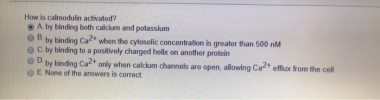 How is calmodulin activated? A. by binding both calcium and potassium B. by binding Ca2+ when the cytosolic concentration is greater than 500 nM C. by binding to a positively charged helix on another protein D. by binding Ca2+ only when calcium channels are open, allowing Ca2+ efflux from the cell E. None of the answers is correct.
hat is the best description of pulmonary blood flow? A) low flow, high pressure C) high flow, low pressure B) low...
 hat is the best description of pulmonary blood flow? A) low flow, high pressure C) high flow, low pressure B) low flow, low pressure D) high flow, high pressure Vhich of the following is the skeletal muscle reflex responsible for preventing excessive tension in the uscle due to overcontraction? A) joint capsule receptors C) Golgi tendon organs B) muscle spindle fibers D) autonomic reflex Vhich of the following stimulates the cells of the adrenal medulla to secrete its excitatory hormones?...
During graded potential on the soma and dendrites, which of these channels are open? (Mark all...
During graded potential on the soma and dendrites, which of these channels are open? (Mark all that apply) 1. Na/K Pump 2. Voltage gated potassium channels 3. Ligand gated sodium channels 4. Voltage gated calcium channels
1) Which ligand-gated ion channels does (glutamate / GABA / glycine) open? 2) How do changes...
1) Which ligand-gated ion channels does (glutamate / GABA / glycine) open? 2) How do changes in (potassium / sodium) concentration affect the resting membrane potential? 3) If (sodium / potassium / chloride) channels are locked open, the membrane potential will continue to change due to ion flow until it reaches what value? (give a numerical value)
If aquaporins were open in the ascending loop of Henle, which direction would water flow? a....
If aquaporins were open in the ascending loop of Henle, which direction would water flow? a. into the filtrate b. out the filtrate c. equally in both directions So the answer is A but im confused as to why so can somebody explain why the answer is A
Regarding the neuromuscular junction... a. Depolarization of the presynaptic membrane directly causes voltage-gated calcium channels in...
Regarding the neuromuscular junction... a. Depolarization of the presynaptic membrane directly causes voltage-gated calcium channels in the membrane to open. b. Action potentials in the sarcolemma directly cause calcium channels to open. c. Action potentials in the sarcoplasmic reticulum indirectly cause the calcium ATPase pump to function, if ATP is present. d. both a) and b) are correct, and c) is incorrect e. a), b) and c) are all correct 2) Following ATP hydrolysis by myosin, which steps occur during...
1) lon Flow (15 points): Consider a neuron (at body temperature) with a chloride concentration of...
 1) lon Flow (15 points): Consider a neuron (at body temperature) with a chloride concentration of 15 mM inside the neuron and 150 mM outside the neuron. Assume that the neuron has a resting membrane potential of-50mV. Which direction will the chloride ions move if all chloride channels open? Does opening of chloride channels have an excitatory or inhibitory effect on the neuron? (5 points) a) -100mV. Which direction b) Assume that the neuron has a resting membrane potential of...
3. Many neurons contain "delayed K channels". Like voltage-gated Nat channels, these voltage-gated K+ channels open in response to a rise in membrane potential and then undergo inactivati...
 3. Many neurons contain "delayed K channels". Like voltage-gated Nat channels, these voltage-gated K+ channels open in response to a rise in membrane potential and then undergo inactivation. However, opening of the voltage-gated K channels lags behind opening of the voltage-gated Na channels. a) Why does neuronal function require the voltage-gated K channels to open more slowly than the voltage-gated Na channels? b) Compared to a neuron that lacks voltage-gated K channels, what differences would you expect in the shape...
 Why is there not a resting membrane potential in autorhythmic cells? A) The Cat+ channels open too early B) The Kt channels are not finished closing when the Cat+ channels open C) The lf channels are open when repolarization ends D) The lf channels are not open when depolarization begins Which cells secrete renin in response to low blood pressure? A) granular cells C) myogenic cells B) macula densa cells D) tubulorenal cells What is the MAIN reason intercalated disks...
 29 From the following graph, which channels/pumps are open/active at position 4? Mark all that apply A. Na+/K+ Pump B. Voltage gated Na+ Channel C. Voltage gated K+ Channel D. Passive K+ channel E. None of the pump/channels are open/active Membrane potential (m)
 How is calmodulin activated? A. by binding both calcium and potassium B. by binding Ca2+ when the cytosolic concentration is greater than 500 nM C. by binding to a positively charged helix on another protein D. by binding Ca2+ only when calcium channels are open, allowing Ca2+ efflux from the cell E. None of the answers is correct.
 hat is the best description of pulmonary blood flow? A) low flow, high pressure C) high flow, low pressure B) low flow, low pressure D) high flow, high pressure Vhich of the following is the skeletal muscle reflex responsible for preventing excessive tension in the uscle due to overcontraction? A) joint capsule receptors C) Golgi tendon organs B) muscle spindle fibers D) autonomic reflex Vhich of the following stimulates the cells of the adrenal medulla to secrete its excitatory hormones?...
 1) lon Flow (15 points): Consider a neuron (at body temperature) with a chloride concentration of 15 mM inside the neuron and 150 mM outside the neuron. Assume that the neuron has a resting membrane potential of-50mV. Which direction will the chloride ions move if all chloride channels open? Does opening of chloride channels have an excitatory or inhibitory effect on the neuron? (5 points) a) -100mV. Which direction b) Assume that the neuron has a resting membrane potential of...
 3. Many neurons contain "delayed K channels". Like voltage-gated Nat channels, these voltage-gated K+ channels open in response to a rise in membrane potential and then undergo inactivation. However, opening of the voltage-gated K channels lags behind opening of the voltage-gated Na channels. a) Why does neuronal function require the voltage-gated K channels to open more slowly than the voltage-gated Na channels? b) Compared to a neuron that lacks voltage-gated K channels, what differences would you expect in the shape...
Most questions answered within 3 hours.
-
Where is the error in this code sequence?
String s1 = "Hello";
String s2 = "ello";...
asked 10 months ago -
Financial data for Joel de Paris, Inc., for last year
follow:
Joel de Paris, Inc.
Balance...
asked 10 months ago -
Consider this reaction:
Al2(SO4)3 (aq)+ BaCl3
(aq) Al2Cl6 (aq)- +
3BaSO4(s) . What is the...
asked 10 months ago -
Suppose that Savneet is considering increasing her
recent random sample from 20 car rentals to 40...
asked 10 months ago -
Trucks arrive at an unloading terminal at an average rate of 120
per hour.
Trucks arrive...
asked 10 months ago -
Why are methanol and ethanol completely soluble in water while
octanol is not very little soluble....
asked 10 months ago -
A facilities manager at a university reads in a research report
that the mean amount of...
asked 10 months ago -
When the CuSO4 is rehydrated by adding water to the anhydrous
compound, is this an endothermic...
asked 10 months ago -
A ray of sunlight is passing from diamond into crown glass; the
angle of incidence is...
asked 10 months ago -
A block of mass 0.249 kg is placed on top of a light, vertical
spring of...
asked 10 months ago -
how do the kidneys compensate in the presences of acidosis
a) trigger hyperventilate
b) reserve acid...
asked 10 months ago -
Question 501 pts
The rental rate of capital to the firm increases. Which of the
following...
asked 10 months ago