Draw and label a graph depicting a government tax on suppliers of a good. Start with...
-
Draw and label a graph depicting a government tax on suppliers of a good.
-
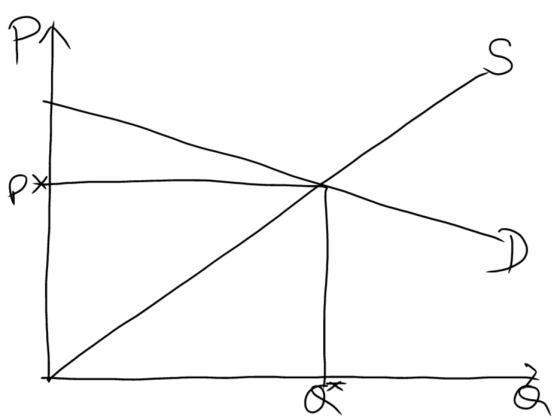
Start with a graph depicting general market equilibrium with the demand curve being relatively flatter then the supply curve.
-
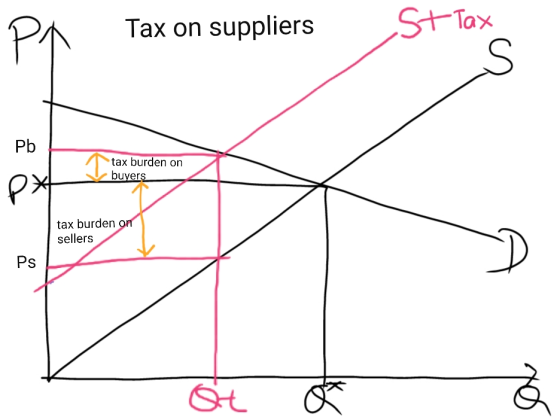
Modify the graph to demonstrate the effect of a tax on the supplier on the market.
-
Homework Answers
Ans) When government imposes tax, burden is shared by both buyers and sellers. Now who will bear greater burden of tax depends upon the elasticity of demand and supply. Accordingly, the less elastic side of the market bears greater burden of tax.
Now, a flatter curve is more elastic and steeper curve is less elastic.
Here, as it is mentioned that demand curve is flatter, demand is less elastic and hence buyers will bear less burden of tax.
Further, a tax on suppliers will shift the supply curve to the left.
[Pb is price paid by buyers after tax and Ps is price received by sellers after tax]
Add Answer to:
Draw and label a graph depicting a government tax on
suppliers of a good.
Start with...
Draw and label a graph depicting a government tax on suppliers of a good. Start with...
Draw and label a graph depicting a government tax on suppliers of a good. Start with a graph depicting general market equilibrium with the demand curve having a slope of 1 (technically negative 1) and the supply curve having a slope of 2. Modify the graph to demonstrate the effect of a tax on the supplier on the market.
Draw and label a graph depicting world trade in which the world price is perfectly elastic...
Draw and label a graph depicting world trade in which the world price is perfectly elastic and higher than the country price. Start with a graph depicting market equilibrium with the demand curve and supply curves having slopes of approximately 1 (negative 1 for demand). Modify the graph to demonstrate the world market price being lower than the country market price.
Draw and label a graph depicting a monopolistic market from perspective of a single firm. Make...
Draw and label a graph depicting a monopolistic market from perspective of a single firm. Make sure you illustrate the profit maximizing price and quantity. a. Start with a graph depicting market equilibrium for the monopolistic market b. Modify the graph to demonstrate that the price at the profit maximizing level of output is above the average variable cost curve,but below the average cost curve c. Is the firm making a profit or loss? d. Will the firm decide to...
Draw and label a graph depicting a monopolistic market from the perspective of a single firm....
Draw and label a graph depicting a monopolistic market from the perspective of a single firm. Make sure you illustrate the profit maximizing price and quantity . Start with a graph depicting market equilibrium for the monopolistic market . Modify the graph to demonstrate that the price at the profit maximizing level of output is below the average variable cost curve . Discuss the following characteristics of a the firm depicted in part 1 : Is the firm making a...
The government is considering levying a tax of $60 per unit on suppliers of either concert...
 The government is considering levying a tax of $60 per unit on suppliers of either concert tickets or bus passes. The supply curve for each of these two goods is identical, as you can see on each of the following graphs. The demand for concert tickets is shown by De (on the first graph), and the demand for bus passes is shown by D. (on the second graph). Suppose the government taxes concert tickets. The following graph shows the annual...
The government is considering levying a tax of $100 per unit on suppliers of either leather jackets or smartphones.
 3. Relationship between tax revenues, deadweight loss, and demandelasticity The government is considering levying a tax of $100 per unit on suppliers of either leather jackets or smartphones. The supply curve for each of these two goods is identical, as you can see on each of the following graphs. The demand for leather jackets is shown by DL (on the first graph), and the demand for smartphones is shown by Ds (on the second graph). Suppose the government taxes leather jackets. The...
The government is considering levying a tax of $80 per unit on suppliers of either leather jackets or smartphones. The supply curve for each of these two goods is identical, as you can see on each of the following graphs. The demand for leather jackets is
 The government is considering levying a tax of $80 per unit on suppliers of either leather jackets or smartphones. The supply curve for each of these two goods is identical, as you can see on each of the following graphs. The demand for leather jackets is shown by DL (on the first graph), and the demand for smartphones is shown by Ds (on the second graph). Suppose the government taxes leather jackets. The following graph shows the annual supply and demand...
draw a graph depicting the MR, MC and demand curves for the monopolist. label the profit-maximizing...
draw a graph depicting the MR, MC and demand curves for the monopolist. label the profit-maximizing quantity of output and the price the monopolist will charge
3. Relationship between tax revenues, deadweight loss, and demandelasticity The government is considering levying a tax...
 3. Relationship between tax revenues, deadweight loss, and demandelasticity The government is considering levying a tax of $120 per unit on suppliers of either leather jackets or smartphones. The supply curve for each of these two goods is identical, as you can see on each of the following graphs. The demand for leather jackets is shown by Di (on the first graph), and the demand for smartphones is shown by Ds (on the second graph). Suppose the government taxes leather...
Can someone please explain C. Role of Government 1. Draw a supply and demand graph with a binding price ceiling. Label...
 Can someone please explain
C. Role of Government 1. Draw a supply and demand graph with a binding price ceiling. Label consumer and producer surplus as well as deadweight loss 2. Who benefits from the imposition of the price ceiling 3. T/F/Explain The current price for your favorite candy is $3. Government imposes a sales tax on this product of $0.50. The new equilibrium price will be $3.50 4. In the graph below, what is the customer's burden of the...
Can someone please explain
C. Role of Government 1. Draw a supply and demand graph with a binding price ceiling. Label consumer and producer surplus as well as deadweight loss 2. Who benefits from the imposition of the price ceiling 3. T/F/Explain The current price for your favorite candy is $3. Government imposes a sales tax on this product of $0.50. The new equilibrium price will be $3.50 4. In the graph below, what is the customer's burden of the...
 The government is considering levying a tax of $60 per unit on suppliers of either concert tickets or bus passes. The supply curve for each of these two goods is identical, as you can see on each of the following graphs. The demand for concert tickets is shown by De (on the first graph), and the demand for bus passes is shown by D. (on the second graph). Suppose the government taxes concert tickets. The following graph shows the annual...
 3. Relationship between tax revenues, deadweight loss, and demandelasticity The government is considering levying a tax of $120 per unit on suppliers of either leather jackets or smartphones. The supply curve for each of these two goods is identical, as you can see on each of the following graphs. The demand for leather jackets is shown by Di (on the first graph), and the demand for smartphones is shown by Ds (on the second graph). Suppose the government taxes leather...
 Can someone please explain
C. Role of Government 1. Draw a supply and demand graph with a binding price ceiling. Label consumer and producer surplus as well as deadweight loss 2. Who benefits from the imposition of the price ceiling 3. T/F/Explain The current price for your favorite candy is $3. Government imposes a sales tax on this product of $0.50. The new equilibrium price will be $3.50 4. In the graph below, what is the customer's burden of the...
Can someone please explain
C. Role of Government 1. Draw a supply and demand graph with a binding price ceiling. Label consumer and producer surplus as well as deadweight loss 2. Who benefits from the imposition of the price ceiling 3. T/F/Explain The current price for your favorite candy is $3. Government imposes a sales tax on this product of $0.50. The new equilibrium price will be $3.50 4. In the graph below, what is the customer's burden of the...
Most questions answered within 3 hours.
-
Where is the error in this code sequence?
String s1 = "Hello";
String s2 = "ello";...
asked 11 months ago -
Financial data for Joel de Paris, Inc., for last year
follow:
Joel de Paris, Inc.
Balance...
asked 11 months ago -
Consider this reaction:
Al2(SO4)3 (aq)+ BaCl3
(aq) Al2Cl6 (aq)- +
3BaSO4(s) . What is the...
asked 11 months ago -
Suppose that Savneet is considering increasing her
recent random sample from 20 car rentals to 40...
asked 11 months ago -
Trucks arrive at an unloading terminal at an average rate of 120
per hour.
Trucks arrive...
asked 11 months ago -
Why are methanol and ethanol completely soluble in water while
octanol is not very little soluble....
asked 11 months ago -
A facilities manager at a university reads in a research report
that the mean amount of...
asked 11 months ago -
When the CuSO4 is rehydrated by adding water to the anhydrous
compound, is this an endothermic...
asked 11 months ago -
A ray of sunlight is passing from diamond into crown glass; the
angle of incidence is...
asked 11 months ago -
A block of mass 0.249 kg is placed on top of a light, vertical
spring of...
asked 11 months ago -
how do the kidneys compensate in the presences of acidosis
a) trigger hyperventilate
b) reserve acid...
asked 11 months ago -
Question 501 pts
The rental rate of capital to the firm increases. Which of the
following...
asked 11 months ago