A random sample of size 16 is drawn from a normal distribution with σ=9.0 for the...
A random sample of size 16 is drawn from a normal distribution with σ=9.0 for the purpose of testing:
H0:μ=30 versus
H1:μ≠30.
The experimenter chooses to define the critical region C to be the set of samples means lying in the interval (23.9,30.1).
What level of significance does the test have?
Homework Answers
Interval = (23.9, 30.1)
Therefore sample mean = (23.9+30.1)/2 = 27
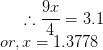
Margin of error = 30.1-27 = 3.1
Now,



Add Answer to:
A random sample of size 16 is drawn from a normal distribution
with σ=9.0 for the...
3. A random sample of size 16 is drawn from a normal distribution with o =...
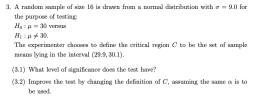 3. A random sample of size 16 is drawn from a normal distribution with o = 9.0 for the purpose of testing: Ho : = 30 versus HP:ll # 30. The experimenter chooses to define the critical region C to be the set of sample means lying in the interval (29.9, 30.1). (3.1) What level of significance does the test have? (3.2) Improve the test by changing the definition of C, assuming the same a is to be used.
A random sample of size 16 is drawn from a nor-mal distribution havingσ=6.0 for the purpose...
A random sample of size 16 is drawn from a nor-mal distribution havingσ=6.0 for the purpose of test-ing H0:μ=30 versus H1:μ=30. The experimenter chooses to define the critical region C to be the set of sample means lying in the interval (29.9, 30.1). What level of significance does the test have? Why is (29.9, 30.1)a poor choice for the critical region? What range of y values should comprise C, assuming the same α is to be used? carefully answer each...
6. Let Xi 1,... ,Xn be a random sample from a normal distribution with mean u and variance ơ2 whi...
 6. Let Xi 1,... ,Xn be a random sample from a normal distribution with mean u and variance ơ2 which are both unknown. (a) Given observations xi, ,Xn, one would like to obtain a (1-a) x 100% one-sided confidence interval for u as a form of L E (-00, u) the expression of u for any a and n. (b) Based on part (a), use the duality between confidence interval and hypothesis testing problem, find a critical region of size...
Let X1, X2, . . . , Xn be a random sample of size n from...
Let X1, X2, . . . , Xn be a random sample of size n from a normal population with mean µX and variance σ ^2 . Let Y1, Y2, . . . , Ym be a random sample of size m from a normal population with mean µY and variance σ ^2 . Also, assume that these two random samples are independent. It is desired to test the following hypotheses H0 : σX = σY versus H1 : σX...
A random sample of 16 values is drawn from a mound-shaped and symmetric distribution. The sample...
A random sample of 16 values is drawn from a mound-shaped and symmetric distribution. The sample mean is 9 and the sample standard deviation is 2. Use a level of significance of 0.05 to conduct a two-tailed test of the claim that the population mean is 8.5. (a) Is it appropriate to use a Student's t distribution? Explain. Yes, because the x distribution is mound-shaped and symmetric and σ is unknown. No, the x distribution is skewed left. No, the...
A random sample of 16 values is drawn from a mound-shaped and symmetric distribution. The sample...
A random sample of 16 values is drawn from a mound-shaped and symmetric distribution. The sample mean is 15 and the sample standard deviation is 2. Use a level of significance of 0.05 to conduct a two-tailed test of the claim that the population mean is 14.5. (a) Is it appropriate to use a Student's t distribution? Explain. Yes, because the x distribution is mound-shaped and symmetric and σ is unknown.No, the x distribution is skewed left. No, the x distribution...
A simple random sample of size 64 is drawn from a normal population with a known...
A simple random sample of size 64 is drawn from a normal population with a known standard deviation σ. The 95% confidence interval for the population mean μ is found to be (12, 16). The approximate population standard deviation σ is:
4. Take a random sample of size 16 from a normal distribution with mean 25 and...
 4. Take a random sample of size 16 from a normal distribution with mean 25 and unknown variance. Find the uniformly most powerful test for testing Ho: 02-16 versus Ha: 0'>16 and me 0.05 level of significance.
Given a normal distribution with μ = 27 and σ = 25. If a random sample...
Given a normal distribution with μ = 27 and σ = 25. If a random sample of size n = 72 is drawn, find P(27 ≤ x ≤ 29). Round to three decimal places.
#1 part A.) To test H0: μ=100 versus H1: μ≠100, a random sample of size n=20...
#1 part A.) To test H0: μ=100 versus H1: μ≠100, a random sample of size n=20 is obtained from a population that is known to be normally distributed. Complete parts (a) through (d) below. (aa.) If x̅=104.4 and s=9.4, compute the test statistic. t0 = __________ (bb.) If the researcher decides to test this hypothesis at the α=0.01 level of significance, determine the critical value(s). Although technology or a t-distribution table can be used to find the critical value, in...
 3. A random sample of size 16 is drawn from a normal distribution with o = 9.0 for the purpose of testing: Ho : = 30 versus HP:ll # 30. The experimenter chooses to define the critical region C to be the set of sample means lying in the interval (29.9, 30.1). (3.1) What level of significance does the test have? (3.2) Improve the test by changing the definition of C, assuming the same a is to be used.
 6. Let Xi 1,... ,Xn be a random sample from a normal distribution with mean u and variance ơ2 which are both unknown. (a) Given observations xi, ,Xn, one would like to obtain a (1-a) x 100% one-sided confidence interval for u as a form of L E (-00, u) the expression of u for any a and n. (b) Based on part (a), use the duality between confidence interval and hypothesis testing problem, find a critical region of size...
 4. Take a random sample of size 16 from a normal distribution with mean 25 and unknown variance. Find the uniformly most powerful test for testing Ho: 02-16 versus Ha: 0'>16 and me 0.05 level of significance.
Most questions answered within 3 hours.
-
Where is the error in this code sequence?
String s1 = "Hello";
String s2 = "ello";...
asked 10 months ago -
Financial data for Joel de Paris, Inc., for last year
follow:
Joel de Paris, Inc.
Balance...
asked 10 months ago -
Consider this reaction:
Al2(SO4)3 (aq)+ BaCl3
(aq) Al2Cl6 (aq)- +
3BaSO4(s) . What is the...
asked 10 months ago -
Suppose that Savneet is considering increasing her
recent random sample from 20 car rentals to 40...
asked 10 months ago -
Trucks arrive at an unloading terminal at an average rate of 120
per hour.
Trucks arrive...
asked 10 months ago -
Why are methanol and ethanol completely soluble in water while
octanol is not very little soluble....
asked 10 months ago -
A facilities manager at a university reads in a research report
that the mean amount of...
asked 10 months ago -
When the CuSO4 is rehydrated by adding water to the anhydrous
compound, is this an endothermic...
asked 10 months ago -
A ray of sunlight is passing from diamond into crown glass; the
angle of incidence is...
asked 10 months ago -
A block of mass 0.249 kg is placed on top of a light, vertical
spring of...
asked 10 months ago -
how do the kidneys compensate in the presences of acidosis
a) trigger hyperventilate
b) reserve acid...
asked 10 months ago -
Question 501 pts
The rental rate of capital to the firm increases. Which of the
following...
asked 10 months ago