The Fibonacci numbers are defined by recurrence (3.22). Give an O.n-time dynamic-programming algorithm to compute the...
The Fibonacci numbers are defined by recurrence (3.22). Give an O.n-time dynamic-programming algorithm to compute the nth Fibonacci number.
Draw the subproblem graph. How many vertices and edges are in the graph?
Homework Answers
1 answer)
def fibonacci(n):
a,b=0,1
while n>0:
a,b=b,a+b
n-=1
return a
ans = fibonacci(8)
print("Fibonacci=",ans)
----> Since it's directly applying the basic fibonacci sequence we can easily say that time complexity is O(n).
2 answer)
Graph:
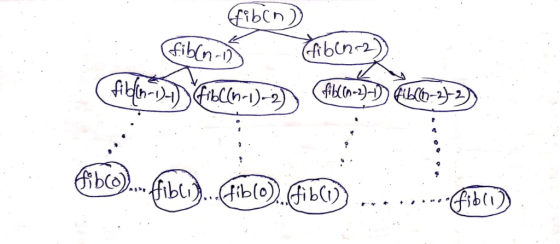
Subproblem graph will have (n+1) vertices.
Let's say v0 to vn...
for i=2 to n
vertex vi will have two leaving edges,....... one edge to the vertex vi-1 and one edge to the vertex vi-2
There'll be no edges leaving the vertiices v0 or vv1.
Therefore, subproblem graph will have 2n-2 edges totally...
Please comment if you've any doubt...
I'm ready to help you.
Add Answer to:
The Fibonacci numbers are defined by recurrence (3.22). Give an
O.n-time dynamic-programming algorithm to compute the...
Give a dynamic programming algorithm that runs within the time complexity. Also give the space complexity of the algorit...
 Give a dynamic programming algorithm that runs within the time
complexity. Also give the space complexity of the algorithm.
Please
Given a directed graph with non-negative integer edge weights, a pair of vertices s and t, and integers K and W, describe a dynamic-programming algorithm for deciding whether there exists a path from s to t that has total weight W and uses exactly K edges. Your algorithm should run in time O(nm)WK). Analyze the time- and space-complexity of your...
Give a dynamic programming algorithm that runs within the time
complexity. Also give the space complexity of the algorithm.
Please
Given a directed graph with non-negative integer edge weights, a pair of vertices s and t, and integers K and W, describe a dynamic-programming algorithm for deciding whether there exists a path from s to t that has total weight W and uses exactly K edges. Your algorithm should run in time O(nm)WK). Analyze the time- and space-complexity of your...
Using R code only 4. The Fibonacci numbers are the sequence of numbers defined by the...
 Using R code only
4. The Fibonacci numbers are the sequence of numbers defined by the linear recurrence equation Fn F-1 F-2 where F F2 1 and by convention Fo 0. For example, the first 8 Fibonacci numbers are 1, 1, 2, 3, 5, 8, 13, 21. (a) For a given n, compute the nth Fibonnaci number using a for loop (b) For a given n, compute the nth Fibonnaci number using a while loop Print the 15th Fibonacci number...
Using R code only
4. The Fibonacci numbers are the sequence of numbers defined by the linear recurrence equation Fn F-1 F-2 where F F2 1 and by convention Fo 0. For example, the first 8 Fibonacci numbers are 1, 1, 2, 3, 5, 8, 13, 21. (a) For a given n, compute the nth Fibonnaci number using a for loop (b) For a given n, compute the nth Fibonnaci number using a while loop Print the 15th Fibonacci number...
Viterbi algorithm We can use dynamic programming on a directed graph G = (V, E) for...
Viterbi algorithm We can use dynamic programming on a directed graph G = (V, E) for speech recognition. Each edge (u, v) in E is labeled with a sound s(u, v) from a finite set S of sounds. The labeled graph is a formal model of a person speaking a restricted language. Each path in the graph starting from a distinguished vertex v0 in V corresponds to a possible sequence of sounds produced by the model. The label of a...
Give pseudocode that performs the traceback to construct an LCS from a filled dynamic programming table...
Give pseudocode that performs the traceback to construct an LCS from a filled dynamic programming table without using the “arrows”, in O(n + m) time. 2. Suppose we are given a “chain” of n nodes as shown below. Each node i is “neighbors” with the node to its left and the node to its right (if they exist). An independent set of these nodes is a subset of the nodes such that no two of the chosen nodes are neighbors....
Problem 1: Dynamic Programming in DAG Let G(V,E), |V| = n, be a directed acyclic graph...
Problem 1: Dynamic Programming in DAG Let G(V,E), |V| = n, be a directed acyclic graph presented in adjacency list representation, where the vertices are labelled with numbers in the set {1, . . . , n}, and where (i, j) is and edge inplies i < j. Suppose also that each vertex has a positive value vi, 1 ≤ i ≤ n. Define the value of a path as the sum of the values of the vertices belonging to...
Could the running time of algorithm max_ind_set_improved() be improved by using dynamic programming or memoization? And...
Could the running time of algorithm max_ind_set_improved() be improved by using dynamic programming or memoization? And if so, which of the two approaches would be preferable? Justify your answer. def max_ind_set(nodes, edges): if len(nodes) <= 1: return len(nodes) node = nodes[0] # pick a node # case 1: node lies in independent set => remove neighbours as well nodes1 = [ n for n in nodes if n != node and (node, n) not in edges ] size1 = 1...
Give the specifications of a pseudo-polynomial time algorithm for Galactic Shortest Path. Hint: G...
 Hi, I'm confused about how to do this, any help is appreciated
thanks!
Give the specifications of a pseudo-polynomial time algorithm for Galactic Shortest Path. Hint: Given an instance of GSP such that G has n vertices and m edges, you may want to use a 5 dimensional m by n by n by L by R array.
Give the specifications of a pseudo-polynomial time algorithm for Galactic Shortest Path. Hint: Given an instance of GSP such that G has...
Hi, I'm confused about how to do this, any help is appreciated
thanks!
Give the specifications of a pseudo-polynomial time algorithm for Galactic Shortest Path. Hint: Given an instance of GSP such that G has n vertices and m edges, you may want to use a 5 dimensional m by n by n by L by R array.
Give the specifications of a pseudo-polynomial time algorithm for Galactic Shortest Path. Hint: Given an instance of GSP such that G has...
1 (15 pts) Implement recursive, memoized, and dynamic programming Fibonacci and study their performances using different...
 1 (15 pts) Implement recursive, memoized, and dynamic programming Fibonacci and study their performances using different problem instans You can choose to look at the perfor- mance by either timing the functions or counting the basic operations (in code) Provide your results below, and submit your code. Also, describe the pros and cons of your choice of performance metric Note: If you decide to use timing, the standard way to time an algorithm is to run the same problem 100...
My homework task is: Let a linear, binary, array A and two positives real numbers a and b, with a < b. Give a dynamic...
My homework task is: Let a linear, binary, array A and two positives real numbers a and b, with a < b. Give a dynamic programming algorithm using bottom-up approach, that splits table A to the minimum numbers of continuous sub-arrays, so that the percentage of units (1s) <= a, OR percentage of units (1s) >= b.. Analyze the run time of the algorithm. For example, with input A = [1; 0; 1; 1; 1; 0; 0; 1; 0; 0;...
Could the running time of algorithm max_ind_set_improved() be improved by using dynamic programmi...
Could the running time of algorithm max_ind_set_improved() be improved by using dynamic programming or memoization? And if so, which of the two approaches would be preferable? Justify your answer. def max_ind_set(nodes, edges): if len(nodes) <= 1: return len(nodes) node = nodes[0] # pick a node # case 1: node lies in independent set => remove neighbours as well nodes1 = [ n for n in nodes if n != node and (node, n) not in edges ] size1 = 1...
 Give a dynamic programming algorithm that runs within the time
complexity. Also give the space complexity of the algorithm.
Please
Given a directed graph with non-negative integer edge weights, a pair of vertices s and t, and integers K and W, describe a dynamic-programming algorithm for deciding whether there exists a path from s to t that has total weight W and uses exactly K edges. Your algorithm should run in time O(nm)WK). Analyze the time- and space-complexity of your...
Give a dynamic programming algorithm that runs within the time
complexity. Also give the space complexity of the algorithm.
Please
Given a directed graph with non-negative integer edge weights, a pair of vertices s and t, and integers K and W, describe a dynamic-programming algorithm for deciding whether there exists a path from s to t that has total weight W and uses exactly K edges. Your algorithm should run in time O(nm)WK). Analyze the time- and space-complexity of your...
 Using R code only
4. The Fibonacci numbers are the sequence of numbers defined by the linear recurrence equation Fn F-1 F-2 where F F2 1 and by convention Fo 0. For example, the first 8 Fibonacci numbers are 1, 1, 2, 3, 5, 8, 13, 21. (a) For a given n, compute the nth Fibonnaci number using a for loop (b) For a given n, compute the nth Fibonnaci number using a while loop Print the 15th Fibonacci number...
Using R code only
4. The Fibonacci numbers are the sequence of numbers defined by the linear recurrence equation Fn F-1 F-2 where F F2 1 and by convention Fo 0. For example, the first 8 Fibonacci numbers are 1, 1, 2, 3, 5, 8, 13, 21. (a) For a given n, compute the nth Fibonnaci number using a for loop (b) For a given n, compute the nth Fibonnaci number using a while loop Print the 15th Fibonacci number...
 Hi, I'm confused about how to do this, any help is appreciated
thanks!
Give the specifications of a pseudo-polynomial time algorithm for Galactic Shortest Path. Hint: Given an instance of GSP such that G has n vertices and m edges, you may want to use a 5 dimensional m by n by n by L by R array.
Give the specifications of a pseudo-polynomial time algorithm for Galactic Shortest Path. Hint: Given an instance of GSP such that G has...
Hi, I'm confused about how to do this, any help is appreciated
thanks!
Give the specifications of a pseudo-polynomial time algorithm for Galactic Shortest Path. Hint: Given an instance of GSP such that G has n vertices and m edges, you may want to use a 5 dimensional m by n by n by L by R array.
Give the specifications of a pseudo-polynomial time algorithm for Galactic Shortest Path. Hint: Given an instance of GSP such that G has...
 1 (15 pts) Implement recursive, memoized, and dynamic programming Fibonacci and study their performances using different problem instans You can choose to look at the perfor- mance by either timing the functions or counting the basic operations (in code) Provide your results below, and submit your code. Also, describe the pros and cons of your choice of performance metric Note: If you decide to use timing, the standard way to time an algorithm is to run the same problem 100...
Most questions answered within 3 hours.
-
Where is the error in this code sequence?
String s1 = "Hello";
String s2 = "ello";...
asked 10 months ago -
Financial data for Joel de Paris, Inc., for last year
follow:
Joel de Paris, Inc.
Balance...
asked 10 months ago -
Consider this reaction:
Al2(SO4)3 (aq)+ BaCl3
(aq) Al2Cl6 (aq)- +
3BaSO4(s) . What is the...
asked 10 months ago -
Suppose that Savneet is considering increasing her
recent random sample from 20 car rentals to 40...
asked 10 months ago -
Trucks arrive at an unloading terminal at an average rate of 120
per hour.
Trucks arrive...
asked 10 months ago -
Why are methanol and ethanol completely soluble in water while
octanol is not very little soluble....
asked 10 months ago -
A facilities manager at a university reads in a research report
that the mean amount of...
asked 10 months ago -
When the CuSO4 is rehydrated by adding water to the anhydrous
compound, is this an endothermic...
asked 10 months ago -
A ray of sunlight is passing from diamond into crown glass; the
angle of incidence is...
asked 10 months ago -
A block of mass 0.249 kg is placed on top of a light, vertical
spring of...
asked 10 months ago -
how do the kidneys compensate in the presences of acidosis
a) trigger hyperventilate
b) reserve acid...
asked 10 months ago -
Question 501 pts
The rental rate of capital to the firm increases. Which of the
following...
asked 10 months ago