1. You add 9.1 g of iron to 29.30 mL of water and observe that the...
1. You add 9.1 g of iron to 29.30 mL of water and observe that the volume of iron and water together is 30.46 mL . Calculate the density of iron.
Express your answer to two significant figures with the appropriate units.
2.
Since density depends on the mass and volume of an object, we need both of these values combined in the correct way to solve for density. Keep in mind that we may not be given the mass and volume directly, or the values may not be given in the units we want and we need to convert to the correct units before solving for density.
When converting between metric units, use the prefixes to help you determine the magnitude of a value. The prefix k indicates kilo, 1000. Therefore 1000 g= 1 kg.
A 19.0 kg iron weightlifting plate has a volume of 2410 cm3 . What is the density of the iron plate in g/cm3?
Express your answer in grams per cubic centimeter to three significant figures.
Homework Answers
Request Answer!
We need at least 10 more requests to produce the answer.
0 / 10 have requested this problem solution
The more requests, the faster the answer.
Add Answer to:
1. You add 9.1 g of iron to 29.30 mL of water and observe that
the...
Part B You add 6.8 g of iron to 29 60 mL of water and observe...
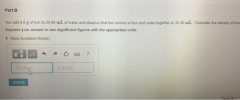 Part B You add 6.8 g of iron to 29 60 mL of water and observe that the volume of iron and water together is 30.46 mL Calculate the density of iron Express your answer to two significant figures with the appropriate units. View Available Hint(s) Valu Units Submit
You add 5.4 g iron to 21.80 mL of water and observe that the volume of iron and water together is 22.49 mL. Calcula...
 You add 5.4 g iron to 21.80 mL of water and observe that the volume of iron and water together is 22.49 mL. Calculate the density of iron. Express your answer to two significant figures with the appropriate units. View Available Hint(s) HA Units Value
You add 5.4 g iron to 21.80 mL of water and observe that the volume of iron and water together is 22.49 mL. Calculate the density of iron. Express your answer to two significant figures...
You add 5.4 g iron to 21.80 mL of water and observe that the volume of iron and water together is 22.49 mL. Calculate the density of iron. Express your answer to two significant figures with the appropriate units. View Available Hint(s) HA Units Value
You add 5.4 g iron to 21.80 mL of water and observe that the volume of iron and water together is 22.49 mL. Calculate the density of iron. Express your answer to two significant figures...
Aluminum has a density of 2.70 g/mL2.70 g/mL. Calculate the mass (in grams) of a piece...
Aluminum has a density of 2.70 g/mL2.70 g/mL. Calculate the mass (in grams) of a piece of aluminum having a volume of 267 mLmL . Express your answer to three significant figures. Iron has a density of 7.86 g/cm37.86 g/cm3 (1 cm3=1 mL1 cm3=1 mL). Calculate the volume (in dLdL) of a piece of iron having a mass of 4.94 kgkg . Note that the density is provided in different units of volume and mass than the desired units of...
You add 4.8 g iron to 21.30 mL of water and observe that the volume of...
You add 4.8 g iron to 21.30 mL of water and observe that the volume of iron and water together is 21.91 mL . Calculate the density of iron. I need the value and units.
You add 8.0 g of iron to 22.10 mL of water and observe that the volume...
You add 8.0 g of iron to 22.10 mL of water and observe that the volume of iron and water together is 23.12 mL . Calculate the density of iron.
You add 6.1 g of iron to 23.60 mL of water and observe that the volume...
You add 6.1 g of iron to 23.60 mL of water and observe that the volume of iron and water together is 24.38 mL . Calculate the density of iron.
Part C Iron has a density of 7.86 g/cm (1 cm = 1 mL). Calculate the...
 Part C Iron has a density of 7.86 g/cm (1 cm = 1 mL). Calculate the volume (in dL) of a piece of iron having a mass of 4.25 kg . Note that the density is provided in different units of volume and mass than the desired units of volume (dL) and the given units of mass (kg). You will need to express the density in kg/dL (1 cm = 1 mL) before calculating the volume for the piece of...
You add 4.3 grams of lead to 22.71 mL of water and observe that the volume...
You add 4.3 grams of lead to 22.71 mL of water and observe that the volume of lead and water together is 23.09 mL, Calculate the density of the lead. Express your answer to three significant figures.
When 25 g of the unknown metal were added, the water was displaced 3.50 mL. Calculate...
When 25 g of the unknown metal were added, the water was displaced 3.50 mL. Calculate the density of the unknown metal. Remember, density = mass/volume. Express your answer as g/cm3 ( 1 mL = 1 cm3). Choose the closest answer. How many significant figures should be shown in the final answer?
10 10 10-6 In micro You can use these relationships to create equalities and conversion factors....
 10 10 10-6 In micro You can use these relationships to create equalities and conversion factors. For example, the prefix dea is denoted with a d and is associated with a factor of 10- If you were to apply this profix to liter, you would obtain the equality 1 dL -10 L. This could be used to create two conversion factors: 1 dL 10-1 L 10-1 The conversion factor used will depend on whether the final unit should be in...
 Part B You add 6.8 g of iron to 29 60 mL of water and observe that the volume of iron and water together is 30.46 mL Calculate the density of iron Express your answer to two significant figures with the appropriate units. View Available Hint(s) Valu Units Submit
 You add 5.4 g iron to 21.80 mL of water and observe that the volume of iron and water together is 22.49 mL. Calculate the density of iron. Express your answer to two significant figures with the appropriate units. View Available Hint(s) HA Units Value
You add 5.4 g iron to 21.80 mL of water and observe that the volume of iron and water together is 22.49 mL. Calculate the density of iron. Express your answer to two significant figures...
You add 5.4 g iron to 21.80 mL of water and observe that the volume of iron and water together is 22.49 mL. Calculate the density of iron. Express your answer to two significant figures with the appropriate units. View Available Hint(s) HA Units Value
You add 5.4 g iron to 21.80 mL of water and observe that the volume of iron and water together is 22.49 mL. Calculate the density of iron. Express your answer to two significant figures...
 Part C Iron has a density of 7.86 g/cm (1 cm = 1 mL). Calculate the volume (in dL) of a piece of iron having a mass of 4.25 kg . Note that the density is provided in different units of volume and mass than the desired units of volume (dL) and the given units of mass (kg). You will need to express the density in kg/dL (1 cm = 1 mL) before calculating the volume for the piece of...
 10 10 10-6 In micro You can use these relationships to create equalities and conversion factors. For example, the prefix dea is denoted with a d and is associated with a factor of 10- If you were to apply this profix to liter, you would obtain the equality 1 dL -10 L. This could be used to create two conversion factors: 1 dL 10-1 L 10-1 The conversion factor used will depend on whether the final unit should be in...
Most questions answered within 3 hours.
-
Where is the error in this code sequence?
String s1 = "Hello";
String s2 = "ello";...
asked 11 months ago -
Financial data for Joel de Paris, Inc., for last year
follow:
Joel de Paris, Inc.
Balance...
asked 11 months ago -
Consider this reaction:
Al2(SO4)3 (aq)+ BaCl3
(aq) Al2Cl6 (aq)- +
3BaSO4(s) . What is the...
asked 11 months ago -
Suppose that Savneet is considering increasing her
recent random sample from 20 car rentals to 40...
asked 11 months ago -
Trucks arrive at an unloading terminal at an average rate of 120
per hour.
Trucks arrive...
asked 11 months ago -
Why are methanol and ethanol completely soluble in water while
octanol is not very little soluble....
asked 11 months ago -
A facilities manager at a university reads in a research report
that the mean amount of...
asked 11 months ago -
When the CuSO4 is rehydrated by adding water to the anhydrous
compound, is this an endothermic...
asked 11 months ago -
A ray of sunlight is passing from diamond into crown glass; the
angle of incidence is...
asked 11 months ago -
A block of mass 0.249 kg is placed on top of a light, vertical
spring of...
asked 11 months ago -
how do the kidneys compensate in the presences of acidosis
a) trigger hyperventilate
b) reserve acid...
asked 11 months ago -
Question 501 pts
The rental rate of capital to the firm increases. Which of the
following...
asked 11 months ago