Customerid is key in both Orders O and Customers C tables. Complete below to select records...
-
Customerid is key in both Orders O and Customers C tables. Complete below to select records that exists in both tables.
SELECT O.orderid, O.desc, C.name
FROM Orders O
Homework Answers
SELECT O.orderid, O.desc, C.name
FROM Orders O, Customers C
WHERE O.Customerid=C.Customerid;
 SELECT O.orderid, O.desc, C.name
FROM Orders O, Customers C
WHERE O.Customerid=C.Customerid;
SELECT O.orderid, O.desc, C.name
FROM Orders O, Customers C
WHERE O.Customerid=C.Customerid;Add Answer to:
Customerid is key in both Orders O and Customers C
tables. Complete below to select records...
1. Select the correctly written query. SELECT ALL FROM CUSTOMERS WHERE 10243 IS CUSTOMERID PULL *...
1. Select the correctly written query. SELECT ALL FROM CUSTOMERS WHERE 10243 IS CUSTOMERID PULL * FROM CUSTOMERS WHERE CUSTOMERID = 10243 GET LIST FROM CUSTOMERS SELECT * FROM CUSTOMERS WHERE CUSTOMERID = 10243 2. The GROUP BY clause can be used in place of a JOIN clause in a SQL query? True False 3. The number of join conditions is always equal to the number of tables being joined _____ one. Plus Divided by Times Minus
Below is the database schema for a company. Primary keys are underlined. Customers (CustomerID, CompanyName, Phone,...
Below is the database schema for a company. Primary keys are underlined. Customers (CustomerID, CompanyName, Phone, BalanceDue) Oders (Orderid, orderdate, customerid, freightamount) Orderdetails (oderid, productid, qtyordered, price) Products (productid, productname, qtyinstock, suggestedprice, minstocklevel) Given this SQL statement: Select * From Customers Inner Join Orders on Orders.CustomerID=Customers.CustomerID Where Orders.CustomerID is Null; Which of the following statement is correct? It is a SQL select statement that will list the ProductName for all products where the Qtyinstock is less than the total QtyOrdered...
o Customer Y CustomerID CustomerName Street City State Sales SalesinvoiceID SaleDate Sales Person Customerid Sales_inventory *...
 o Customer Y CustomerID CustomerName Street City State Sales SalesinvoiceID SaleDate Sales Person Customerid Sales_inventory * SalesinvoicelD 3 Itemid Quantity SoldPrice Inventory ItemID Description Color VendorID QuantityOnHand ListPrice 95) 95) Referring to the diagram above, which tables would need to be referenced in the FROM statement for the SELECT statement of "SELECT s.CustomeriD, s.SaleDate, s.SalesinvoicelD, SUM(Quantity SoldPrice) AS Order Total"? A) Sales AS s, Sale_Inventory B) Sale_Inventory, Inventory C) Customer, Sales AS s, Sale_Inventory, Inventory. D) Sales AS s, Inventory
Display all customers. If a customer has placed any orders, also display the highest..... Tables: CREATE TABLE Sales.Cu...
 Display all customers. If a customer has placed any orders, also
display the highest.....
Tables:
CREATE TABLE Sales.Customers
(
CustomerId
INT
NOT NULL
IDENTITY,
CustomerName
NVARCHAR(50)
NOT NULL,
StreetAddress NVARCHAR(50) NULL,
City
NVARCHAR(20)
NULL,
[State]
NVARCHAR(20)
NULL,
PostalCode
NVARCHAR(10)
NULL,
Country
NVARCHAR(20)
NULL,
Contact
NVARCHAR(50)
NULL,
Email
NVARCHAR(50)
NULL,
CONSTRAINT PK_Customers PRIMARY KEY(CustomerId)
);
CREATE TABLE HR.Employees
(
EmployeeId
INT
NOT NULL
IDENTITY,
FirstName
NVARCHAR(50) NOT
NULL,
LastName
NVARCHAR(50)
NOT NULL,
BirthDate DATE
NOT NULL,
HireDate
DATE
NOT NULL,
HomeAddress...
Display all customers. If a customer has placed any orders, also
display the highest.....
Tables:
CREATE TABLE Sales.Customers
(
CustomerId
INT
NOT NULL
IDENTITY,
CustomerName
NVARCHAR(50)
NOT NULL,
StreetAddress NVARCHAR(50) NULL,
City
NVARCHAR(20)
NULL,
[State]
NVARCHAR(20)
NULL,
PostalCode
NVARCHAR(10)
NULL,
Country
NVARCHAR(20)
NULL,
Contact
NVARCHAR(50)
NULL,
Email
NVARCHAR(50)
NULL,
CONSTRAINT PK_Customers PRIMARY KEY(CustomerId)
);
CREATE TABLE HR.Employees
(
EmployeeId
INT
NOT NULL
IDENTITY,
FirstName
NVARCHAR(50) NOT
NULL,
LastName
NVARCHAR(50)
NOT NULL,
BirthDate DATE
NOT NULL,
HireDate
DATE
NOT NULL,
HomeAddress...
Ram furnitures produces chairs and tables in accordance with job orders from customers. Given below are...
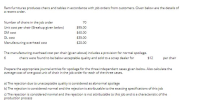 Ram furnitures produces chairs and tables in accordance with job orders from customers. Given below are the details of a recent order. Number of chairs in the job order Unit cost per chair (Breakup given below) DM COSE DL cost Manufacturing overhead cost 70 $95.00 $40.00 $35.00 $20.00 The manufacturing overhead cost per chair (given above) includes a provision for normal spoilage. 6 chairs were found to be below acceptable quality and sold to a scrap dealer for $12 per...
QUESTION 5 Suppose there are two tables: A and B. and we run command SELECT *...
QUESTION 5 Suppose there are two tables: A and B. and we run command SELECT * from A LEFT JOIN B on A.orderid = B.orderid. What would be the code output? only the records from table A where tables A and B have the same orderid only the records from table B where tables A and B have the same orderid the complete set of records from table A, along with the matching records (depending on the availability) from table...
List the names of all customers who bought both envelopes and labels (either in the same order or different orders).please give me an sql query for this question and i have tables as follows customer(...
List the names of all customers who bought both envelopes and labels (either in the same order or different orders).please give me an sql query for this question and i have tables as follows customer(customer_name,address,zipcode,customer_id,state),office_supplies(item_name,item_id,cost,category),orders(order_id,date,customer_id) order_details(quantity,order_id,item_id)
Customer (CustomerId, CustomerName) Employee (EmployeeId, EmployeeName, Salary, SupervisorId) Product(ProductId, ProductName, ListPrice) Orders (OrderId, OrderDate, CustomerId, EmployeeId,...
Customer (CustomerId, CustomerName) Employee (EmployeeId, EmployeeName, Salary, SupervisorId) Product(ProductId, ProductName, ListPrice) Orders (OrderId, OrderDate, CustomerId, EmployeeId, Total) OrderedProduct (OrderId, ProductId, Quantity, Price) Write the code to complete the methods in OrderJDBC.java (look for TODO items). <---**IN BOLD** throughout code. /* OrderJDBC.java - A JDBC program for accessing and updating an order database on MySQL. */ import java.io.File; import java.math.BigDecimal; import java.sql.Connection; import java.sql.DriverManager; import java.sql.PreparedStatement; import java.sql.ResultSet; import java.sql.ResultSetMetaData; import java.sql.SQLException; import java.sql.Statement; import java.util.Scanner; /** * An application for...
Which one below is a negative gradient? Select one: O A о в. O C CX Incorrect D. Both A and B E. Both B and C Your...
 Which one below is a negative gradient? Select one: O A о в. O C CX Incorrect D. Both A and B E. Both B and C Your answer is incorrect. The correct answer is:
Which one below is a negative gradient? Select one: O A о в. O C CX Incorrect D. Both A and B E. Both B and C Your answer is incorrect. The correct answer is:
Which one below is a negative gradient? Select one: O A о в. O C CX Incorrect D. Both A and B E. Both B and C Your answer is incorrect. The correct answer is:
BONUS QUESTION: Suppose you have two tables, EMPLOYEES with primary key employee_ID, and DEPARTMENTS with primary...
BONUS QUESTION: Suppose you have two tables, EMPLOYEES with primary key employee_ID, and DEPARTMENTS with primary key department_ID. Assume each department may have many employees, but each employee is only assigned one department. What would be the correct SQL syntax for retrieving data from both tables? (HINT: You must find out what is the foreign key) A. SELECT employee_ID, employee_name, department_ID, department_location FROM Employees JOIN Departments ON Employees.employee_ID = Departments.employee_ID; B. SELECT employee_ID, employee_name, department_ID, department_location FROM Employees JOIN Departments...
 o Customer Y CustomerID CustomerName Street City State Sales SalesinvoiceID SaleDate Sales Person Customerid Sales_inventory * SalesinvoicelD 3 Itemid Quantity SoldPrice Inventory ItemID Description Color VendorID QuantityOnHand ListPrice 95) 95) Referring to the diagram above, which tables would need to be referenced in the FROM statement for the SELECT statement of "SELECT s.CustomeriD, s.SaleDate, s.SalesinvoicelD, SUM(Quantity SoldPrice) AS Order Total"? A) Sales AS s, Sale_Inventory B) Sale_Inventory, Inventory C) Customer, Sales AS s, Sale_Inventory, Inventory. D) Sales AS s, Inventory
 Display all customers. If a customer has placed any orders, also
display the highest.....
Tables:
CREATE TABLE Sales.Customers
(
CustomerId
INT
NOT NULL
IDENTITY,
CustomerName
NVARCHAR(50)
NOT NULL,
StreetAddress NVARCHAR(50) NULL,
City
NVARCHAR(20)
NULL,
[State]
NVARCHAR(20)
NULL,
PostalCode
NVARCHAR(10)
NULL,
Country
NVARCHAR(20)
NULL,
Contact
NVARCHAR(50)
NULL,
Email
NVARCHAR(50)
NULL,
CONSTRAINT PK_Customers PRIMARY KEY(CustomerId)
);
CREATE TABLE HR.Employees
(
EmployeeId
INT
NOT NULL
IDENTITY,
FirstName
NVARCHAR(50) NOT
NULL,
LastName
NVARCHAR(50)
NOT NULL,
BirthDate DATE
NOT NULL,
HireDate
DATE
NOT NULL,
HomeAddress...
Display all customers. If a customer has placed any orders, also
display the highest.....
Tables:
CREATE TABLE Sales.Customers
(
CustomerId
INT
NOT NULL
IDENTITY,
CustomerName
NVARCHAR(50)
NOT NULL,
StreetAddress NVARCHAR(50) NULL,
City
NVARCHAR(20)
NULL,
[State]
NVARCHAR(20)
NULL,
PostalCode
NVARCHAR(10)
NULL,
Country
NVARCHAR(20)
NULL,
Contact
NVARCHAR(50)
NULL,
Email
NVARCHAR(50)
NULL,
CONSTRAINT PK_Customers PRIMARY KEY(CustomerId)
);
CREATE TABLE HR.Employees
(
EmployeeId
INT
NOT NULL
IDENTITY,
FirstName
NVARCHAR(50) NOT
NULL,
LastName
NVARCHAR(50)
NOT NULL,
BirthDate DATE
NOT NULL,
HireDate
DATE
NOT NULL,
HomeAddress...
 Ram furnitures produces chairs and tables in accordance with job orders from customers. Given below are the details of a recent order. Number of chairs in the job order Unit cost per chair (Breakup given below) DM COSE DL cost Manufacturing overhead cost 70 $95.00 $40.00 $35.00 $20.00 The manufacturing overhead cost per chair (given above) includes a provision for normal spoilage. 6 chairs were found to be below acceptable quality and sold to a scrap dealer for $12 per...
 Which one below is a negative gradient? Select one: O A о в. O C CX Incorrect D. Both A and B E. Both B and C Your answer is incorrect. The correct answer is:
Which one below is a negative gradient? Select one: O A о в. O C CX Incorrect D. Both A and B E. Both B and C Your answer is incorrect. The correct answer is:
Which one below is a negative gradient? Select one: O A о в. O C CX Incorrect D. Both A and B E. Both B and C Your answer is incorrect. The correct answer is:
Most questions answered within 3 hours.
-
Where is the error in this code sequence?
String s1 = "Hello";
String s2 = "ello";...
asked 10 months ago -
Financial data for Joel de Paris, Inc., for last year
follow:
Joel de Paris, Inc.
Balance...
asked 10 months ago -
Consider this reaction:
Al2(SO4)3 (aq)+ BaCl3
(aq) Al2Cl6 (aq)- +
3BaSO4(s) . What is the...
asked 10 months ago -
Suppose that Savneet is considering increasing her
recent random sample from 20 car rentals to 40...
asked 10 months ago -
Trucks arrive at an unloading terminal at an average rate of 120
per hour.
Trucks arrive...
asked 10 months ago -
Why are methanol and ethanol completely soluble in water while
octanol is not very little soluble....
asked 10 months ago -
A facilities manager at a university reads in a research report
that the mean amount of...
asked 10 months ago -
When the CuSO4 is rehydrated by adding water to the anhydrous
compound, is this an endothermic...
asked 10 months ago -
A ray of sunlight is passing from diamond into crown glass; the
angle of incidence is...
asked 10 months ago -
A block of mass 0.249 kg is placed on top of a light, vertical
spring of...
asked 10 months ago -
how do the kidneys compensate in the presences of acidosis
a) trigger hyperventilate
b) reserve acid...
asked 10 months ago -
Question 501 pts
The rental rate of capital to the firm increases. Which of the
following...
asked 10 months ago