What is the output of the following Java program? class Food { void flavor() {...
What is the output of the following Java program?
class Food {
void flavor() { System.out.println("bland");
}
}
class Pepper extends Food {
void flavor() { System.out.println("spicy");
}
}
public class Lunch {
public static void main(String[] args) {
Pepper lunch = new
Food();
lunch.flavor();
}
}
Select one:
a. bland
b. bland
spicy
c. spicy
d. the program does not compile
e. no output
Homework Answers
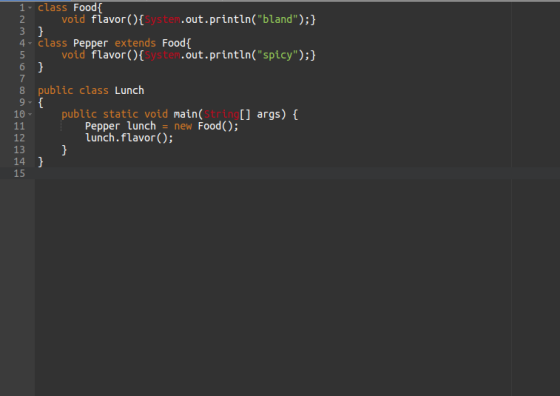
output:
D. The program does not compile
explanation:
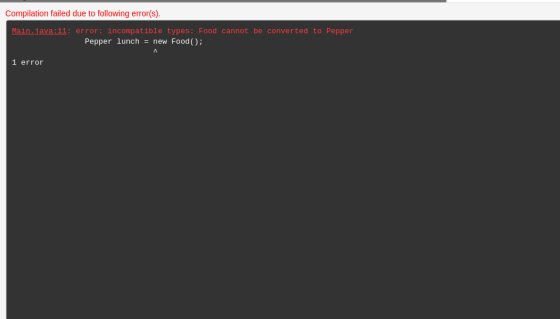
In the above code the variable lunch was initialized of child class that is Pepper and object of parent type that is Food.which is incompatable due to type difference.
The output will be like this:
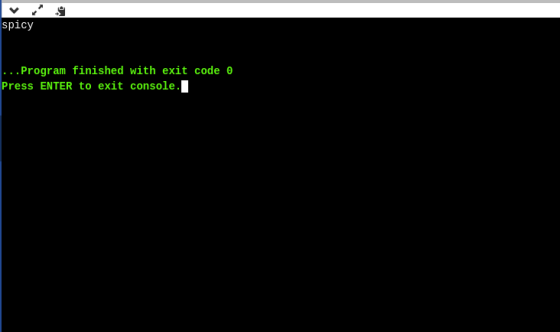
If you change object Food to Pepper the output will be : spicy
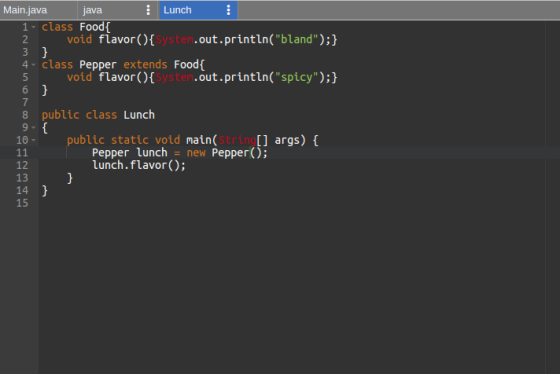
Code for that:
class Food {
void flavor() { System.out.println("bland");
}
}
class Pepper extends Food {
void flavor() { System.out.println("spicy");
}
}
public class Lunch {
public static void main(String[] args) {
Pepper lunch = new
Pepper();
lunch.flavor();
}
}
Any queries feel free to ask
Please give your positive feedback
Thank you
We were unable to transcribe this image
Compilation failed due to following error(s). Main.java:11: error: incompatible types: Food cannot be converted to Pepper Pepper lunch = new Food(); 1 error
We were unable to transcribe this image
spicy ... Program finished with exit code o Press ENTER to exit console.
Add Answer to:
What is the output of the following Java program?
class Food {
void flavor() {...
1. What does a Java compiler do? Select one: a. Runs Java programs b. Translates byte...
1. What does a Java compiler do? Select one: a. Runs Java programs b. Translates byte code in ".class" files into machine language c. Translates source code in ".class" files into machine language d. Translates source code in ".java" files into Java byte code in ".class" files e. Translates source code in ".java" files into machine language 2. A subclass will _____ one superclass. Select one: a. abstract b. extend c. implement d. inherit e. override 3. Consider the following...
1) Consider the following Java program: 1 public class HelloWorld { 2 // My first program!...
1) Consider the following Java program: 1 public class HelloWorld { 2 // My first program! 3 public static void main(String[] args) { 4 System.out.println("Hello, World!"); 5 } 6 } What is on line 1? a. a variable declaration b. a statement c. a method (subroutine) definition d. a comment e. a class definition 2) Which one of the following does NOT describe an array? a. It can be used in a for-each loop. b. It has a numbered sequence...
2016 points output of following Java Program? public class Base { public final void show() {...
 2016 points output of following Java Program? public class Base { public final void show() { . System.out.println("Base::show() called"); public class Derived extends Base { public void show() { System.out.println("Derived::show() called"); } e lor rested in order public class Main { ects from and public static void main(String[] args) { Base b = new Derived(); b.show();
What is the output for the following program codes? a) [ 0.5 Mark ] class A...
What is the output for the following program codes? a) [ 0.5 Mark ] class A { int i; } class B extends A { int j; void display() { super.i = j + 1; System.out.println(j + " " + i); }} class inheritance { public static void main(String args[]) { B obj = new B(); obj.i=1; obj.j=2; obj.display(); }} OUTPUT: b) [ 0.5 Mark ] class Parent { public void getBike(){ System.out.println("Suzuki Bike"); }} class Child extends Parent {...
What is the output of this program? class A { public int i; private int j;...
What is the output of this program? class A { public int i; private int j; } class B extends A { void display() { super.j = super.i + 1; System.out.println(super.i + " " + super.j); } } class Inheritance { public static void main(String args[]) { B obj = new B(); obj.i=1; obj.j=2; obj.display(); } } Java language!! // include explanation!
What will be the output of the following Java code? class Output { public static void...
What will be the output of the following Java code? class Output { public static void main(String args[]) { boolean a = true; boolean b = false; boolean c = a ^ b; System.out.println(!c); } } a) 0 b) 1 c) false d) true
What is the output of running class C? The three Java classes are in separate Java...
 What is the output of running class C? The three Java classes are in separate Java files in the same directory (or in the same package). class A { public AO { System.out.println("The default constructor of A"); } // end A constructor } // end class A class B extends A { public BCString s) { System.out.println(s); } // end B constructor } // end class B public class C { public static void main(String[] args) { B b =...
What is the output of the following code? class parent { public void someFunction() { System.out.println("Parent...
What is the output of the following code? class parent { public void someFunction() { System.out.println("Parent Function"); } } public class child extends parent { public void someFunction() { System.out.println("Child Function"); } public static void main(String args) { parent p1 = new parent(); parent p2 = new child(); child c1 = new child(); p1.someFunction(); p2.someFunction(); c1.someFunction(); } }
The method m() of class B overrides the m() method of class A, true or false?...
 The method m() of class B overrides the m() method of class A, true or false? class A int i; public void maint i) { this.is } } class B extends A{ public void m(Strings) { 1 Select one: True False For the following code, which statement is correct? public class Test { public static void main(String[] args) { Object al = new AC: Object a2 = new Object(); System.out.println(al); System.out.println(a): } } class A intx @Override public String toString()...
Java questions QUESTION 8 Assume the following classes are each defined in their own java files...
 Java questions
QUESTION 8 Assume the following classes are each defined in their own java files and compile public class A public void display { System.out.println("A's display"); public class B extends A{ public void display { System.out.println("B's display"); public class C extends A public void display { System.out.println("C's display"); public class D { public static void main(String args) { 3: int i = ((int)(Moth.random(* 10)) if (i == 0) a = new BO: else if (i == 1) a =...
Java questions
QUESTION 8 Assume the following classes are each defined in their own java files and compile public class A public void display { System.out.println("A's display"); public class B extends A{ public void display { System.out.println("B's display"); public class C extends A public void display { System.out.println("C's display"); public class D { public static void main(String args) { 3: int i = ((int)(Moth.random(* 10)) if (i == 0) a = new BO: else if (i == 1) a =...
 2016 points output of following Java Program? public class Base { public final void show() { . System.out.println("Base::show() called"); public class Derived extends Base { public void show() { System.out.println("Derived::show() called"); } e lor rested in order public class Main { ects from and public static void main(String[] args) { Base b = new Derived(); b.show();
 What is the output of running class C? The three Java classes are in separate Java files in the same directory (or in the same package). class A { public AO { System.out.println("The default constructor of A"); } // end A constructor } // end class A class B extends A { public BCString s) { System.out.println(s); } // end B constructor } // end class B public class C { public static void main(String[] args) { B b =...
 The method m() of class B overrides the m() method of class A, true or false? class A int i; public void maint i) { this.is } } class B extends A{ public void m(Strings) { 1 Select one: True False For the following code, which statement is correct? public class Test { public static void main(String[] args) { Object al = new AC: Object a2 = new Object(); System.out.println(al); System.out.println(a): } } class A intx @Override public String toString()...
 Java questions
QUESTION 8 Assume the following classes are each defined in their own java files and compile public class A public void display { System.out.println("A's display"); public class B extends A{ public void display { System.out.println("B's display"); public class C extends A public void display { System.out.println("C's display"); public class D { public static void main(String args) { 3: int i = ((int)(Moth.random(* 10)) if (i == 0) a = new BO: else if (i == 1) a =...
Java questions
QUESTION 8 Assume the following classes are each defined in their own java files and compile public class A public void display { System.out.println("A's display"); public class B extends A{ public void display { System.out.println("B's display"); public class C extends A public void display { System.out.println("C's display"); public class D { public static void main(String args) { 3: int i = ((int)(Moth.random(* 10)) if (i == 0) a = new BO: else if (i == 1) a =...
Most questions answered within 3 hours.
-
Where is the error in this code sequence?
String s1 = "Hello";
String s2 = "ello";...
asked 10 months ago -
Financial data for Joel de Paris, Inc., for last year
follow:
Joel de Paris, Inc.
Balance...
asked 10 months ago -
Consider this reaction:
Al2(SO4)3 (aq)+ BaCl3
(aq) Al2Cl6 (aq)- +
3BaSO4(s) . What is the...
asked 10 months ago -
Suppose that Savneet is considering increasing her
recent random sample from 20 car rentals to 40...
asked 10 months ago -
Trucks arrive at an unloading terminal at an average rate of 120
per hour.
Trucks arrive...
asked 10 months ago -
Why are methanol and ethanol completely soluble in water while
octanol is not very little soluble....
asked 10 months ago -
A facilities manager at a university reads in a research report
that the mean amount of...
asked 10 months ago -
When the CuSO4 is rehydrated by adding water to the anhydrous
compound, is this an endothermic...
asked 10 months ago -
A ray of sunlight is passing from diamond into crown glass; the
angle of incidence is...
asked 10 months ago -
A block of mass 0.249 kg is placed on top of a light, vertical
spring of...
asked 10 months ago -
how do the kidneys compensate in the presences of acidosis
a) trigger hyperventilate
b) reserve acid...
asked 10 months ago -
Question 501 pts
The rental rate of capital to the firm increases. Which of the
following...
asked 10 months ago