Glucose is a simple sugar and a molecular compound. A concentrated sample of an aqueous glucose...
- Glucose is a simple sugar and a molecular compound. A concentrated sample of an aqueous glucose (C6H12O6, M= 180.16 g/mol) solution has a density of 1.23 g/mLand contains 58.0 % glucose by mass.
- Write an equation for the dissolution of glucose in water.
b) Does this solution conduct an electric current? Explain.
[No]
c) What is the molarity of this glucose solution?
[3.96 M]
- Calculate the number of glucose molecules contained in 1 mL of this solution.
Homework Answers
lets tackle this questions one by one
A. equation for dissolution of glucose in water
C6H12O6 (s) + H2O (l) -------> C6H12O6 (aq)
since glucose is not ionic in nature and is infact covalent while dissolution it does not dissociates into the ions.
B. aqueous solution of glucose does not conduct electricity
any aqueous solution conducts electricity because it has ions in it but glucose when dissolved in water does not dissociates into the ions since the bonds in glucose are covalent in nature
so glucose does not conduct electricity
C. molarity of e glucose solution
since we know the molarity is
molarity = 
since it contains 58% glucose by mass
lets consider this as 100 gm solution
so the mass of glucose is 58gm (0.058kg)
mass of water = (100-58)
=42 gm (0.042kg)
to calculate molarity we need to know the moles of solute i.e. moles of glucose
moles of glucose = mass of glucose / molar mass of glucose
= 58gm/ 180.16 gm/mol
=0.3216 moles of glucose
to calculate volume of solution in literes
volume = mass/density
= 100g/1.23 moles
=81.30 ml
=0.0813 L
so since the molarity is=
=0.3216/0.0813
=3.96 molar
hence molarity of this solution is 3.96 .
D.
calculate no of glucose molecule in 1 ml of this solution
since 1 L of this solution contains 3.96 moles
so 1 ml will contain 3.96/1000
0.00396 moles
(since 1 L =1000 ml )
0.00396* 6.022*1027 (avogadros no)
2  1021
molecules are present
1021
molecules are present
i hope this helps if you have any query or want more detailed explaination feel free to ask in the comment section below.
noofmoleso f solute volumeofsolutioninliters
noofmoleso f solute volumeofsolutioninliters
We were unable to transcribe this image
noofmoleso f solute volumeofsolutioninliters
noofmoleso f solute volumeofsolutioninliters
We were unable to transcribe this image
Add Answer to:
Glucose is a simple sugar and a molecular compound. A
concentrated sample of an aqueous glucose...
1. Glucose (C6H12O6, M= 180.16 g/mol) solutions are commercially available. A concentrated sample of an aqueous...
1. Glucose (C6H12O6, M= 180.16 g/mol) solutions are commercially available. A concentrated sample of an aqueous glucose solution has a density of 1.25 g/mL and contains 55.0 % glucose by mass at 20 °C a) What is the molarity of this glucose solution? b) What is the molality of this solution? c) What is the mole fraction of glucose in this solution?
A 0.050-mol sample of this compound weighs 940 g. The molecular formul is , and 34.1%...
 A 0.050-mol sample of this compound weighs 940 g. The molecular formul is , and 34.1% oxygen. The molecular formula of this compound 3. A particular compound contains, by mass, 25.5% carbon, 40.4% fluo 4. Calculate the number of moles of sulfuric acid in 2.00 L of 18.5 M H2SO4, concentrated sulfuric acid. 5. Determine the molarity of 0.650 L solution containing 0.356 mol of CoCl2 6. Determine the molarity of 0.450 L solution containing 2.35 g of CoSO4. (FM155)...
An aqueous solution of glucose is 17.5% C6H12O6 by mass and has a density of 1.10...
An aqueous solution of glucose is 17.5% C6H12O6 by mass and has a density of 1.10 g/mL. What is the molarity and molality of the solution? What is the mole fraction of glucose?
Glucose solutions used for intravenous medical applications are typically 5.00 % (m/m) Glucose dissolved in water....
Glucose solutions used for intravenous medical applications are typically 5.00 % (m/m) Glucose dissolved in water. What is the molarity associated with a typical 5.00 % Glucose solution. Molar Mass (Glucose) = 180.16 g/mol; Density of normal glucose solution = 1.01 g/mL 0.280 M b) 0.364 M c) 2.75 M d) 3.57 M e) 9.09 M
A solution prepared by dissolving 90.0 mg of a sugar (a molecular compound and a nonelectrolyte) in...
A solution prepared by dissolving 90.0 mg of a sugar (a molecular compound and a nonelectrolyte) in 1.00 g of water froze at -0.930°C. What is the molar mass of this sugar (g/mol)? The value of Kf is 1.86°C/m.
A solution prepared by dissolving 513 mg of a sugar (a molecular compound and a nonelectrolyte)...
A solution prepared by dissolving 513 mg of a sugar (a molecular compound and a nonelectrolyte) in 1.00 g of water froze at -2.79 °C. What is the molar mass of this sugar? The value of Kf is 1.86°C/m. Answer in g/mol.
Fructose, which is the predominant sugar in fruit juice, contains exactly 368 Cal for 100 grams o...
 Fructose, which is the predominant sugar in fruit juice, contains exactly 368 Cal for 100 grams of fructose. Aglass with 296 mL (10.fl oz.) of apple juice has 180. Cal. If 150. of those Cal are from fructose, what is the molarity of the fructose (180.16 g/mol) in the juice solution? Assume all numbers are significant to the ones place. M fructose
Fructose, which is the predominant sugar in fruit juice, contains exactly 368 Cal for 100 grams of fructose....
Fructose, which is the predominant sugar in fruit juice, contains exactly 368 Cal for 100 grams of fructose. Aglass with 296 mL (10.fl oz.) of apple juice has 180. Cal. If 150. of those Cal are from fructose, what is the molarity of the fructose (180.16 g/mol) in the juice solution? Assume all numbers are significant to the ones place. M fructose
Fructose, which is the predominant sugar in fruit juice, contains exactly 368 Cal for 100 grams of fructose....
26. What would be the Molarity of an aqueous solution that has a mole fraction of...
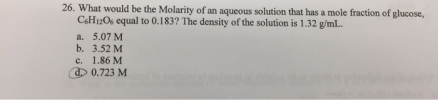 26. What would be the Molarity of an aqueous solution that has a mole fraction of glucose, C6H12O6 equal to 0.183? The density of the solution is 1.32 g/mL. a. 5.07 M b. 3.52 M c. 1.86 M do 0.723 M
An aqueous solution has a density of 1.68 g/mL and contains 80.9% sugar by mass. How...
An aqueous solution has a density of 1.68 g/mL and contains 80.9% sugar by mass. How many kilograms of sugar are contained in 1.80 gallons of this solution? (1 gallon = 3.785 L) 5.09 kg 3.70 kg 9.26 kg 6.02 kg 2.45 kg
please solve and explain 30. An aqueous solution of 0.35 MCHECH NHF(BTO) has a pH of...
 please solve and explain
30. An aqueous solution of 0.35 MCHECH NHF(BTO) has a pH of A. 2.91 B. 6.82 c. 7.18 D. 11.09 E. 13.54 31. What is the pOH of a solution of a 1.4 x 10⁻³ M Sr(OH)2 aqueous solution? A. 2.55 B. 2.85 C. 3.15 D. 11.15 E. 11.45 32. A 1.10 g sample contains only glucose (C6H1206) and sucrose (C12H2011). When the sample is dissolved in water to a total solution volume of 25.0 mL,...
please solve and explain
30. An aqueous solution of 0.35 MCHECH NHF(BTO) has a pH of A. 2.91 B. 6.82 c. 7.18 D. 11.09 E. 13.54 31. What is the pOH of a solution of a 1.4 x 10⁻³ M Sr(OH)2 aqueous solution? A. 2.55 B. 2.85 C. 3.15 D. 11.15 E. 11.45 32. A 1.10 g sample contains only glucose (C6H1206) and sucrose (C12H2011). When the sample is dissolved in water to a total solution volume of 25.0 mL,...
 A 0.050-mol sample of this compound weighs 940 g. The molecular formul is , and 34.1% oxygen. The molecular formula of this compound 3. A particular compound contains, by mass, 25.5% carbon, 40.4% fluo 4. Calculate the number of moles of sulfuric acid in 2.00 L of 18.5 M H2SO4, concentrated sulfuric acid. 5. Determine the molarity of 0.650 L solution containing 0.356 mol of CoCl2 6. Determine the molarity of 0.450 L solution containing 2.35 g of CoSO4. (FM155)...
 Fructose, which is the predominant sugar in fruit juice, contains exactly 368 Cal for 100 grams of fructose. Aglass with 296 mL (10.fl oz.) of apple juice has 180. Cal. If 150. of those Cal are from fructose, what is the molarity of the fructose (180.16 g/mol) in the juice solution? Assume all numbers are significant to the ones place. M fructose
Fructose, which is the predominant sugar in fruit juice, contains exactly 368 Cal for 100 grams of fructose....
Fructose, which is the predominant sugar in fruit juice, contains exactly 368 Cal for 100 grams of fructose. Aglass with 296 mL (10.fl oz.) of apple juice has 180. Cal. If 150. of those Cal are from fructose, what is the molarity of the fructose (180.16 g/mol) in the juice solution? Assume all numbers are significant to the ones place. M fructose
Fructose, which is the predominant sugar in fruit juice, contains exactly 368 Cal for 100 grams of fructose....
 26. What would be the Molarity of an aqueous solution that has a mole fraction of glucose, C6H12O6 equal to 0.183? The density of the solution is 1.32 g/mL. a. 5.07 M b. 3.52 M c. 1.86 M do 0.723 M
 please solve and explain
30. An aqueous solution of 0.35 MCHECH NHF(BTO) has a pH of A. 2.91 B. 6.82 c. 7.18 D. 11.09 E. 13.54 31. What is the pOH of a solution of a 1.4 x 10⁻³ M Sr(OH)2 aqueous solution? A. 2.55 B. 2.85 C. 3.15 D. 11.15 E. 11.45 32. A 1.10 g sample contains only glucose (C6H1206) and sucrose (C12H2011). When the sample is dissolved in water to a total solution volume of 25.0 mL,...
please solve and explain
30. An aqueous solution of 0.35 MCHECH NHF(BTO) has a pH of A. 2.91 B. 6.82 c. 7.18 D. 11.09 E. 13.54 31. What is the pOH of a solution of a 1.4 x 10⁻³ M Sr(OH)2 aqueous solution? A. 2.55 B. 2.85 C. 3.15 D. 11.15 E. 11.45 32. A 1.10 g sample contains only glucose (C6H1206) and sucrose (C12H2011). When the sample is dissolved in water to a total solution volume of 25.0 mL,...
Most questions answered within 3 hours.
-
Where is the error in this code sequence?
String s1 = "Hello";
String s2 = "ello";...
asked 10 months ago -
Financial data for Joel de Paris, Inc., for last year
follow:
Joel de Paris, Inc.
Balance...
asked 10 months ago -
Consider this reaction:
Al2(SO4)3 (aq)+ BaCl3
(aq) Al2Cl6 (aq)- +
3BaSO4(s) . What is the...
asked 10 months ago -
Suppose that Savneet is considering increasing her
recent random sample from 20 car rentals to 40...
asked 10 months ago -
Trucks arrive at an unloading terminal at an average rate of 120
per hour.
Trucks arrive...
asked 10 months ago -
Why are methanol and ethanol completely soluble in water while
octanol is not very little soluble....
asked 10 months ago -
A facilities manager at a university reads in a research report
that the mean amount of...
asked 10 months ago -
When the CuSO4 is rehydrated by adding water to the anhydrous
compound, is this an endothermic...
asked 10 months ago -
A ray of sunlight is passing from diamond into crown glass; the
angle of incidence is...
asked 10 months ago -
A block of mass 0.249 kg is placed on top of a light, vertical
spring of...
asked 10 months ago -
how do the kidneys compensate in the presences of acidosis
a) trigger hyperventilate
b) reserve acid...
asked 10 months ago -
Question 501 pts
The rental rate of capital to the firm increases. Which of the
following...
asked 10 months ago