If Spain specializes in production it can produce 300 Tons of Fish or 327 Tons of...
If Spain specializes in production it can produce 300 Tons of Fish or 327 Tons of Grain. Norway on the other hand can produce 200 Tons of Fish or 200 Tons of Grain. Calculate the ratio of Tons of Fish relative to Tons of Grain associated with the country with the least opportunity cost to produce grain. Record your answer to two decimal places.
Homework Answers
Opportunity cost of Producing Grain for
Spain = 300/327 = 0.92 ton of fish
Norway = 200/200 =1 ton of fish
So, Spain has the least opportunity cost to produce grain = 0.92 ton of fish per ton of grain
Add Answer to:
If Spain specializes in production it can produce 300 Tons of
Fish or 327 Tons of...
Green Island can either produce 20 tons of fish or 40 tons of coconuts. Putting fish...
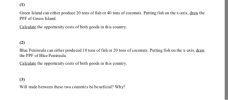 Green Island can either produce 20 tons of fish or 40 tons of coconuts. Putting fish on the x-axis, draw the PPF of Green Island. Calculate the opportunity costs of both goods in this country. Blue Peninsula can either produced 10 tons of fish or 20 tons of coconuts. Putting fish on the x-axis, draw. the PPF of Blue Peninsula Calculate the opportunity costs of both goods in this country. Will trade between these two countries be beneficial? Why
2. Problems and Applications Q2 An American worker can produce either 5 cars or 9 tons...
 2. Problems and Applications Q2 An American worker can produce either 5 cars or 9 tons of grain a year. A Japanese worker can produce either 3 cars or 9 tons of grain a year. To keep things simple, assume that each country has 100 million workers. Complete the following table with the number of workers needed to make one car or 1 ton of grain in the United States and Japan. Workers Needed to Make 1 Car 1 Ton...
2. Problems and Applications Q2 An American worker can produce either 5 cars or 9 tons...
 2. Problems and Applications Q2 An American worker can produce either 5 cars or 9 tons of grain a year. A Japanese worker can produce either 3 cars or 9 tons of grain a year. To keep things simple, assume that each country has 100 million workers. Complete the following table with the number of workers needed to make one car or 1 ton of grain in the United States and Japan. Workers Needed to Make 1 Car1 Ton of...
An American worker can produce either 5 cars or 8 tons of grain a year. A...
 An American worker can produce either 5 cars or 8 tons of grain a year. A lapanese worker can produce either 4 cars or 9 tons of grain a year. To keep things simple, assume that each country has 100 million workers Complete the foflowing table with the number of workers needed to make one car or 1 ton of grain in the United States and Japan. Workers Needed to Make 1 Car 1 Ton of Grain United StatesY Japan...
U.S. and Mexico both produce vehicles and tons of plastic, which are sold for the same...
 U.S. and Mexico both produce vehicles and tons of plastic, which are sold for the same price in both countries. Suppose that with one unit of labor and one unit of capital, the U.S. can produce either 20 vehicles or 45 tons of plastic and Mexico can produce either 10 vehicles or 17 tons of plastic. What is the opportunity cost of producing one ton of plastic (in terms of vehicles) for Mexico? Provide your answer as a number rounded...
If the fictitious country of Islandia puts all of its production resources into fish, it can...
 If the fictitious country of Islandia puts all of its production resources into fish, it can produce 35 units of fish. If it puts all of its production resources into coconuts, it can produce 70 units of coconuts. If the fictitious country of Mountania puts all of its production resources into fish, it can produce 30 units of fish. If it puts all of its production resources into coconuts, it can produce 80 units of coconuts. Assume that both countries...
3. American and Japanese workers can each produce 4 cars a year. An American worker can...
3. American and Japanese workers can each produce 4 cars a year. An American worker can produce 10 tons of grain a year, whereas a Japanese worker can produce 5 tons of grain a year. To keep things simple, assume that each country has 100 million workers. a. Graph the production possibilities frontier of the American and Japanese economies. b. For the US, what is the opportunity cost of a car? Of grain? For Japan, what is the opportunity cost...
Question 11 (1 point) Suppose that Spain and France both produce ships and grapes, which are...
 Question 11 (1 point) Suppose that Spain and France both produce ships and grapes, which are sold for the same price in both countries. The table below shows the produce in one year using the same amounts of capital and labor. What is the opportunity cost of producing one ship (in terms of tons of grapes) for France? Provide your answer as a number rounded to two decimal places. Do not include any symbols, such as "s," ", "%," or...
Question 10 (1 point) Suppose that Spain and France both produce ships and grapes, which are...
 Question 10 (1 point) Suppose that Spain and France both produce ships and grapes, which are sold for the same price in both countries. The table below shows the combinations of the two goods that each country can produce in one year using the same amounts of capital and labor. What is the opportunity cost of producing one ship (in terms of tons of grapes) for France? Provide your answer as a number rounded to two decimal places. Do not...
Question 11 (1 point) Suppose that Spain and France both produce ships and grapes, which are...
 Question 11 (1 point) Suppose that Spain and France both produce ships and grapes, which are sold for the same price in both countries. The table below shows the combinations of the two goods that each country can produce in one year using the same amounts of capital and labor. What is the opportunity cost of producing one ship (in terms of tons of grapes) for Spain? Provide your answer as a number rounded to two decimal places. Do not...
 Green Island can either produce 20 tons of fish or 40 tons of coconuts. Putting fish on the x-axis, draw the PPF of Green Island. Calculate the opportunity costs of both goods in this country. Blue Peninsula can either produced 10 tons of fish or 20 tons of coconuts. Putting fish on the x-axis, draw. the PPF of Blue Peninsula Calculate the opportunity costs of both goods in this country. Will trade between these two countries be beneficial? Why
 2. Problems and Applications Q2 An American worker can produce either 5 cars or 9 tons of grain a year. A Japanese worker can produce either 3 cars or 9 tons of grain a year. To keep things simple, assume that each country has 100 million workers. Complete the following table with the number of workers needed to make one car or 1 ton of grain in the United States and Japan. Workers Needed to Make 1 Car 1 Ton...
 2. Problems and Applications Q2 An American worker can produce either 5 cars or 9 tons of grain a year. A Japanese worker can produce either 3 cars or 9 tons of grain a year. To keep things simple, assume that each country has 100 million workers. Complete the following table with the number of workers needed to make one car or 1 ton of grain in the United States and Japan. Workers Needed to Make 1 Car1 Ton of...
 An American worker can produce either 5 cars or 8 tons of grain a year. A lapanese worker can produce either 4 cars or 9 tons of grain a year. To keep things simple, assume that each country has 100 million workers Complete the foflowing table with the number of workers needed to make one car or 1 ton of grain in the United States and Japan. Workers Needed to Make 1 Car 1 Ton of Grain United StatesY Japan...
 U.S. and Mexico both produce vehicles and tons of plastic, which are sold for the same price in both countries. Suppose that with one unit of labor and one unit of capital, the U.S. can produce either 20 vehicles or 45 tons of plastic and Mexico can produce either 10 vehicles or 17 tons of plastic. What is the opportunity cost of producing one ton of plastic (in terms of vehicles) for Mexico? Provide your answer as a number rounded...
 If the fictitious country of Islandia puts all of its production resources into fish, it can produce 35 units of fish. If it puts all of its production resources into coconuts, it can produce 70 units of coconuts. If the fictitious country of Mountania puts all of its production resources into fish, it can produce 30 units of fish. If it puts all of its production resources into coconuts, it can produce 80 units of coconuts. Assume that both countries...
 Question 11 (1 point) Suppose that Spain and France both produce ships and grapes, which are sold for the same price in both countries. The table below shows the produce in one year using the same amounts of capital and labor. What is the opportunity cost of producing one ship (in terms of tons of grapes) for France? Provide your answer as a number rounded to two decimal places. Do not include any symbols, such as "s," ", "%," or...
 Question 10 (1 point) Suppose that Spain and France both produce ships and grapes, which are sold for the same price in both countries. The table below shows the combinations of the two goods that each country can produce in one year using the same amounts of capital and labor. What is the opportunity cost of producing one ship (in terms of tons of grapes) for France? Provide your answer as a number rounded to two decimal places. Do not...
 Question 11 (1 point) Suppose that Spain and France both produce ships and grapes, which are sold for the same price in both countries. The table below shows the combinations of the two goods that each country can produce in one year using the same amounts of capital and labor. What is the opportunity cost of producing one ship (in terms of tons of grapes) for Spain? Provide your answer as a number rounded to two decimal places. Do not...
Most questions answered within 3 hours.
-
Where is the error in this code sequence?
String s1 = "Hello";
String s2 = "ello";...
asked 10 months ago -
Financial data for Joel de Paris, Inc., for last year
follow:
Joel de Paris, Inc.
Balance...
asked 10 months ago -
Consider this reaction:
Al2(SO4)3 (aq)+ BaCl3
(aq) Al2Cl6 (aq)- +
3BaSO4(s) . What is the...
asked 10 months ago -
Suppose that Savneet is considering increasing her
recent random sample from 20 car rentals to 40...
asked 10 months ago -
Trucks arrive at an unloading terminal at an average rate of 120
per hour.
Trucks arrive...
asked 10 months ago -
Why are methanol and ethanol completely soluble in water while
octanol is not very little soluble....
asked 10 months ago -
A facilities manager at a university reads in a research report
that the mean amount of...
asked 10 months ago -
When the CuSO4 is rehydrated by adding water to the anhydrous
compound, is this an endothermic...
asked 10 months ago -
A ray of sunlight is passing from diamond into crown glass; the
angle of incidence is...
asked 10 months ago -
A block of mass 0.249 kg is placed on top of a light, vertical
spring of...
asked 10 months ago -
how do the kidneys compensate in the presences of acidosis
a) trigger hyperventilate
b) reserve acid...
asked 10 months ago -
Question 501 pts
The rental rate of capital to the firm increases. Which of the
following...
asked 11 months ago