* For each step write a balanced equation. Make sure to indicate the phases of material....
* For each step write a balanced equation. Make sure to indicate the phases of material.
Step 1: An aluminum soda can will be used as the source of aluminum in this synthesis. The solid aluminum is dissolved in an aqueous solution of 4 M KOH (the 4M refers to the concentration, 4 moles of KOH per L of solution) in the presence of water. During this reaction, the dihydrogen gas escapes into the atmosphere and an aqueous product of potassium aluminum hydroxide is formed.
Step 2: After solid impurities are removed by filtration, 9 M aqueous sulfuric acid (H2SO4) is then added to the potassium aluminum hydroxide aqueous solution. Initially, aluminum hydroxide precipitates as a solid out of solution, also forming water, and potassium sulfate
Step 3: Additional sulfuric acid is added to neutralize the basic aluminum hydroxide, forming aqueous aluminum sulfate and water.
Step 4: At this point, the solution contains aqueous potassium ions, aluminum ions, and sulfate ions and water. An ice bath is used to cool the solution and to help combine the ions and water to form a crystalline solid hydrate, called potassium aluminum sulfate dodecahydrate. We can then perform a filtration to separate the solid crystalline hydrate from the solution and isolate the solid.
Homework Answers

Add Answer to:
* For each step write a balanced equation. Make sure to indicate
the phases of material....
6. Write a balanced equation describing each of the following chemical reactions. (a) Solid potassium chlorate,...
6. Write a balanced equation describing each of the following chemical reactions. (a) Solid potassium chlorate, KClO3, decomposes to form solid potassium chloride and diatomic oxygen gas. (b) Solid aluminum metal reacts with solid diatomic iodine to form solid Al2I6. (c) When solid sodium chloride is added to aqueous sulfuric acid, hydrogen chloride gas and aqueous sodium sulfate are produced. (d) Aqueous solutions of phosphoric acid and potassium hydroxide react to produce aqueous potassium dihydrogen phosphate and liquid water.
B. Write a balanced chemical reaction for the following word equations. (7 points) a. Potassium chlorate decompose...
 B. Write a balanced chemical reaction for the following word equations. (7 points) a. Potassium chlorate decomposes to form potassium chloride and oxygen. b. Aqueous solutions of copper (II) nitrate and sodium hydroxide react to form solid copper (II) hydroxide and a solution of sodium nitrate. b. Aqueous solutions of copper (II) nitrate and sodium hydroxide react to form solid copper (II) hydroxide and a solution of sodium nitrate. c. Diphosphorous tetrabromide reacts with fluorine gas to produce diphosphorous tetrafluoride...
Write a balanced chemical equation for each reaction in the experiment. Include the states of all...
Write a balanced chemical equation for each reaction in the experiment. Include the states of all materials. the precipitation reaction between copper(II) nitrate and sodium hydroxide making a precipitate of copper(II) hydroxide and aqueous sodium nitrate the single displacement and oxidation-reduction reaction between excess aqueous hydrochloric acid and aluminum metal to make aqueous aluminum chloride and hydrogen gas the single displacement and oxidation-reduction reaction between aqueous copper(II) chloride and aluminum metal to make aqueous aluminum chloride and metallic copper the...
interpretation of a chemical change and nomenclature report pagea Interpretation of a Chemical Change & Nomenclature...
 interpretation of a chemical change and nomenclature report
pagea
Interpretation of a Chemical Change & Nomenclature Report Pages Observations: Reaction Appearance Touch (Hot, cold, or no change) Smell (Describe) Did reaction occur? (yes/no) 1. List the reactions (by number) that: a. formed a precipitate: b. changed color: c. produced a gas: d. were endothermic: e. were exothermic: 2. Name the following: RbCI Fe(NO3)2 Ag2804_ KOH Mg3N2 3. Write the chemical formulas for: Sodium sulfate: Hydrochloric acid: Copper (II) chloride: Calcium...
interpretation of a chemical change and nomenclature report
pagea
Interpretation of a Chemical Change & Nomenclature Report Pages Observations: Reaction Appearance Touch (Hot, cold, or no change) Smell (Describe) Did reaction occur? (yes/no) 1. List the reactions (by number) that: a. formed a precipitate: b. changed color: c. produced a gas: d. were endothermic: e. were exothermic: 2. Name the following: RbCI Fe(NO3)2 Ag2804_ KOH Mg3N2 3. Write the chemical formulas for: Sodium sulfate: Hydrochloric acid: Copper (II) chloride: Calcium...
Write the balanced chemical equation for each of these reactions. Include phases. When aqueous sodium hydroxide...
 Write the balanced chemical equation for each of these reactions. Include phases. When aqueous sodium hydroxide is added to a solution containing lead nitrate, a solid precipitate forms. However, when additional aqueous hydroxide is added the precipitate redissolves forming a soluble [Pb(OH)_4]^2- (aq) complex ion.
Write the balanced chemical equation for each of the reactions. Include phases. When aqueous sodium hydroxide...
Write the balanced chemical equation for each of the reactions. Include phases. When aqueous sodium hydroxide is added to a solution containing lead(II) nitrate, a solid precipitate forms. equation: However, when additional aqueous hydroxide is added, the precipitate redissolves, forming a soluble [Pb(OH)4]2−(aq)[Pb(OH)4]2−(aq) complex ion. equation:
Experiment 7 Preparation of Alum PURPOSE oF EXPERIMENT: Prepare KAI(So,)2 12H20, an aluminum alum...
 CHEM 101 LAB 7 PRELAB QUESTIONS B C AND D
Experiment 7 Preparation of Alum PURPOSE oF EXPERIMENT: Prepare KAI(So,)2 12H20, an aluminum alum, from aluminum metal. (Note: ExPERIMENT 8 describes the gravimetric analysis of the sulfate content in alum.) Alums have the general formula MM(So) 12HO, where M* is commonly Na". K', Tl., NH,., or Ag, and Mt''is A广, Fe". Cr". Ti". or Co. . Samples of these compounds have a variety of uses in our everyday lives. Sodium...
CHEM 101 LAB 7 PRELAB QUESTIONS B C AND D
Experiment 7 Preparation of Alum PURPOSE oF EXPERIMENT: Prepare KAI(So,)2 12H20, an aluminum alum, from aluminum metal. (Note: ExPERIMENT 8 describes the gravimetric analysis of the sulfate content in alum.) Alums have the general formula MM(So) 12HO, where M* is commonly Na". K', Tl., NH,., or Ag, and Mt''is A广, Fe". Cr". Ti". or Co. . Samples of these compounds have a variety of uses in our everyday lives. Sodium...
Write the balanced chemical equation for each of the reactions. Include phases. When aqueous sodium hydroxide...
 Write the balanced chemical equation for each of the reactions. Include phases. When aqueous sodium hydroxide is added to a solution containing lead(II) nitrate, a solid precipitate forms. equation: 2 NaOH + Pb(NO3)2 + Pb(OH), + 2NaNO, However, when additional aqueous hydroxide is added, the precipitate redissolves, forming a soluble (Pb(OH),12- (aq) complex ion. equation: Pb(OH), +20H (Pb(OH) 2 -
2. (8 points) Write and balance the equation based upon the following information: a. The reaction...
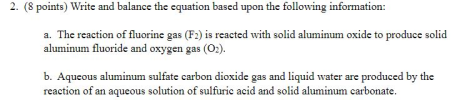 2. (8 points) Write and balance the equation based upon the following information: a. The reaction of fluorine gas (F2) is reacted with solid aluminum oxide to produce solid aluminum fluoride and oxygen gas (O.). b. Aqueous aluminum sulfate carbon dioxide gas and liquid water are produced by the reaction of an aqueous solution of sulfuric acid and solid aluminum carbonate.
Write a balanced chemical equation for each of the following reactions: 1. Hydrogen + chlorine hydrogen...
 Write a balanced chemical equation for each of the following reactions: 1. Hydrogen + chlorine hydrogen chloride 2. Hydrogen + nitrogen — ammonia 3. Carbon + steam → carbon monoxide + hydrogen 4. Calcium oxide + water calcium hydroxide 5. Phosphorus + oxygen → diphosphorus pentoxide 6. Aluminum sulfate + calcium hydroxide → aluminum hydroxide + calcium sulfate 7. Aluminum + oxygen aluminum oxide 8. Sodium peroxide + water sodium hydroxide + oxygen 9. Copper + concentrated sulfuric acid →...
 B. Write a balanced chemical reaction for the following word equations. (7 points) a. Potassium chlorate decomposes to form potassium chloride and oxygen. b. Aqueous solutions of copper (II) nitrate and sodium hydroxide react to form solid copper (II) hydroxide and a solution of sodium nitrate. b. Aqueous solutions of copper (II) nitrate and sodium hydroxide react to form solid copper (II) hydroxide and a solution of sodium nitrate. c. Diphosphorous tetrabromide reacts with fluorine gas to produce diphosphorous tetrafluoride...
 interpretation of a chemical change and nomenclature report
pagea
Interpretation of a Chemical Change & Nomenclature Report Pages Observations: Reaction Appearance Touch (Hot, cold, or no change) Smell (Describe) Did reaction occur? (yes/no) 1. List the reactions (by number) that: a. formed a precipitate: b. changed color: c. produced a gas: d. were endothermic: e. were exothermic: 2. Name the following: RbCI Fe(NO3)2 Ag2804_ KOH Mg3N2 3. Write the chemical formulas for: Sodium sulfate: Hydrochloric acid: Copper (II) chloride: Calcium...
interpretation of a chemical change and nomenclature report
pagea
Interpretation of a Chemical Change & Nomenclature Report Pages Observations: Reaction Appearance Touch (Hot, cold, or no change) Smell (Describe) Did reaction occur? (yes/no) 1. List the reactions (by number) that: a. formed a precipitate: b. changed color: c. produced a gas: d. were endothermic: e. were exothermic: 2. Name the following: RbCI Fe(NO3)2 Ag2804_ KOH Mg3N2 3. Write the chemical formulas for: Sodium sulfate: Hydrochloric acid: Copper (II) chloride: Calcium...
 Write the balanced chemical equation for each of these reactions. Include phases. When aqueous sodium hydroxide is added to a solution containing lead nitrate, a solid precipitate forms. However, when additional aqueous hydroxide is added the precipitate redissolves forming a soluble [Pb(OH)_4]^2- (aq) complex ion.
 CHEM 101 LAB 7 PRELAB QUESTIONS B C AND D
Experiment 7 Preparation of Alum PURPOSE oF EXPERIMENT: Prepare KAI(So,)2 12H20, an aluminum alum, from aluminum metal. (Note: ExPERIMENT 8 describes the gravimetric analysis of the sulfate content in alum.) Alums have the general formula MM(So) 12HO, where M* is commonly Na". K', Tl., NH,., or Ag, and Mt''is A广, Fe". Cr". Ti". or Co. . Samples of these compounds have a variety of uses in our everyday lives. Sodium...
CHEM 101 LAB 7 PRELAB QUESTIONS B C AND D
Experiment 7 Preparation of Alum PURPOSE oF EXPERIMENT: Prepare KAI(So,)2 12H20, an aluminum alum, from aluminum metal. (Note: ExPERIMENT 8 describes the gravimetric analysis of the sulfate content in alum.) Alums have the general formula MM(So) 12HO, where M* is commonly Na". K', Tl., NH,., or Ag, and Mt''is A广, Fe". Cr". Ti". or Co. . Samples of these compounds have a variety of uses in our everyday lives. Sodium...
 Write the balanced chemical equation for each of the reactions. Include phases. When aqueous sodium hydroxide is added to a solution containing lead(II) nitrate, a solid precipitate forms. equation: 2 NaOH + Pb(NO3)2 + Pb(OH), + 2NaNO, However, when additional aqueous hydroxide is added, the precipitate redissolves, forming a soluble (Pb(OH),12- (aq) complex ion. equation: Pb(OH), +20H (Pb(OH) 2 -
 2. (8 points) Write and balance the equation based upon the following information: a. The reaction of fluorine gas (F2) is reacted with solid aluminum oxide to produce solid aluminum fluoride and oxygen gas (O.). b. Aqueous aluminum sulfate carbon dioxide gas and liquid water are produced by the reaction of an aqueous solution of sulfuric acid and solid aluminum carbonate.
 Write a balanced chemical equation for each of the following reactions: 1. Hydrogen + chlorine hydrogen chloride 2. Hydrogen + nitrogen — ammonia 3. Carbon + steam → carbon monoxide + hydrogen 4. Calcium oxide + water calcium hydroxide 5. Phosphorus + oxygen → diphosphorus pentoxide 6. Aluminum sulfate + calcium hydroxide → aluminum hydroxide + calcium sulfate 7. Aluminum + oxygen aluminum oxide 8. Sodium peroxide + water sodium hydroxide + oxygen 9. Copper + concentrated sulfuric acid →...
Most questions answered within 3 hours.
-
Where is the error in this code sequence?
String s1 = "Hello";
String s2 = "ello";...
asked 10 months ago -
Financial data for Joel de Paris, Inc., for last year
follow:
Joel de Paris, Inc.
Balance...
asked 10 months ago -
Consider this reaction:
Al2(SO4)3 (aq)+ BaCl3
(aq) Al2Cl6 (aq)- +
3BaSO4(s) . What is the...
asked 10 months ago -
Suppose that Savneet is considering increasing her
recent random sample from 20 car rentals to 40...
asked 10 months ago -
Trucks arrive at an unloading terminal at an average rate of 120
per hour.
Trucks arrive...
asked 10 months ago -
Why are methanol and ethanol completely soluble in water while
octanol is not very little soluble....
asked 10 months ago -
A facilities manager at a university reads in a research report
that the mean amount of...
asked 10 months ago -
When the CuSO4 is rehydrated by adding water to the anhydrous
compound, is this an endothermic...
asked 10 months ago -
A ray of sunlight is passing from diamond into crown glass; the
angle of incidence is...
asked 10 months ago -
A block of mass 0.249 kg is placed on top of a light, vertical
spring of...
asked 10 months ago -
how do the kidneys compensate in the presences of acidosis
a) trigger hyperventilate
b) reserve acid...
asked 10 months ago -
Question 501 pts
The rental rate of capital to the firm increases. Which of the
following...
asked 10 months ago