Action potential is amplified everywhere EXCEPT: a. axon hillock b. nodes of ranvier c. internal space...
Action potential is amplified everywhere EXCEPT:
a. axon hillock
b. nodes of ranvier
c. internal space (space between nodes of ranvier)
Homework Answers
Action potential is the change in the electrical potential and which occurs on the surface of cell. Action potential is a short term change. Action potential occurs due to stimulation. And this leads to transmission of electric impulse. This impulse travels across the cell membrane. It involves a series of electrical and chemical changes.
An example of action potential is the nerve impulse passing from nerve fibers to muscles.
Axon hillock is the specialized part of cell which connects to the axon. It is part of axon of a nerve. It connects the cell body with axon. Plasma membrane generates nerve impulse in the axon hillock.
Nodes of ranvier is also called myelin sheath gap. It is seen in the myelinated axon of a nerve. Nodes of ranvier facilitate rapid conduction of nerve impulse.
The internal space ( space between nodes of ranvier) is called internode.
The action potential is amplified everywhere except internal space (space between nodes of ranvier), ie; at the internode. Action potential jump from one node of ranvier to the other node of ranvier. Action potential will not be amplified at the internodes.
Add Answer to:
Action potential is amplified everywhere EXCEPT:
a. axon hillock
b. nodes of ranvier
c. internal space...
Multiple Choice Action potentials A) rapid reversal of membrane potential B) occurs at nodes of ranvier...
 Multiple Choice Action potentials A) rapid reversal of membrane potential B) occurs at nodes of ranvier C) occurs along myelin sheath D) dependent on voltage gated channels E) occurs at axon hillock
Post-synaptic potentials are integrated in the _of a neuron. A. Nodes of Ranvier OB. Dendrites c....
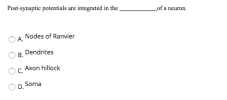 Post-synaptic potentials are integrated in the _of a neuron. A. Nodes of Ranvier OB. Dendrites c. Axon hillock OD. Soma
Complete the sentences describing the insulation of an axon. lipid synapses Schwann cells nodes of Ranvier...
 Complete the sentences describing the insulation of an axon. lipid synapses Schwann cells nodes of Ranvier oligodendrocytes cell membrane insulator myelin sheath axon hillocks carbohydrate Axons of the peripheral nervous system are associated with neuroglia cells called These cells, wrapped repeatedly around the axon, form a coating called a of multiple layers of the of the neuroglia cells. . It consists Myelin consists of protein and large amounts of white appearance. giving heavily myelinated tissue a As the cells wrap...
The action potential travels down: A. the dendrite. B. the synapse. C. the axon. D. both...
The action potential travels down: A. the dendrite. B. the synapse. C. the axon. D. both the dendrite and axon.
QUESTION 8 he membrane potential becomes more negative than the resting potential during the after-hyperpolarization phase...
 QUESTION 8 he membrane potential becomes more negative than the resting potential during the after-hyperpolarization phase of the action potential (AHP) because Ligand-galed Nat channels are inactivated and cannot be opened Voltage-gated K channels become inactivated The K equilibrium potential is below the resting membrane potential All ofthe above. None of the above QUESTION 9 When an action potential reaches the axon terminal, release of neurotransmitter is triggered by... a. movement of sodium ions into the axon terminal b. movement...
The resting membrane potential of a neuronal axon is -70 mV. When an action potential is...
The resting membrane potential of a neuronal axon is -70 mV. When an action potential is triggered, Na+ ions move into the axon, which reverses the voltage, bringing it towards 0 mV. Which of the following is the correct term for this sequence of events? a. Repolarization b. Hyperpolarization c. Depolarization d. Hypopolarization e. Isopolarization
41. Schwann cells are associated with: a. Nodes of Ranvier b. Myelin sheath c. Unmyelinated axons d. Synaptic cleft...
 41. Schwann cells are associated with: a. Nodes of Ranvier b. Myelin sheath c. Unmyelinated axons d. Synaptic cleft 42. A synapse does not involve the: a. Presynaptic neuron b. Postsynaptic neuron c Cell body d. Involvement of calcium 43. Which of following is not a connective tissue? a cardiac muscle b. cartilage c blood d. adipose 44. The type of gland that secretes substances into circulatory system are called: a. Exocrine glands b. Endocrine glands c. Simple glands d....
What is the relationship between the arrival of an action potential (nerve impulse) at the axon...
What is the relationship between the arrival of an action potential (nerve impulse) at the axon terminal and exocytosis of neurotransmitters?
around the axon, which keeps Na Kions from leaking across the membrane. The create(s) an O...
 around the axon, which keeps Na Kions from leaking across the membrane. The create(s) an O a. Schwann cells . action potential O b. dendrites - insulation layer O c. mylein sheath - insulation layer d. Node of Ranvier . action potential
An action potential occurs at the membrane of an axon because a) negatively charged Na+flow into...
An action potential occurs at the membrane of an axon because a) negatively charged Na+flow into the cell b) positively charged Na+flow out of the cell c) positively charged Na+flow into the cell d) negatively charged Na+flow out of the cell e) none of the above
 Multiple Choice Action potentials A) rapid reversal of membrane potential B) occurs at nodes of ranvier C) occurs along myelin sheath D) dependent on voltage gated channels E) occurs at axon hillock
 Post-synaptic potentials are integrated in the _of a neuron. A. Nodes of Ranvier OB. Dendrites c. Axon hillock OD. Soma
 Complete the sentences describing the insulation of an axon. lipid synapses Schwann cells nodes of Ranvier oligodendrocytes cell membrane insulator myelin sheath axon hillocks carbohydrate Axons of the peripheral nervous system are associated with neuroglia cells called These cells, wrapped repeatedly around the axon, form a coating called a of multiple layers of the of the neuroglia cells. . It consists Myelin consists of protein and large amounts of white appearance. giving heavily myelinated tissue a As the cells wrap...
 QUESTION 8 he membrane potential becomes more negative than the resting potential during the after-hyperpolarization phase of the action potential (AHP) because Ligand-galed Nat channels are inactivated and cannot be opened Voltage-gated K channels become inactivated The K equilibrium potential is below the resting membrane potential All ofthe above. None of the above QUESTION 9 When an action potential reaches the axon terminal, release of neurotransmitter is triggered by... a. movement of sodium ions into the axon terminal b. movement...
 41. Schwann cells are associated with: a. Nodes of Ranvier b. Myelin sheath c. Unmyelinated axons d. Synaptic cleft 42. A synapse does not involve the: a. Presynaptic neuron b. Postsynaptic neuron c Cell body d. Involvement of calcium 43. Which of following is not a connective tissue? a cardiac muscle b. cartilage c blood d. adipose 44. The type of gland that secretes substances into circulatory system are called: a. Exocrine glands b. Endocrine glands c. Simple glands d....
 around the axon, which keeps Na Kions from leaking across the membrane. The create(s) an O a. Schwann cells . action potential O b. dendrites - insulation layer O c. mylein sheath - insulation layer d. Node of Ranvier . action potential
Most questions answered within 3 hours.
-
Where is the error in this code sequence?
String s1 = "Hello";
String s2 = "ello";...
asked 10 months ago -
Financial data for Joel de Paris, Inc., for last year
follow:
Joel de Paris, Inc.
Balance...
asked 10 months ago -
Consider this reaction:
Al2(SO4)3 (aq)+ BaCl3
(aq) Al2Cl6 (aq)- +
3BaSO4(s) . What is the...
asked 10 months ago -
Suppose that Savneet is considering increasing her
recent random sample from 20 car rentals to 40...
asked 10 months ago -
Trucks arrive at an unloading terminal at an average rate of 120
per hour.
Trucks arrive...
asked 10 months ago -
Why are methanol and ethanol completely soluble in water while
octanol is not very little soluble....
asked 10 months ago -
A facilities manager at a university reads in a research report
that the mean amount of...
asked 10 months ago -
When the CuSO4 is rehydrated by adding water to the anhydrous
compound, is this an endothermic...
asked 10 months ago -
A ray of sunlight is passing from diamond into crown glass; the
angle of incidence is...
asked 10 months ago -
A block of mass 0.249 kg is placed on top of a light, vertical
spring of...
asked 10 months ago -
how do the kidneys compensate in the presences of acidosis
a) trigger hyperventilate
b) reserve acid...
asked 10 months ago -
Question 501 pts
The rental rate of capital to the firm increases. Which of the
following...
asked 10 months ago