Implement a method public static double[] product(double[] v1, double[] v2) that, given two arrays, v1 and...
Implement a method
public static double[] product(double[] v1, double[] v2)
that, given two arrays, v1 and v2, of floating-point numbers,
returns a new array containing the component-wise product
of vectors v1 and v2, that is, an array whose ith element is v1[i]
* v2[i].
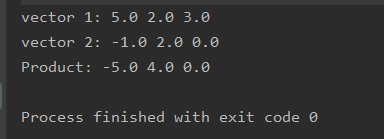
For example, if v1 is { 5, 2, 3 } and v2 is { -1, 2, 0 }, then the method should return { -5, 4, 0 }.
Homework Answers

public static double[] product(double[] v1, double[] v2) {
    double[] result = new double[v1.length];
    for (int i = 0; i < v1.length; i++) {
        result[i] = v1[i] * v2[i];
    }
    return result;
}

public class ProductTest {

    public static double[] product(double[] v1, double[] v2) {
        double[] result = new double[v1.length];
        for (int i = 0; i < v1.length; i++) {
            result[i] = v1[i] * v2[i];
        }
        return result;
    }

    public static void print(double[] arr) {
        for (int i = 0; i < arr.length; ++i) {
            System.out.print(arr[i] + " ");
        }
        System.out.println();
    }

    public static void main(String[] args) {
        double[] v1 = {5, 2, 3};
        double[] v2 = {-1, 2, 0};

        System.out.print("vector 1: ");
        print(v1);
        System.out.print("vector 2: ");
        print(v2);
        double[] result = product(v1, v2);
        System.out.print("Product: ");
        print(result);
    }
}
Add Answer to:
Implement a method
public static double[] product(double[] v1, double[] v2)
that, given two arrays, v1 and...
In Java for [computing] please. Thanks. Implement a method public static double[] difference(double[] vec1, double[] vec2)...
In Java for [computing] please. Thanks. Implement a method public static double[] difference(double[] vec1, double[] vec2) to compute the (component-wise) difference of vectors vec1 and vec2 as a new vector. Assume that vec1 and vec2 are of the same length. The difference of vectors (a1, a2, . . . , an) and (b1, b2, . . . , bn) is (a1 − b1, a2 − b2, . . . , an − bn). For example, the difference of (−2, −4,...
Using java fix the code I implemented so that it passes the JUnit Tests. MATRIX3 public...
Using java fix the code I implemented so that it passes the JUnit Tests. MATRIX3 public class Matrix3 { private double[][] matrix; /** * Creates a 3x3 matrix from an 2D array * @param v array containing 3 components of the desired vector */ public Matrix3(double[][] array) { this.matrix = array; } /** * Clones an existing matrix * @param old an existing Matrix3 object */ public Matrix3(Matrix3 old) { matrix = new double[old.matrix.length][]; for(int i = 0; i <...
You will implement the following method public static int[] linearSearchExtended(int[][] numbers, int key) { // Implement...
You will implement the following method public static int[] linearSearchExtended(int[][] numbers, int key) { // Implement this method return new int[] {}; } There is a utility method provided for you with the following signature. You may use this method to convert a list of integers into an array. public static int[] convertIntegers(List<Integer> integers) Provided code import java.util.ArrayList; import java.util.Iterator; import java.util.List; import java.util.Scanner; public class MatrixSearch { // This method converts a list of integers to an array...
public static int[] interleaveArray(int[] a, int[] b) Given two arrays, return the array which interleaves the...
public static int[] interleaveArray(int[] a, int[] b) Given two arrays, return the array which interleaves the elements of the two arrays. The two arrays do not have to be the same length. For example, given a = [1, 2, 3] and b = [4, 5, 6, 7, 8], the method returns c = [1, 4, 2, 5, 3, 6, 7, 8] Parameters: a - given array b - given array Returns: the array which interleaves the elements of the two...
public class SimpleSoftmax { /** * This method calculates the softmax output of a...
public class SimpleSoftmax { /** * This method calculates the softmax output of a non-normalized array. * Example: double[] nonNormArr = {-3.0, 0.2, 7.8} * gives the result {0.00002, 0.00050, 0.99948} * Details of how to compute the softmax output can be found at zyBook instructions. * Hint: use Math.exp(double a) to calculate the exponential values. * @param nonNormArr The non-normalized array to be softmaxed. * @return The softmax output of the input...
Implementing the function method using c, some sample codes are showed below: typedef struct{ double *vector;...
Implementing the function method using c, some sample codes are showed below: typedef struct{ double *vector; int count; int length; }Vector; Vector create_vector(int length){ Vector vec; vec.vector = (int*)malloc(sizeof(int)*length); if (vec.vector == NULL){ vec.length = 0; vec.count =0; return vec; }vec.count =0; vec.length = length; } /* Calculate and return the variance of the elements in a vector. */ double var(Vector vec) { } /* Calculate and return the standard deviation of the elements in a vector. */ double stdv(Vector...
Assignment is designed to develop your ability to create static methods and manipulate 1D and 2D...
Assignment is designed to develop your ability to create static methods and manipulate 1D and 2D arrays in Java. Create a single Java class Matrix and inside the class create the specified static methods as described Task # Description 1 Create a matrix (known components) 2 Create a matrix (random components) 3 Create a matrix from vectors 4 Compare two matrices 5 Add two matrices 6 Subtract two matrices 7 Multiply a matrix by a scalar 8 Multiply two matrices...
1) Write a public static method named printArray, that takes two arguments. The first argument is...
1) Write a public static method named printArray, that takes two arguments. The first argument is an Array of int and the second argument is a String. The method should print out a list of the values in the array, each separated by the value of the second argument. For example, given the following Array declaration and instantiation: int[] myArray = {1, 22, 333, 400, 5005, 9}; printArray(myArray, ", ") will print out 1, 22, 333, 400, 5005, 9 printArray(myArray,...
pls help java ASAP!!!!!!! Topic String Tokenizer Static Methods Static Variables Primitive Arrays Description Enhance the...
 pls help java ASAP!!!!!!!
Topic String Tokenizer Static Methods Static Variables Primitive Arrays Description Enhance the last assignment by providing the following additional features: (The additional features are listed in bold below) Class Statistics In the class Statistics, create the following static methods (in addition to the instance methods already provided). • A public static method for computing sorted data. • A public static method for computing min value. • A public static method for computing max value. • A...
pls help java ASAP!!!!!!!
Topic String Tokenizer Static Methods Static Variables Primitive Arrays Description Enhance the last assignment by providing the following additional features: (The additional features are listed in bold below) Class Statistics In the class Statistics, create the following static methods (in addition to the instance methods already provided). • A public static method for computing sorted data. • A public static method for computing min value. • A public static method for computing max value. • A...
Part 1. Primitive Types, Sorting, Recursion for Homework.java a) Implement the static method initializeArray that receives...
Part 1. Primitive Types, Sorting, Recursion for Homework.java a) Implement the static method initializeArray that receives as a parameter an array of integers. Use a for loop and an if statement to put 0s in the odd positions of the array and 5s in the even positions. b) Implement the static method printArray that receives as a parameter an array of integers. Use a for statements to print all the elements in the array. c) Implement the static method insertionSort...
 pls help java ASAP!!!!!!!
Topic String Tokenizer Static Methods Static Variables Primitive Arrays Description Enhance the last assignment by providing the following additional features: (The additional features are listed in bold below) Class Statistics In the class Statistics, create the following static methods (in addition to the instance methods already provided). • A public static method for computing sorted data. • A public static method for computing min value. • A public static method for computing max value. • A...
pls help java ASAP!!!!!!!
Topic String Tokenizer Static Methods Static Variables Primitive Arrays Description Enhance the last assignment by providing the following additional features: (The additional features are listed in bold below) Class Statistics In the class Statistics, create the following static methods (in addition to the instance methods already provided). • A public static method for computing sorted data. • A public static method for computing min value. • A public static method for computing max value. • A...
Most questions answered within 3 hours.
-
Where is the error in this code sequence?
String s1 = "Hello";
String s2 = "ello";...
asked 11 months ago -
Financial data for Joel de Paris, Inc., for last year
follow:
Joel de Paris, Inc.
Balance...
asked 11 months ago -
Consider this reaction:
Al2(SO4)3 (aq)+ BaCl3
(aq) Al2Cl6 (aq)- +
3BaSO4(s) . What is the...
asked 11 months ago -
Suppose that Savneet is considering increasing her
recent random sample from 20 car rentals to 40...
asked 11 months ago -
Trucks arrive at an unloading terminal at an average rate of 120
per hour.
Trucks arrive...
asked 11 months ago -
Why are methanol and ethanol completely soluble in water while
octanol is not very little soluble....
asked 11 months ago -
A facilities manager at a university reads in a research report
that the mean amount of...
asked 11 months ago -
When the CuSO4 is rehydrated by adding water to the anhydrous
compound, is this an endothermic...
asked 11 months ago -
A ray of sunlight is passing from diamond into crown glass; the
angle of incidence is...
asked 11 months ago -
A block of mass 0.249 kg is placed on top of a light, vertical
spring of...
asked 11 months ago -
how do the kidneys compensate in the presences of acidosis
a) trigger hyperventilate
b) reserve acid...
asked 11 months ago -
Question 501 pts
The rental rate of capital to the firm increases. Which of the
following...
asked 11 months ago