in the the lab experiment of Friedel-Crafts Alkylation: 0.4 ml of benzene was mixed with 0.8...
in the the lab experiment of Friedel-Crafts Alkylation: 0.4 ml of benzene was mixed with 0.8 ml of 2-chloro 2 methyl propane (the ratio is 1 to 2) to produce 1-4 dibutyl benzene. how to calculate percent yeild and what is the limiting reagent?
Homework Answers
Determination of limiting reagent :
Number of moles of benzene =
weight(grams)/molecular weight
Weight of benzene = volume* density
= 0.4 ml * 0.876
= 0.3504 grams
Moles of benzene = 0.3504/78
= 0.00449 moles (or) 4.49 m.moles.
Number of moles of 2-chloro-2-methyl propane = weight/molecular weight
Weight of 2-chloro-2-methylpropane = density * volume
= 0.851*0.8
= 0.6808 grams.
Moles of 2-chloro-2-methylpropane = 0.6808/92.57
= 0.007354 moles (or) 7.3544 m.moles.
Among the two reactants benzene has less number of moles.thus benzene is the limiting reagent.
Calculation of theoretical yield:
78 grams of benzene produces 190.32 grams of 1,4-di butyl benzene.
0.3504 grams of benzene produces ? grams of 1,4- diDbutyl benzene
= 0.3504*190.32/78
= 0.854 grams.
Theoretical yield (100% yield) = 0.854 ki.
% of yield = experimental weight (grams)*100/theoretical yield
But experimental weight is not given in the data.
Add Answer to:
in the the lab experiment of Friedel-Crafts Alkylation: 0.4 ml
of benzene was mixed with 0.8...
1. a student want to synthesize ethyl benzene using friedel-craft's alkylation. However she worries that it...
1. a student want to synthesize ethyl benzene using friedel-craft's alkylation. However she worries that it may end up with mixture of ethylbenzene and 1,4-diethylbenzene. propose a reaction that can use to get pure ethylbenzene. 2.the friedel-crafts reaction of benzene with 2-chloro-3-methylbutane in the presence of AlCl3 occurs with the carbocation rearrangement. what is the structure of the product.
The following questions are from an experiment titled Friedel-Crafts Alkylation for Organic Chemistry II Lab. There...
 The following questions are from an experiment titled
Friedel-Crafts Alkylation for Organic Chemistry II Lab. There are
pictures attached of the lab manual.
2) Is this method a good route for the preparation of
p-sec-butyltoulene? Give reasons for your answer.
3) Why do you use a large excess of toulene. What are its
functions?
4) What is the purpose for adding the hydrochloric acid to the
water in the separatory funnel in step 5? Hint: If no acid is
added,...
The following questions are from an experiment titled
Friedel-Crafts Alkylation for Organic Chemistry II Lab. There are
pictures attached of the lab manual.
2) Is this method a good route for the preparation of
p-sec-butyltoulene? Give reasons for your answer.
3) Why do you use a large excess of toulene. What are its
functions?
4) What is the purpose for adding the hydrochloric acid to the
water in the separatory funnel in step 5? Hint: If no acid is
added,...
These question are for the Friedel Crafts Alkylation of 1,4-Dimethoxybenzene organic chem lab 1. Why is...
 These question are for the Friedel Crafts Alkylation of
1,4-Dimethoxybenzene organic chem lab
1. Why is 1,4-di-t-butyl-2,5-dimethoxybenzene the preferred product of this reaction? Why is neither 1,2-di-t-butyl-3,6-dimethoxybenzene nor 1,3-di-t-butyl-3,6-dimethoxybenzene formed as side products? OCH3 OCH3 OCH3 OCH3 1,2-di-t-butyl-3,6-dimethoxybenzene 1,3-di-t-butyl-3,6-dimethoxybenzene 2. 3. 4. Why was the product washed with water? Why was the product washed with methanol? We used t-butyl alcohol to generate t-butyl cation. Suggest two other compounds that could be used to generate the t-butyl cation.
These question are for the Friedel Crafts Alkylation of
1,4-Dimethoxybenzene organic chem lab
1. Why is 1,4-di-t-butyl-2,5-dimethoxybenzene the preferred product of this reaction? Why is neither 1,2-di-t-butyl-3,6-dimethoxybenzene nor 1,3-di-t-butyl-3,6-dimethoxybenzene formed as side products? OCH3 OCH3 OCH3 OCH3 1,2-di-t-butyl-3,6-dimethoxybenzene 1,3-di-t-butyl-3,6-dimethoxybenzene 2. 3. 4. Why was the product washed with water? Why was the product washed with methanol? We used t-butyl alcohol to generate t-butyl cation. Suggest two other compounds that could be used to generate the t-butyl cation.
Chern 204-PSI, 6 . Friedel Crafts Acylation of an Unknown Benzene Compound (One weck lab The...
 Chern 204-PSI, 6 . Friedel Crafts Acylation of an Unknown Benzene Compound (One weck lab The Intent of this Lab To acetylate an unknown benzene compound via a Friedel-Crafts acylation and use spectroscopic techniques to determine the acetophenone derivative's identity Introduction The Friedel-Crafts reaction dates back to before 1900 and it is still widely used today. The active electrophilic agent (an acylium ion) is classically prepared and reacts very quickly. Another appealing feature of this reaction is that the acylated...
Show how you would synthesize each compound from benzene, toluene, or phenol using the following reactions:...
 Show how you would synthesize each compound from benzene, toluene, or phenol using the following reactions: Reactions 1. Halogenation 2. Nitration 3. Sulfonation 4. Friedel-Crafts acylation 5. Friedel-Crafts alkylation 6. Oxidation of methyl group 7. Reduction of nitro group • Choose the starting material from the drop-down list • Enter the number(s) of the desired reactions in the order that you wish to use them without commas between • If a reaction is used more than once, enter its number...
a quantity of 300 mL of 0.8 M HCl is mixed with 300mL of 0.4 M...
a quantity of 300 mL of 0.8 M HCl is mixed with 300mL of 0.4 M Ba(OH)2 in a constant pressure calorimeter having a heat capacity of 415 J/degrees C. the initial temperature of both solutions is the same at 22.0 degrees C. Given that the specific heat of the solution is 4.184J/g degrees C the density of the solution is 1.00 g/mL, and that the heat of neutralization for the process H^+(aq)+OH^-(aq)->H2O (1) is -56.2 kJ/mol, what is the...
In an experiment we used : thiophene (0.8 ml), n-butyllithium ( 3.125 ml), 2-chloropyrimidine ( 0.515...
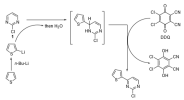 In an experiment we used : thiophene (0.8 ml), n-butyllithium (
3.125 ml), 2-chloropyrimidine ( 0.515 ml), DDQ (1.136 ml) to
synthesize 2-chloro-4-(2-thienyl)
pyrimidine
using this scheme
we obtained 0.078 g of the pure product calculate the
yield % ??
then H20 n-Bu-Li
In an experiment we used : thiophene (0.8 ml), n-butyllithium (
3.125 ml), 2-chloropyrimidine ( 0.515 ml), DDQ (1.136 ml) to
synthesize 2-chloro-4-(2-thienyl)
pyrimidine
using this scheme
we obtained 0.078 g of the pure product calculate the
yield % ??
then H20 n-Bu-Li
QUESTIONS 1. What is the purpose of the sulfuric acid (yes, it's a catalyst, but why...
 QUESTIONS 1. What is the purpose of the sulfuric acid (yes, it's a catalyst, but why is it a catalyst? What is it doing that makes the reaction possible? Would the reaction just go slower without it, or would the reaction not go at all? Why?) 2. If isobutyl alcohol (2 methyl propanol) is used instead of tert butyl alcohol, a mixture of products is obtained. One the products is the same as the product obtained with the tert butyl...
thanks 3. Complete the blank areas in the reagent and product tables below and make a...
 thanks
3. Complete the blank areas in the reagent and product tables below and make a copy in your lab notebook: 2-methyl-2- butanol Hydrochloric Acid 2-chloro-2- methylbutane Structure H-CI N/A 12 M N/A Molar Mass Molarity Mp/Bp Moles Volume Density 10.0 ml 25.0 mL N/A N/A *calculate the theoretically values 4. Based on the above information, what is the limiting reagent of the experiment?
thanks
3. Complete the blank areas in the reagent and product tables below and make a copy in your lab notebook: 2-methyl-2- butanol Hydrochloric Acid 2-chloro-2- methylbutane Structure H-CI N/A 12 M N/A Molar Mass Molarity Mp/Bp Moles Volume Density 10.0 ml 25.0 mL N/A N/A *calculate the theoretically values 4. Based on the above information, what is the limiting reagent of the experiment?
3. Complete the blank areas in the reagent and product tables below and make a copy...
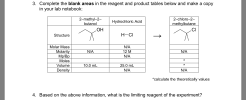 3. Complete the blank areas in the reagent and product tables below and make a copy in your lab notebook: 2-methyl-2- butanol Hydrochloric Acid 2-chloro-2- methylbutane ОН Structure H-CI -> N/A N/A 12 M N/A N/A Molar Mass Molarity Mp/Bp Moles Volume Density 10.0 mL 25.0 mL N/A N/A *calculate the theoretically values 4. Based on the above information, what is the limiting reagent of the experiment?
 The following questions are from an experiment titled
Friedel-Crafts Alkylation for Organic Chemistry II Lab. There are
pictures attached of the lab manual.
2) Is this method a good route for the preparation of
p-sec-butyltoulene? Give reasons for your answer.
3) Why do you use a large excess of toulene. What are its
functions?
4) What is the purpose for adding the hydrochloric acid to the
water in the separatory funnel in step 5? Hint: If no acid is
added,...
The following questions are from an experiment titled
Friedel-Crafts Alkylation for Organic Chemistry II Lab. There are
pictures attached of the lab manual.
2) Is this method a good route for the preparation of
p-sec-butyltoulene? Give reasons for your answer.
3) Why do you use a large excess of toulene. What are its
functions?
4) What is the purpose for adding the hydrochloric acid to the
water in the separatory funnel in step 5? Hint: If no acid is
added,...
 These question are for the Friedel Crafts Alkylation of
1,4-Dimethoxybenzene organic chem lab
1. Why is 1,4-di-t-butyl-2,5-dimethoxybenzene the preferred product of this reaction? Why is neither 1,2-di-t-butyl-3,6-dimethoxybenzene nor 1,3-di-t-butyl-3,6-dimethoxybenzene formed as side products? OCH3 OCH3 OCH3 OCH3 1,2-di-t-butyl-3,6-dimethoxybenzene 1,3-di-t-butyl-3,6-dimethoxybenzene 2. 3. 4. Why was the product washed with water? Why was the product washed with methanol? We used t-butyl alcohol to generate t-butyl cation. Suggest two other compounds that could be used to generate the t-butyl cation.
These question are for the Friedel Crafts Alkylation of
1,4-Dimethoxybenzene organic chem lab
1. Why is 1,4-di-t-butyl-2,5-dimethoxybenzene the preferred product of this reaction? Why is neither 1,2-di-t-butyl-3,6-dimethoxybenzene nor 1,3-di-t-butyl-3,6-dimethoxybenzene formed as side products? OCH3 OCH3 OCH3 OCH3 1,2-di-t-butyl-3,6-dimethoxybenzene 1,3-di-t-butyl-3,6-dimethoxybenzene 2. 3. 4. Why was the product washed with water? Why was the product washed with methanol? We used t-butyl alcohol to generate t-butyl cation. Suggest two other compounds that could be used to generate the t-butyl cation.
 Chern 204-PSI, 6 . Friedel Crafts Acylation of an Unknown Benzene Compound (One weck lab The Intent of this Lab To acetylate an unknown benzene compound via a Friedel-Crafts acylation and use spectroscopic techniques to determine the acetophenone derivative's identity Introduction The Friedel-Crafts reaction dates back to before 1900 and it is still widely used today. The active electrophilic agent (an acylium ion) is classically prepared and reacts very quickly. Another appealing feature of this reaction is that the acylated...
 Show how you would synthesize each compound from benzene, toluene, or phenol using the following reactions: Reactions 1. Halogenation 2. Nitration 3. Sulfonation 4. Friedel-Crafts acylation 5. Friedel-Crafts alkylation 6. Oxidation of methyl group 7. Reduction of nitro group • Choose the starting material from the drop-down list • Enter the number(s) of the desired reactions in the order that you wish to use them without commas between • If a reaction is used more than once, enter its number...
 In an experiment we used : thiophene (0.8 ml), n-butyllithium (
3.125 ml), 2-chloropyrimidine ( 0.515 ml), DDQ (1.136 ml) to
synthesize 2-chloro-4-(2-thienyl)
pyrimidine
using this scheme
we obtained 0.078 g of the pure product calculate the
yield % ??
then H20 n-Bu-Li
In an experiment we used : thiophene (0.8 ml), n-butyllithium (
3.125 ml), 2-chloropyrimidine ( 0.515 ml), DDQ (1.136 ml) to
synthesize 2-chloro-4-(2-thienyl)
pyrimidine
using this scheme
we obtained 0.078 g of the pure product calculate the
yield % ??
then H20 n-Bu-Li
 QUESTIONS 1. What is the purpose of the sulfuric acid (yes, it's a catalyst, but why is it a catalyst? What is it doing that makes the reaction possible? Would the reaction just go slower without it, or would the reaction not go at all? Why?) 2. If isobutyl alcohol (2 methyl propanol) is used instead of tert butyl alcohol, a mixture of products is obtained. One the products is the same as the product obtained with the tert butyl...
 thanks
3. Complete the blank areas in the reagent and product tables below and make a copy in your lab notebook: 2-methyl-2- butanol Hydrochloric Acid 2-chloro-2- methylbutane Structure H-CI N/A 12 M N/A Molar Mass Molarity Mp/Bp Moles Volume Density 10.0 ml 25.0 mL N/A N/A *calculate the theoretically values 4. Based on the above information, what is the limiting reagent of the experiment?
thanks
3. Complete the blank areas in the reagent and product tables below and make a copy in your lab notebook: 2-methyl-2- butanol Hydrochloric Acid 2-chloro-2- methylbutane Structure H-CI N/A 12 M N/A Molar Mass Molarity Mp/Bp Moles Volume Density 10.0 ml 25.0 mL N/A N/A *calculate the theoretically values 4. Based on the above information, what is the limiting reagent of the experiment?
 3. Complete the blank areas in the reagent and product tables below and make a copy in your lab notebook: 2-methyl-2- butanol Hydrochloric Acid 2-chloro-2- methylbutane ОН Structure H-CI -> N/A N/A 12 M N/A N/A Molar Mass Molarity Mp/Bp Moles Volume Density 10.0 mL 25.0 mL N/A N/A *calculate the theoretically values 4. Based on the above information, what is the limiting reagent of the experiment?
Most questions answered within 3 hours.
-
Where is the error in this code sequence?
String s1 = "Hello";
String s2 = "ello";...
asked 11 months ago -
Financial data for Joel de Paris, Inc., for last year
follow:
Joel de Paris, Inc.
Balance...
asked 11 months ago -
Consider this reaction:
Al2(SO4)3 (aq)+ BaCl3
(aq) Al2Cl6 (aq)- +
3BaSO4(s) . What is the...
asked 11 months ago -
Suppose that Savneet is considering increasing her
recent random sample from 20 car rentals to 40...
asked 11 months ago -
Trucks arrive at an unloading terminal at an average rate of 120
per hour.
Trucks arrive...
asked 11 months ago -
Why are methanol and ethanol completely soluble in water while
octanol is not very little soluble....
asked 11 months ago -
A facilities manager at a university reads in a research report
that the mean amount of...
asked 11 months ago -
When the CuSO4 is rehydrated by adding water to the anhydrous
compound, is this an endothermic...
asked 11 months ago -
A ray of sunlight is passing from diamond into crown glass; the
angle of incidence is...
asked 11 months ago -
A block of mass 0.249 kg is placed on top of a light, vertical
spring of...
asked 11 months ago -
how do the kidneys compensate in the presences of acidosis
a) trigger hyperventilate
b) reserve acid...
asked 11 months ago -
Question 501 pts
The rental rate of capital to the firm increases. Which of the
following...
asked 11 months ago