Identification of Organic Liquids by Physical Properties 1. Which physical property is more useful for determining...
Identification of Organic Liquids by Physical Properties
1. Which physical property is more useful for determining the identity of the liquid? Explain
2. Will an impurity affect the refractive index of a liquid? Explain
Homework Answers

Add Answer to:
Identification of Organic Liquids by Physical Properties
1. Which physical property is more useful for determining...
Which property or properties would be the most useful in characterizing an organic compound that a...
 Which property or properties would be the most useful in characterizing an organic compound that a solid at room temperature. melting point 1L refractive index IL boiling pointIV. color is a solid at room a. b. II and IV f. II and II1 js a lvguid a rooeriy or propertis would be the most usctaul in characteriving an organic compound that I. melting point I. refractive index III. boiling pointIV. color a. b. III and IV c.? f. II and...
Q1: State two physical properties of materials which assist in the identification of the material as...
Q1: State two physical properties of materials which assist in the identification of the material as organic or inorganic in nature. Q2: TRUE OR FALSE... Structural isomers have the same molecular structure Q3: How many hydrogen atoms are contained in a molecule of 1-chloro-4-heptyne? Q4: TRUE OR FALSE... A cis isomer of a substituted alkene bears like groups bonded on the same side of the double bond. Q5: TRUE OR FALSE... The elements of water can be added to alkene...
38 Report Sheet . Identification of Substances by Physical Properties 8. When water and bromoform are...
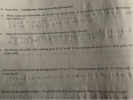 38 Report Sheet . Identification of Substances by Physical Properties 8. When water and bromoform are (See Table 3.1.) and bromoform are mixed, two layers form. Is the bottom layer water or bromoform? Sunce bromo form is more dense than a e botton layer is of brolno storm so the bottone s e 9. What solvent would you use to determine the density of zinc chloride Ca loupe o. Antoa e gо да се с о с will not dessous...
QUESTION 1 Which of the following is a property of both gases and liquids? a. Indefinite...
 QUESTION 1 Which of the following is a property of both gases and liquids? a. Indefinite volume b. Definite shape c. Definite volume d. Indefinite shape QUESTION 2 In which of the following pairs of chemical formulas do the two members of the pair contain the same number of elements as well as the same number of atoms? a. CoBry and COBr2 b. Cs and CS c. CoCl2 and CoCl3 d. NH4Brand NISO4 QUESTION 3 Which of the following statements...
Exercise 1 - Questions 1. Define physical and chemical properties and give at least 3 examples...
 Exercise 1 - Questions
1. Define physical and chemical properties and give at
least 3 examples of each type of property.
2. Which substances in Data Table 1 have melting points
below room temperature? Are these substances more likely to be
ionic or molecular compounds based on melting point alone?
Explain.
3. Which substances in Data Table 1 have melting points
above room temperature? Are these substances more likely to be
ionic or molecular compounds based on melting point alone?...
Exercise 1 - Questions
1. Define physical and chemical properties and give at
least 3 examples of each type of property.
2. Which substances in Data Table 1 have melting points
below room temperature? Are these substances more likely to be
ionic or molecular compounds based on melting point alone?
Explain.
3. Which substances in Data Table 1 have melting points
above room temperature? Are these substances more likely to be
ionic or molecular compounds based on melting point alone?...
This is lab report for identification of hydrocarbon. I have my data for hydrocarbon but i don't know how to explain for...
 This is lab report for
identification of hydrocarbon. I have my data for hydrocarbon but i
don't know how to explain for question 1. Can u help me with it?
And i will attcah the table 1 for possible hydrocarbon.
58 Table 1. List of possible hydrocarbons Boiling point Refractive Hydrocarbon Name (°C) index (n20) cyclopentane 49 1.4065 2,2-dimethylbutane 50 1.3688 2,3-dimethylbutane 1.3750 3-methylpentane 63 1.3765 n-hexane 69 1.3749 methylcyclopentane 72 1.4097 2,4-dimethylpentane 80 1.3815 cyclohexane 81 1.4266 2,3-dimethylpentane 90...
This is lab report for
identification of hydrocarbon. I have my data for hydrocarbon but i
don't know how to explain for question 1. Can u help me with it?
And i will attcah the table 1 for possible hydrocarbon.
58 Table 1. List of possible hydrocarbons Boiling point Refractive Hydrocarbon Name (°C) index (n20) cyclopentane 49 1.4065 2,2-dimethylbutane 50 1.3688 2,3-dimethylbutane 1.3750 3-methylpentane 63 1.3765 n-hexane 69 1.3749 methylcyclopentane 72 1.4097 2,4-dimethylpentane 80 1.3815 cyclohexane 81 1.4266 2,3-dimethylpentane 90...
1. Indicate which of the following would be considered physical properties (P) and which would be...
 1. Indicate which of the following would be considered physical properties (P) and which would be considered chemical properties (C) of iron. ー-a. Iron reacts with oxygen to form iron oxides. b. Iron is a good conductor of heat and electricity. C. Iron melts at 1535°C. d. When iron is immersed in a solution of hydrochloric acid, hydrogen gas is produced. e. Iron becomes red-hot when heated. __ f. A500-cc volume of iron has a mass of 3930 g. Iron...
Unshared, or lone, electron pairs play an important role in determining the chemical and physical properties...
 Unshared, or lone, electron pairs play an important role in determining the chemical and physical properties of organic compounds. Thus, it is important to know which atoms carry unshared pairs. Use the structural formulas below to determine the number of unshared pairs at each designated atom. Be sure your answers are consistent with the formal charges on the formulas The number of unshared pairs at atom a is The number of unshared pairs at atom bis The number of unshared...
Lo 8: Properties of the Plasma Membrane 1) Draw the structure of a phospholipid and label...
Lo 8: Properties of the Plasma Membrane 1) Draw the structure of a phospholipid and label the three parts: Glycerol backbone, fatty acid tails and phosphate head group. Label which regions are hydrophobic and which are hydrophilic. Be able to explain WHY they have the property they do (think of their chemical make up-look it up if you need a reminder). 2) Describe two properties that affect membrane fluidity? Draw a representation of how each property affects membrane fluidity. Explain...
PART B: TRENDS IN ATOMIC PROPERTIES Use your graphs to answer the following questions. 1. State the general periodic relationship between the physical property and increasing atomic number within...
 PART B: TRENDS IN ATOMIC PROPERTIES Use your graphs to answer the following questions. 1. State the general periodic relationship between the physical property and increasing atomic number within a period of elements. a) lonization energy b) Atomic radius c) Electronegativity 2. State the general periodic relationship between the physical property and increasing atomic number within a group of elements. a) lonization energy b) Atomic radius c) Electronegativity
PART B: TRENDS IN ATOMIC PROPERTIES Use your graphs to answer the...
PART B: TRENDS IN ATOMIC PROPERTIES Use your graphs to answer the following questions. 1. State the general periodic relationship between the physical property and increasing atomic number within a period of elements. a) lonization energy b) Atomic radius c) Electronegativity 2. State the general periodic relationship between the physical property and increasing atomic number within a group of elements. a) lonization energy b) Atomic radius c) Electronegativity
PART B: TRENDS IN ATOMIC PROPERTIES Use your graphs to answer the...
 Which property or properties would be the most useful in characterizing an organic compound that a solid at room temperature. melting point 1L refractive index IL boiling pointIV. color is a solid at room a. b. II and IV f. II and II1 js a lvguid a rooeriy or propertis would be the most usctaul in characteriving an organic compound that I. melting point I. refractive index III. boiling pointIV. color a. b. III and IV c.? f. II and...
 38 Report Sheet . Identification of Substances by Physical Properties 8. When water and bromoform are (See Table 3.1.) and bromoform are mixed, two layers form. Is the bottom layer water or bromoform? Sunce bromo form is more dense than a e botton layer is of brolno storm so the bottone s e 9. What solvent would you use to determine the density of zinc chloride Ca loupe o. Antoa e gо да се с о с will not dessous...
 QUESTION 1 Which of the following is a property of both gases and liquids? a. Indefinite volume b. Definite shape c. Definite volume d. Indefinite shape QUESTION 2 In which of the following pairs of chemical formulas do the two members of the pair contain the same number of elements as well as the same number of atoms? a. CoBry and COBr2 b. Cs and CS c. CoCl2 and CoCl3 d. NH4Brand NISO4 QUESTION 3 Which of the following statements...
 Exercise 1 - Questions
1. Define physical and chemical properties and give at
least 3 examples of each type of property.
2. Which substances in Data Table 1 have melting points
below room temperature? Are these substances more likely to be
ionic or molecular compounds based on melting point alone?
Explain.
3. Which substances in Data Table 1 have melting points
above room temperature? Are these substances more likely to be
ionic or molecular compounds based on melting point alone?...
Exercise 1 - Questions
1. Define physical and chemical properties and give at
least 3 examples of each type of property.
2. Which substances in Data Table 1 have melting points
below room temperature? Are these substances more likely to be
ionic or molecular compounds based on melting point alone?
Explain.
3. Which substances in Data Table 1 have melting points
above room temperature? Are these substances more likely to be
ionic or molecular compounds based on melting point alone?...
 This is lab report for
identification of hydrocarbon. I have my data for hydrocarbon but i
don't know how to explain for question 1. Can u help me with it?
And i will attcah the table 1 for possible hydrocarbon.
58 Table 1. List of possible hydrocarbons Boiling point Refractive Hydrocarbon Name (°C) index (n20) cyclopentane 49 1.4065 2,2-dimethylbutane 50 1.3688 2,3-dimethylbutane 1.3750 3-methylpentane 63 1.3765 n-hexane 69 1.3749 methylcyclopentane 72 1.4097 2,4-dimethylpentane 80 1.3815 cyclohexane 81 1.4266 2,3-dimethylpentane 90...
This is lab report for
identification of hydrocarbon. I have my data for hydrocarbon but i
don't know how to explain for question 1. Can u help me with it?
And i will attcah the table 1 for possible hydrocarbon.
58 Table 1. List of possible hydrocarbons Boiling point Refractive Hydrocarbon Name (°C) index (n20) cyclopentane 49 1.4065 2,2-dimethylbutane 50 1.3688 2,3-dimethylbutane 1.3750 3-methylpentane 63 1.3765 n-hexane 69 1.3749 methylcyclopentane 72 1.4097 2,4-dimethylpentane 80 1.3815 cyclohexane 81 1.4266 2,3-dimethylpentane 90...
 1. Indicate which of the following would be considered physical properties (P) and which would be considered chemical properties (C) of iron. ー-a. Iron reacts with oxygen to form iron oxides. b. Iron is a good conductor of heat and electricity. C. Iron melts at 1535°C. d. When iron is immersed in a solution of hydrochloric acid, hydrogen gas is produced. e. Iron becomes red-hot when heated. __ f. A500-cc volume of iron has a mass of 3930 g. Iron...
 Unshared, or lone, electron pairs play an important role in determining the chemical and physical properties of organic compounds. Thus, it is important to know which atoms carry unshared pairs. Use the structural formulas below to determine the number of unshared pairs at each designated atom. Be sure your answers are consistent with the formal charges on the formulas The number of unshared pairs at atom a is The number of unshared pairs at atom bis The number of unshared...
 PART B: TRENDS IN ATOMIC PROPERTIES Use your graphs to answer the following questions. 1. State the general periodic relationship between the physical property and increasing atomic number within a period of elements. a) lonization energy b) Atomic radius c) Electronegativity 2. State the general periodic relationship between the physical property and increasing atomic number within a group of elements. a) lonization energy b) Atomic radius c) Electronegativity
PART B: TRENDS IN ATOMIC PROPERTIES Use your graphs to answer the...
PART B: TRENDS IN ATOMIC PROPERTIES Use your graphs to answer the following questions. 1. State the general periodic relationship between the physical property and increasing atomic number within a period of elements. a) lonization energy b) Atomic radius c) Electronegativity 2. State the general periodic relationship between the physical property and increasing atomic number within a group of elements. a) lonization energy b) Atomic radius c) Electronegativity
PART B: TRENDS IN ATOMIC PROPERTIES Use your graphs to answer the...
Most questions answered within 3 hours.
-
Where is the error in this code sequence?
String s1 = "Hello";
String s2 = "ello";...
asked 11 months ago -
Financial data for Joel de Paris, Inc., for last year
follow:
Joel de Paris, Inc.
Balance...
asked 11 months ago -
Consider this reaction:
Al2(SO4)3 (aq)+ BaCl3
(aq) Al2Cl6 (aq)- +
3BaSO4(s) . What is the...
asked 11 months ago -
Suppose that Savneet is considering increasing her
recent random sample from 20 car rentals to 40...
asked 11 months ago -
Trucks arrive at an unloading terminal at an average rate of 120
per hour.
Trucks arrive...
asked 11 months ago -
Why are methanol and ethanol completely soluble in water while
octanol is not very little soluble....
asked 11 months ago -
A facilities manager at a university reads in a research report
that the mean amount of...
asked 11 months ago -
When the CuSO4 is rehydrated by adding water to the anhydrous
compound, is this an endothermic...
asked 11 months ago -
A ray of sunlight is passing from diamond into crown glass; the
angle of incidence is...
asked 11 months ago -
A block of mass 0.249 kg is placed on top of a light, vertical
spring of...
asked 11 months ago -
how do the kidneys compensate in the presences of acidosis
a) trigger hyperventilate
b) reserve acid...
asked 11 months ago -
Question 501 pts
The rental rate of capital to the firm increases. Which of the
following...
asked 11 months ago