Use Matlab to create: Step continuous signal at any starting time, Ramp continuous signal at any...
Use Matlab to create: Step continuous signal at any starting time, Ramp continuous signal at any starting time, Add and subtract two signals, Shifted signals by any time
Homework Answers
clc,clear, close all
%% Step continuous signal at any starting time t0
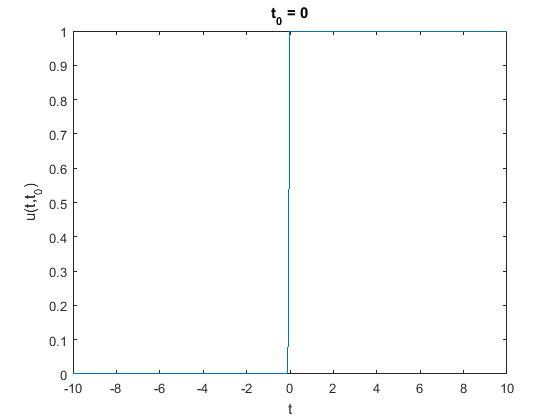
u = @(t,t0) t>=t0;
%% Ramp continuous signal at any starting time t0
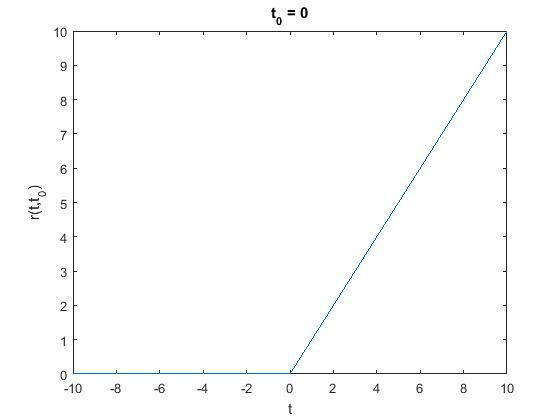
r = @(t,t0) (t-t0).*(t>t0);
%% plotting step signal
%
t = -10:0.1:10; % time vector
t0 = 0; % starting at 0
figure
plot(t,u(t,t0))
xlabel('t'),ylabel('u(t,t_0)')
title(['t_0 = ' num2str(t0)])
%% plotting ramp signal
%
t = -10:0.1:10; % time vector
t0 = 0; % starting at 0
figure
plot(t,r(t,t0))
xlabel('t'),ylabel('r(t,t_0)')
title(['t_0 = ' num2str(t0)])
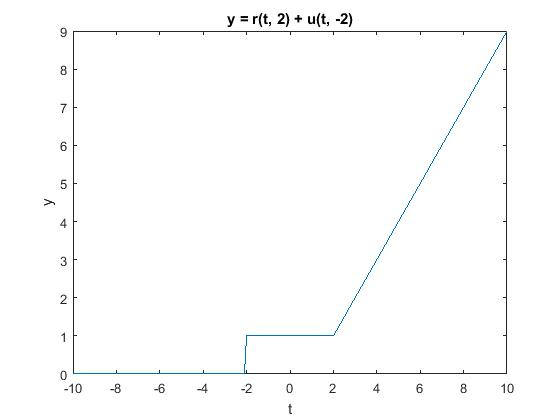
%% add two signals
%
t = -10:0.1:10; % time vector
% adding shifted step and ramp
a = 2; % t0 for ramp
b = -2; % t0 for step
y = r(t,a) + u(t,b);
figure
plot(t,y)
xlabel('t'),ylabel('y')
title(['y = r(t, ' num2str(a) ') + u(t, ' num2str(b) ')'])
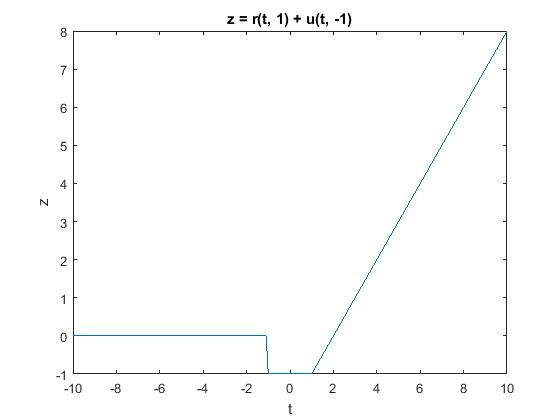
%% subtract two signals
%
t = -10:0.1:10; % time vector
% substracting shifted step from ramp
a = 1; % t0 for ramp
b = -1; % t0 for step
z = r(t,a) - u(t,b);
figure
plot(t,z)
xlabel('t'),ylabel('z')
title(['z = r(t, ' num2str(a) ') + u(t, ' num2str(b) ')'])
------------------------------------------------------------------------------
COMMENT DOWN FOR ANY QUERY RELATED TO THIS ANSWER,
IF YOU'RE SATISFIED, GIVE A THUMBS UP
~yc~
Add Answer to:
Use Matlab to create: Step continuous signal at any starting
time, Ramp continuous signal at any...
step by step please. Consider two continuous time signals given below. Keeping b(t) as a fixed...
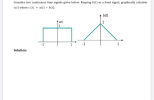 step by step please.
Consider two continuous time signals given below. Keeping b(t) as a fixed signal, graphically calculate c(t) where c (t) = a(t) .b(t). b(t) Solution:
step by step please.
Consider two continuous time signals given below. Keeping b(t) as a fixed signal, graphically calculate c(t) where c (t) = a(t) .b(t). b(t) Solution:
(A.) Use MATLAB to generate a pulsed sine wave signal having a frequency F-10KHZ and a...
 (A.) Use MATLAB to generate a pulsed sine wave signal having a frequency F-10KHZ and a pulse width of T-.5ms. The pulse repetition time is 1ms (pulse repetition rate is 1000 pulses/sec), i.e., the signal is zero between pulses. Model the signal to start at time t-0 and to end at a time t=Tstop. Use a sample time of .001ms to approximate an analog environment. Display the signal in MATLAB appropriate for an analog signal, first for Tstop 1ms and...
need matlab code Exercise: Use MATLAB to generate a low frequency signal: xy(t) = 3 cos(1400)...
 need matlab code
Exercise: Use MATLAB to generate a low frequency signal: xy(t) = 3 cos(1400) And a higher frequency signal: xz(t) = 2 cos(10,000st) Now add these two signals together to generate the dual-component signal: y(t) = 3 cos(14007a)+ 2 cos(10,000) Points to be addressed: Again, manually calculate the theoretical magnitude spectra of y(t) and show this in your report (use Microsoft Visio or similar for your diagram). Clearly label all axes! Contrast this working to what you see...
need matlab code
Exercise: Use MATLAB to generate a low frequency signal: xy(t) = 3 cos(1400) And a higher frequency signal: xz(t) = 2 cos(10,000st) Now add these two signals together to generate the dual-component signal: y(t) = 3 cos(14007a)+ 2 cos(10,000) Points to be addressed: Again, manually calculate the theoretical magnitude spectra of y(t) and show this in your report (use Microsoft Visio or similar for your diagram). Clearly label all axes! Contrast this working to what you see...
Now use MATLAB to generate and plot 15seconds of this signal in the time-domain.Use the fft()...
 Now use MATLAB to generate and plot 15seconds of this signal
in the time-domain.Use the fft() function to find the fourier
transform of this signal and plot its magnitude spectrum
School of Engineering Task 3 - The Fourier Transform: Scaling property Exercise: Let's take a look now at using the Fourier transform on aperiodic signals. Consider the real exponential signal from the discharging capacitor in tas 3 of laboratory 1 which was found to be: You(t)=e"u(t) Begin by calculating manually...
Now use MATLAB to generate and plot 15seconds of this signal
in the time-domain.Use the fft() function to find the fourier
transform of this signal and plot its magnitude spectrum
School of Engineering Task 3 - The Fourier Transform: Scaling property Exercise: Let's take a look now at using the Fourier transform on aperiodic signals. Consider the real exponential signal from the discharging capacitor in tas 3 of laboratory 1 which was found to be: You(t)=e"u(t) Begin by calculating manually...
Q. 2 A continuous time signal x(t) has the Continuous Time Fourier Transform shown in Fig...
 Q. 2 A continuous time signal x(t) has the Continuous Time Fourier Transform shown in Fig 2. Xc() -80007 0 80001 2 (rad/s) Fig 2 According to the sampling theorem, find the maximum allowable sampling period T for this signal. Also plot the Fourier Transforms of the sampled signal X:(j) and X(elo). Label the resulting signals appropriately (both in frequency and amplitude axis). Assuming that the sampling period is increased 1.2 times, what is the new sampling frequency 2? What...
Its related to MATLAB Generate a continuous-time signal z(t)-cos(2π 10t + 5) + cos(2π30t + 5). You may use the part of...
 Its related to MATLAB
Generate a continuous-time signal z(t)-cos(2π 10t + 5) + cos(2π30t + 5). You may use the part of the followings. a >>t0:0.001:1; >plot (t, x_t) b. Generate a discrete-time signal x[n] = (1/4)(u[n]-u[n-4). You may use the part of the followings >>a_n-ones (1, 4) s> b_nzeros (1, 7) >> stem(n, x n)
Generate a continuous-time signal z(t)-cos(2π 10t + 5) + cos(2π30t + 5). You may use the part of the followings. a >>t0:0.001:1; >plot (t,...
Its related to MATLAB
Generate a continuous-time signal z(t)-cos(2π 10t + 5) + cos(2π30t + 5). You may use the part of the followings. a >>t0:0.001:1; >plot (t, x_t) b. Generate a discrete-time signal x[n] = (1/4)(u[n]-u[n-4). You may use the part of the followings >>a_n-ones (1, 4) s> b_nzeros (1, 7) >> stem(n, x n)
Generate a continuous-time signal z(t)-cos(2π 10t + 5) + cos(2π30t + 5). You may use the part of the followings. a >>t0:0.001:1; >plot (t,...
Create a sinusoidal signal V(in) with the following parameters – VOFF = 10 + 2V, AMPLITUDE...
Create a sinusoidal signal V(in) with the following parameters – VOFF = 10 + 2V, AMPLITUDE = 3V, FREQUENCY= 500 Hz. Design a level shifting circuit such that the lower peak of V(in) is shifted to 5V, and the higher peak of V(in) is shifted to 0. Show by means of PSPICE Time Response simulation that your circuit really works. [Continue to use the two 9V batteries]. Make sure to explain every step in your design.
Digital Signal Processing (EEC 4963) Assignment 1 Discrete-Time Signals Express the signal 1. 1, 3sns-1 71 elsewher...
 Digital Signal Processing (EEC 4963) Assignment 1 Discrete-Time Signals Express the signal 1. 1, 3sns-1 71 elsewhere 0, using each of the following representation methods (a) Graphical representation. (b) Sequence representation. (c) In terms of the unit sample function, δ[n], unit step function, u[n], and the unit ramp function, r[n].
Digital Signal Processing (EEC 4963) Assignment 1 Discrete-Time Signals Express the signal 1. 1, 3sns-1 71 elsewhere 0, using each of the following representation methods (a) Graphical representation. (b) Sequence...
Digital Signal Processing (EEC 4963) Assignment 1 Discrete-Time Signals Express the signal 1. 1, 3sns-1 71 elsewhere 0, using each of the following representation methods (a) Graphical representation. (b) Sequence representation. (c) In terms of the unit sample function, δ[n], unit step function, u[n], and the unit ramp function, r[n].
Digital Signal Processing (EEC 4963) Assignment 1 Discrete-Time Signals Express the signal 1. 1, 3sns-1 71 elsewhere 0, using each of the following representation methods (a) Graphical representation. (b) Sequence...
For Problems (9-10), use the continuous-time system depicted below which converts the input signal X(t) into...
 For Problems (9-10), use the continuous-time system depicted below which converts the input signal X(t) into the corresponding output signal y(t) = {x()} = 10 x(t) u(t - 3). system y(t) = $ { x(t) } = 10 x(t) · u(t – 3). (9) (10 points) (a) Compute the formula for the Ramp Response, yramp(t) = { r(t)}. (b) Plot the Ramp Response. Label both axes. Give key values of time and amplitude. (10) (10 points) (a) Compute the formula...
Problem (8) MATLAB Problem) Write a Matlab Function that plots the of the following signal in...
 Problem (8) MATLAB Problem) Write a Matlab Function that plots the of the following signal in the discrete time domain for any value of the shift k and for any range of it: nak *(1 – k) = fccm (c(n - keink 0. n<R Problem (9) MATLAB Problem) Subplot the following signals in the same figure choose an appropriate range for : x(n) = b cos (0.1bana ym) = 2"sin (0.1b mn + ) וחו
 step by step please.
Consider two continuous time signals given below. Keeping b(t) as a fixed signal, graphically calculate c(t) where c (t) = a(t) .b(t). b(t) Solution:
step by step please.
Consider two continuous time signals given below. Keeping b(t) as a fixed signal, graphically calculate c(t) where c (t) = a(t) .b(t). b(t) Solution:
 (A.) Use MATLAB to generate a pulsed sine wave signal having a frequency F-10KHZ and a pulse width of T-.5ms. The pulse repetition time is 1ms (pulse repetition rate is 1000 pulses/sec), i.e., the signal is zero between pulses. Model the signal to start at time t-0 and to end at a time t=Tstop. Use a sample time of .001ms to approximate an analog environment. Display the signal in MATLAB appropriate for an analog signal, first for Tstop 1ms and...
 need matlab code
Exercise: Use MATLAB to generate a low frequency signal: xy(t) = 3 cos(1400) And a higher frequency signal: xz(t) = 2 cos(10,000st) Now add these two signals together to generate the dual-component signal: y(t) = 3 cos(14007a)+ 2 cos(10,000) Points to be addressed: Again, manually calculate the theoretical magnitude spectra of y(t) and show this in your report (use Microsoft Visio or similar for your diagram). Clearly label all axes! Contrast this working to what you see...
need matlab code
Exercise: Use MATLAB to generate a low frequency signal: xy(t) = 3 cos(1400) And a higher frequency signal: xz(t) = 2 cos(10,000st) Now add these two signals together to generate the dual-component signal: y(t) = 3 cos(14007a)+ 2 cos(10,000) Points to be addressed: Again, manually calculate the theoretical magnitude spectra of y(t) and show this in your report (use Microsoft Visio or similar for your diagram). Clearly label all axes! Contrast this working to what you see...
 Now use MATLAB to generate and plot 15seconds of this signal
in the time-domain.Use the fft() function to find the fourier
transform of this signal and plot its magnitude spectrum
School of Engineering Task 3 - The Fourier Transform: Scaling property Exercise: Let's take a look now at using the Fourier transform on aperiodic signals. Consider the real exponential signal from the discharging capacitor in tas 3 of laboratory 1 which was found to be: You(t)=e"u(t) Begin by calculating manually...
Now use MATLAB to generate and plot 15seconds of this signal
in the time-domain.Use the fft() function to find the fourier
transform of this signal and plot its magnitude spectrum
School of Engineering Task 3 - The Fourier Transform: Scaling property Exercise: Let's take a look now at using the Fourier transform on aperiodic signals. Consider the real exponential signal from the discharging capacitor in tas 3 of laboratory 1 which was found to be: You(t)=e"u(t) Begin by calculating manually...
 Q. 2 A continuous time signal x(t) has the Continuous Time Fourier Transform shown in Fig 2. Xc() -80007 0 80001 2 (rad/s) Fig 2 According to the sampling theorem, find the maximum allowable sampling period T for this signal. Also plot the Fourier Transforms of the sampled signal X:(j) and X(elo). Label the resulting signals appropriately (both in frequency and amplitude axis). Assuming that the sampling period is increased 1.2 times, what is the new sampling frequency 2? What...
 Its related to MATLAB
Generate a continuous-time signal z(t)-cos(2π 10t + 5) + cos(2π30t + 5). You may use the part of the followings. a >>t0:0.001:1; >plot (t, x_t) b. Generate a discrete-time signal x[n] = (1/4)(u[n]-u[n-4). You may use the part of the followings >>a_n-ones (1, 4) s> b_nzeros (1, 7) >> stem(n, x n)
Generate a continuous-time signal z(t)-cos(2π 10t + 5) + cos(2π30t + 5). You may use the part of the followings. a >>t0:0.001:1; >plot (t,...
Its related to MATLAB
Generate a continuous-time signal z(t)-cos(2π 10t + 5) + cos(2π30t + 5). You may use the part of the followings. a >>t0:0.001:1; >plot (t, x_t) b. Generate a discrete-time signal x[n] = (1/4)(u[n]-u[n-4). You may use the part of the followings >>a_n-ones (1, 4) s> b_nzeros (1, 7) >> stem(n, x n)
Generate a continuous-time signal z(t)-cos(2π 10t + 5) + cos(2π30t + 5). You may use the part of the followings. a >>t0:0.001:1; >plot (t,...
 Digital Signal Processing (EEC 4963) Assignment 1 Discrete-Time Signals Express the signal 1. 1, 3sns-1 71 elsewhere 0, using each of the following representation methods (a) Graphical representation. (b) Sequence representation. (c) In terms of the unit sample function, δ[n], unit step function, u[n], and the unit ramp function, r[n].
Digital Signal Processing (EEC 4963) Assignment 1 Discrete-Time Signals Express the signal 1. 1, 3sns-1 71 elsewhere 0, using each of the following representation methods (a) Graphical representation. (b) Sequence...
Digital Signal Processing (EEC 4963) Assignment 1 Discrete-Time Signals Express the signal 1. 1, 3sns-1 71 elsewhere 0, using each of the following representation methods (a) Graphical representation. (b) Sequence representation. (c) In terms of the unit sample function, δ[n], unit step function, u[n], and the unit ramp function, r[n].
Digital Signal Processing (EEC 4963) Assignment 1 Discrete-Time Signals Express the signal 1. 1, 3sns-1 71 elsewhere 0, using each of the following representation methods (a) Graphical representation. (b) Sequence...
 For Problems (9-10), use the continuous-time system depicted below which converts the input signal X(t) into the corresponding output signal y(t) = {x()} = 10 x(t) u(t - 3). system y(t) = $ { x(t) } = 10 x(t) · u(t – 3). (9) (10 points) (a) Compute the formula for the Ramp Response, yramp(t) = { r(t)}. (b) Plot the Ramp Response. Label both axes. Give key values of time and amplitude. (10) (10 points) (a) Compute the formula...
 Problem (8) MATLAB Problem) Write a Matlab Function that plots the of the following signal in the discrete time domain for any value of the shift k and for any range of it: nak *(1 – k) = fccm (c(n - keink 0. n<R Problem (9) MATLAB Problem) Subplot the following signals in the same figure choose an appropriate range for : x(n) = b cos (0.1bana ym) = 2"sin (0.1b mn + ) וחו
Most questions answered within 3 hours.
-
Where is the error in this code sequence?
String s1 = "Hello";
String s2 = "ello";...
asked 10 months ago -
Financial data for Joel de Paris, Inc., for last year
follow:
Joel de Paris, Inc.
Balance...
asked 10 months ago -
Consider this reaction:
Al2(SO4)3 (aq)+ BaCl3
(aq) Al2Cl6 (aq)- +
3BaSO4(s) . What is the...
asked 10 months ago -
Suppose that Savneet is considering increasing her
recent random sample from 20 car rentals to 40...
asked 10 months ago -
Trucks arrive at an unloading terminal at an average rate of 120
per hour.
Trucks arrive...
asked 10 months ago -
Why are methanol and ethanol completely soluble in water while
octanol is not very little soluble....
asked 10 months ago -
A facilities manager at a university reads in a research report
that the mean amount of...
asked 10 months ago -
When the CuSO4 is rehydrated by adding water to the anhydrous
compound, is this an endothermic...
asked 10 months ago -
A ray of sunlight is passing from diamond into crown glass; the
angle of incidence is...
asked 10 months ago -
A block of mass 0.249 kg is placed on top of a light, vertical
spring of...
asked 10 months ago -
how do the kidneys compensate in the presences of acidosis
a) trigger hyperventilate
b) reserve acid...
asked 10 months ago -
Question 501 pts
The rental rate of capital to the firm increases. Which of the
following...
asked 10 months ago