
Homework Answers
Add Answer to:
step by step please.
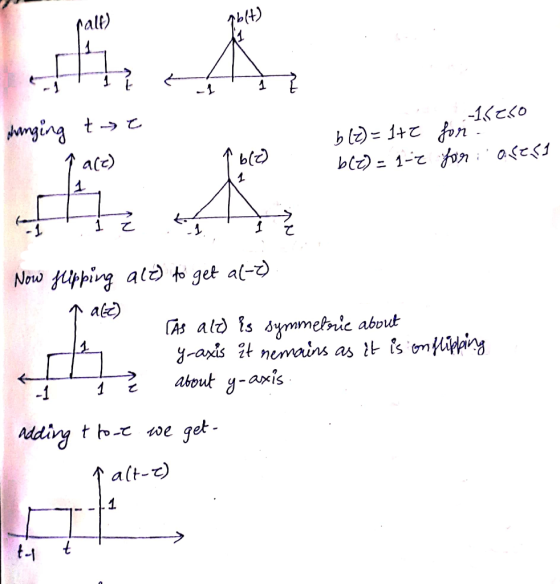
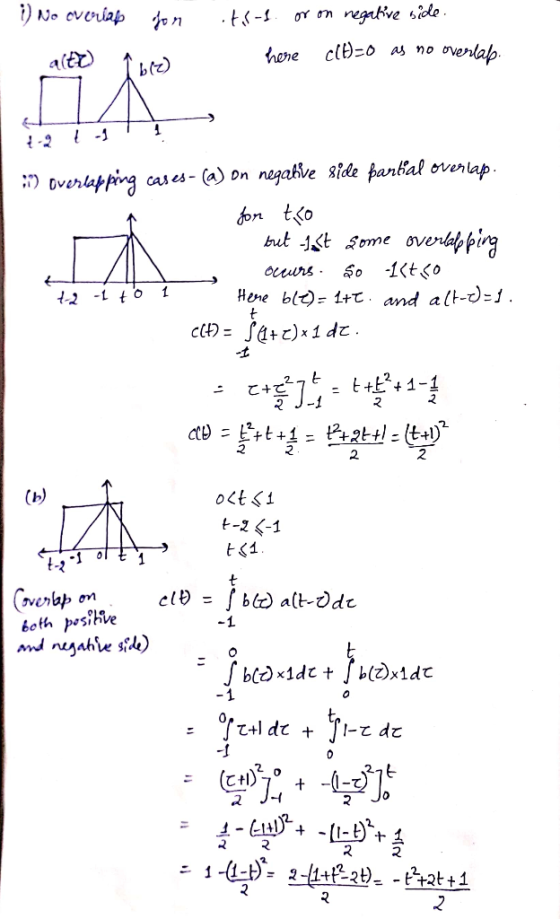
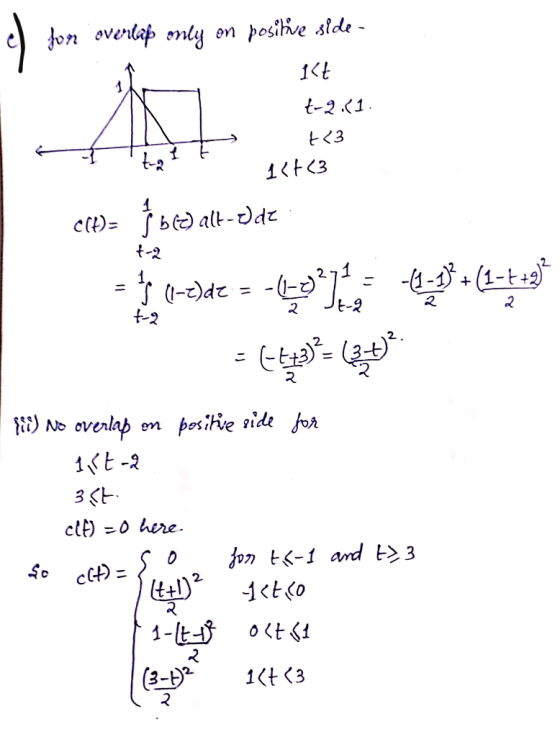
Consider two continuous time signals given below. Keeping b(t) as a fixed...
(b) Consider continuous-time signals xi(t) and x2(t) respectively given as (t +1 -1 <t<o x1(t) =...
 (b) Consider continuous-time signals xi(t) and x2(t) respectively given as (t +1 -1 <t<o x1(t) = { 2 Ost<2 , I 0 otherwise x2(t) = u(t) – uſt – 2). Find the convolution xı(t) * x2(t). (15 marks)
Question 2 (50 points]: Continuous-Time Signals Given the following continuous-time signal (t). (t) 5t (a) [4%]...
 Question 2 (50 points]: Continuous-Time Signals Given the following continuous-time signal (t). (t) 5t (a) [4%] What is the fundamental period (i.e., T) and fundamental frequency (ie, wo) of (+)? (b) [8%] Calculate the time average, average power and total energy of x(t). Is x(t) an energy signal? Explain. (c) [8%] Calculate the Fourier series coefficients of (t), i.e., {x}. [Hint: You can make use of the result in Q1(a).] (d) [8%] What is the percentage of power loss if...
6- A continuous-time periodic signal r(t) is given graphically below (a) Determine the exponential Fourier coefficients...
 6- A continuous-time periodic signal r(t) is given graphically below (a) Determine the exponential Fourier coefficients c for k+oo r(t) Cet k=-oo where ck is given by T/2 x(t)ejkwotdt -T/2 Ск T (b) (t) is applied as an input to an LTI system whose frequency response is H(jw)2 sin(w) = Determine the corresponding output y(t) (c) Sketch y(t). Be re to mark the ces properly su x(t)t 0 -T
6- A continuous-time periodic signal r(t) is given graphically below (a)...
6- A continuous-time periodic signal r(t) is given graphically below (a) Determine the exponential Fourier coefficients c for k+oo r(t) Cet k=-oo where ck is given by T/2 x(t)ejkwotdt -T/2 Ск T (b) (t) is applied as an input to an LTI system whose frequency response is H(jw)2 sin(w) = Determine the corresponding output y(t) (c) Sketch y(t). Be re to mark the ces properly su x(t)t 0 -T
6- A continuous-time periodic signal r(t) is given graphically below (a)...
answer a and b only Suppose that two continuous time signal are given by x(t) and...
 answer a and b only
Suppose that two continuous time signal are given by x(t) and v(t) as: x(t) = u(t) - 2u(t - 1) + u(t - 2) v(t) = u(t)- uſt - 1) Answer the following questions: (a) Plot signals x(t) and v(t). (b) Find the convolution of y(t) = x(t-3) = v(t) (c) Plot for y(t).
answer a and b only
Suppose that two continuous time signal are given by x(t) and v(t) as: x(t) = u(t) - 2u(t - 1) + u(t - 2) v(t) = u(t)- uſt - 1) Answer the following questions: (a) Plot signals x(t) and v(t). (b) Find the convolution of y(t) = x(t-3) = v(t) (c) Plot for y(t).
Consider a continuous time system given by the differential equation j(t) + 4y(t) + 4y(t) =...
 Consider a continuous time system given by the differential equation j(t) + 4y(t) + 4y(t) = 4ü(t) + 2i(t) + 4v(t). Suppose that the input v(t) is given by y(t) = e-2 u(t)where u(t)equals the step signal. Determine the corresponding response y(t), showing all your workings.
6- A continuous-time periodic signal r(t) is given graphically below (a) Determine the exponential Fourier coefficients...
 6- A continuous-time periodic signal r(t) is given graphically below (a) Determine the exponential Fourier coefficients c for k+oo r(t) Cet k=-oo where ck is given by T/2 x(t)ejkwotdt -T/2 Ск T (b) (t) is applied as an input to an LTI system whose frequency response is H(jw)2 sin(w) = Determine the corresponding output y(t) (c) Sketch y(t). Be re to mark the ces properly su x(t)t 0 -T
Use Matlab to create: Step continuous signal at any starting time, Ramp continuous signal at any...
Use Matlab to create: Step continuous signal at any starting time, Ramp continuous signal at any starting time, Add and subtract two signals, Shifted signals by any time
(a) Determine the Fourier transform of x(t) 26(t-1)-6(t-3) (b) Compute the convolution sum of the following signals, (6%) [696] (c) The Fourier transform of a continuous-time signal a(t) is given bel...
 (a) Determine the Fourier transform of x(t) 26(t-1)-6(t-3) (b) Compute the convolution sum of the following signals, (6%) [696] (c) The Fourier transform of a continuous-time signal a(t) is given below. Determine the [696] total energy of (t) 4 sin w (d) Determine the DC value and the average power of the following periodic signal. (6%) 0.5 0.5 (e) Determine the Nyquist rate for the following signal. (6%) x(t) = [1-0.78 cos(50nt + π/4)]2. (f) Sketch the frequency spectrum of...
please show all work and steps , thank you Exercise 3. Consider the continuous-time signal (t)...
 please show all work and steps
, thank you
Exercise 3. Consider the continuous-time signal (t) = sin(at) where a is a positive finite value. Let y(t) = zº(t). The following signals are sampled using a train of impulses with periodicity T, 8(t – kt): signal z(t) is sampled to obtain 2.(t), and signal y(t) is sampled to obtain yo(t). A) Determine the range of values for T that allows complete recovery of r(t) from .(t) [pt. 10]. B) Determine...
please show all work and steps
, thank you
Exercise 3. Consider the continuous-time signal (t) = sin(at) where a is a positive finite value. Let y(t) = zº(t). The following signals are sampled using a train of impulses with periodicity T, 8(t – kt): signal z(t) is sampled to obtain 2.(t), and signal y(t) is sampled to obtain yo(t). A) Determine the range of values for T that allows complete recovery of r(t) from .(t) [pt. 10]. B) Determine...
Consider a sampler which samples the continuous-time input signal x(t) at a sampling frequency fs =...
 Consider a sampler which samples the continuous-time input signal x(t) at a sampling frequency fs = 8000 Hz and produces at its output a sampled discrete-time signal x$(t) = x(nTs), where To = 1/fs is the sampling period. If the sampled signal is passed through a unity-gain lowpass filter with cutoff frequency of fs/2, sketch the magnitude spectrum of the resulting signal for the following input signals: (a) x(t) = cos(6000nt). (b) x(t) = cos(12000nt). (c) x(t) = cos(18000nt).
 (b) Consider continuous-time signals xi(t) and x2(t) respectively given as (t +1 -1 <t<o x1(t) = { 2 Ost<2 , I 0 otherwise x2(t) = u(t) – uſt – 2). Find the convolution xı(t) * x2(t). (15 marks)
 Question 2 (50 points]: Continuous-Time Signals Given the following continuous-time signal (t). (t) 5t (a) [4%] What is the fundamental period (i.e., T) and fundamental frequency (ie, wo) of (+)? (b) [8%] Calculate the time average, average power and total energy of x(t). Is x(t) an energy signal? Explain. (c) [8%] Calculate the Fourier series coefficients of (t), i.e., {x}. [Hint: You can make use of the result in Q1(a).] (d) [8%] What is the percentage of power loss if...
 6- A continuous-time periodic signal r(t) is given graphically below (a) Determine the exponential Fourier coefficients c for k+oo r(t) Cet k=-oo where ck is given by T/2 x(t)ejkwotdt -T/2 Ск T (b) (t) is applied as an input to an LTI system whose frequency response is H(jw)2 sin(w) = Determine the corresponding output y(t) (c) Sketch y(t). Be re to mark the ces properly su x(t)t 0 -T
6- A continuous-time periodic signal r(t) is given graphically below (a)...
6- A continuous-time periodic signal r(t) is given graphically below (a) Determine the exponential Fourier coefficients c for k+oo r(t) Cet k=-oo where ck is given by T/2 x(t)ejkwotdt -T/2 Ск T (b) (t) is applied as an input to an LTI system whose frequency response is H(jw)2 sin(w) = Determine the corresponding output y(t) (c) Sketch y(t). Be re to mark the ces properly su x(t)t 0 -T
6- A continuous-time periodic signal r(t) is given graphically below (a)...
 answer a and b only
Suppose that two continuous time signal are given by x(t) and v(t) as: x(t) = u(t) - 2u(t - 1) + u(t - 2) v(t) = u(t)- uſt - 1) Answer the following questions: (a) Plot signals x(t) and v(t). (b) Find the convolution of y(t) = x(t-3) = v(t) (c) Plot for y(t).
answer a and b only
Suppose that two continuous time signal are given by x(t) and v(t) as: x(t) = u(t) - 2u(t - 1) + u(t - 2) v(t) = u(t)- uſt - 1) Answer the following questions: (a) Plot signals x(t) and v(t). (b) Find the convolution of y(t) = x(t-3) = v(t) (c) Plot for y(t).
 Consider a continuous time system given by the differential equation j(t) + 4y(t) + 4y(t) = 4ü(t) + 2i(t) + 4v(t). Suppose that the input v(t) is given by y(t) = e-2 u(t)where u(t)equals the step signal. Determine the corresponding response y(t), showing all your workings.
 6- A continuous-time periodic signal r(t) is given graphically below (a) Determine the exponential Fourier coefficients c for k+oo r(t) Cet k=-oo where ck is given by T/2 x(t)ejkwotdt -T/2 Ск T (b) (t) is applied as an input to an LTI system whose frequency response is H(jw)2 sin(w) = Determine the corresponding output y(t) (c) Sketch y(t). Be re to mark the ces properly su x(t)t 0 -T
 (a) Determine the Fourier transform of x(t) 26(t-1)-6(t-3) (b) Compute the convolution sum of the following signals, (6%) [696] (c) The Fourier transform of a continuous-time signal a(t) is given below. Determine the [696] total energy of (t) 4 sin w (d) Determine the DC value and the average power of the following periodic signal. (6%) 0.5 0.5 (e) Determine the Nyquist rate for the following signal. (6%) x(t) = [1-0.78 cos(50nt + π/4)]2. (f) Sketch the frequency spectrum of...
 please show all work and steps
, thank you
Exercise 3. Consider the continuous-time signal (t) = sin(at) where a is a positive finite value. Let y(t) = zº(t). The following signals are sampled using a train of impulses with periodicity T, 8(t – kt): signal z(t) is sampled to obtain 2.(t), and signal y(t) is sampled to obtain yo(t). A) Determine the range of values for T that allows complete recovery of r(t) from .(t) [pt. 10]. B) Determine...
please show all work and steps
, thank you
Exercise 3. Consider the continuous-time signal (t) = sin(at) where a is a positive finite value. Let y(t) = zº(t). The following signals are sampled using a train of impulses with periodicity T, 8(t – kt): signal z(t) is sampled to obtain 2.(t), and signal y(t) is sampled to obtain yo(t). A) Determine the range of values for T that allows complete recovery of r(t) from .(t) [pt. 10]. B) Determine...
 Consider a sampler which samples the continuous-time input signal x(t) at a sampling frequency fs = 8000 Hz and produces at its output a sampled discrete-time signal x$(t) = x(nTs), where To = 1/fs is the sampling period. If the sampled signal is passed through a unity-gain lowpass filter with cutoff frequency of fs/2, sketch the magnitude spectrum of the resulting signal for the following input signals: (a) x(t) = cos(6000nt). (b) x(t) = cos(12000nt). (c) x(t) = cos(18000nt).
Most questions answered within 3 hours.
-
Where is the error in this code sequence?
String s1 = "Hello";
String s2 = "ello";...
asked 11 months ago -
Financial data for Joel de Paris, Inc., for last year
follow:
Joel de Paris, Inc.
Balance...
asked 11 months ago -
Consider this reaction:
Al2(SO4)3 (aq)+ BaCl3
(aq) Al2Cl6 (aq)- +
3BaSO4(s) . What is the...
asked 11 months ago -
Suppose that Savneet is considering increasing her
recent random sample from 20 car rentals to 40...
asked 1 year ago -
Trucks arrive at an unloading terminal at an average rate of 120
per hour.
Trucks arrive...
asked 1 year ago -
Why are methanol and ethanol completely soluble in water while
octanol is not very little soluble....
asked 1 year ago -
A facilities manager at a university reads in a research report
that the mean amount of...
asked 1 year ago -
When the CuSO4 is rehydrated by adding water to the anhydrous
compound, is this an endothermic...
asked 1 year ago -
A ray of sunlight is passing from diamond into crown glass; the
angle of incidence is...
asked 1 year ago -
A block of mass 0.249 kg is placed on top of a light, vertical
spring of...
asked 1 year ago -
how do the kidneys compensate in the presences of acidosis
a) trigger hyperventilate
b) reserve acid...
asked 1 year ago -
Question 501 pts
The rental rate of capital to the firm increases. Which of the
following...
asked 1 year ago