describe the process involved in the catalysis of a substrate by an enzyme and state how...
describe the process involved in the catalysis of a substrate by an enzyme and state how competitive inhibition and allosteric inhibition affect this catalysis
Homework Answers
substrates bind to the active site of the enzyme, the conformation of the enzyme is such that the substrates can bind to the active site then the enzyme-substrate complex forms, the enzyme reduces the activation energy of the reaction so that the reaction can occur fast, once the substrate is converted to product and product is released and the enzyme becomes free to catalyze the conversion of next molecules
the competitive inhibitor binds to the active site of the enzyme, so the substrate cannot bind so the enzyme is inhibited, but the binding of competitive inhibitor is reversible at high concentrations of the substrate the inhibitor is removed from the active site.
Allosteric inhibitors bind to the site other than active site and change the conformation of the protein so that the enzyme cannot bind to the substrate, allosteric regulation is reversible as the concentration of the regulator decreases the regulator is removed from the enzyme.
Add Answer to:
describe the process involved in the catalysis of a
substrate by an enzyme and state how...
describe the role of enzymes in the catalysis of biological reactions (include in the discussion substrate,...
describe the role of enzymes in the catalysis of biological reactions (include in the discussion substrate, product, active site, lock and key model, activation energy, enzyme substrate complex, and transition state complex, and steps of enzyme action)?
Chapter 8. Enzyme Regulation and Inhibition 1. Competitive inhibitors are always of which type? a) allosteric...
 Chapter 8. Enzyme Regulation and Inhibition 1. Competitive inhibitors are always of which type? a) allosteric b) irreversible c) reversible d) suicide 2. DIFP is: a) a competitive inhibitor b) an allosteric inhibitor c) a noncompetitive inhibitor d) a suicide inhibitor 3. Competitive inhibitors: a) bind to the active site b) bind to the enzyme-substrate complex c) bind outside the active site and decrease substrate binding d) bind outside the active site and decrease rate of catalysis.
enzyme has a molar mass of 30 kilodatons. From this information, calculate Keat for this enzyme-catalyzed...
 enzyme has a molar mass of 30 kilodatons. From this information, calculate Keat for this enzyme-catalyzed reaction both with and without inhibitor. Also explain from the data given on the graph which type of enzyme inhibition any is curring Series 1 - no inhibitor. Series 2 inhibitor present • Seriesi Series2 Linear (Series1) Linear (Series2) Chapter 8. Enzyme Regulation and Inhibition 1. Competitive inhibitors are always of which type? a) allosteric b) irreversible c) reversible d) suicide 2. DIFP is:...
A variety of factors influence enzyme activity. Substances that bind to the enzyme and interfere with...
 A variety of factors influence enzyme activity. Substances that bind to the enzyme and interfere with substrate binding or catalysis are inhibitors. Identify the type of inhibition associated with each of the descriptions and examples by classifying each statement as irreversible, competitive, or mixed inhibition. Irreversible inhibition Competitive inhibition Mixed inhibition Answer Bank the Al ion binds to acetylcholinesterase or to the acetylcholinesterase-substrate complex malonate, which resembles succinate, binds to the succinate dehydrogenase active site inhibitor may permanently modify an...
3. Why is an allosteric enzyme more sensitive to substrate concentration around Km values than a...
 3. Why is an allosteric enzyme more sensitive to substrate concentration around Km values than a Michaelis-Menten enzyme with the same Vmax? 4. Explain how pH and temperature influence enzyme activity. ( A Lineweaver-Burk (double reciprocal) plot was used to compare the effects of three different reversible inhibitors (A, B and C) on an enzyme. The plot of 1/V vs 1/[S] for the enzyme with no inhibitor is shown in a solid black line. The plot of 1/V vs 1/[S]...
( --/ Question 1 What is the incorrect statement about catalysis? The enzyme-substrate complex has lower...
 ( --/ Question 1 What is the incorrect statement about catalysis? The enzyme-substrate complex has lower free energy than the free substrate The stronger the enzyme-substrate interaction, the higher the Km value. At very high substrate concentrations, the reaction rate is independent of the substrate concentration. The enzyme-substrate complex is not the transition-state molecule. The higher the turnover number of a catalyst, the lower the catalyst concentration needed to reach a certain maximum reaction rate.
Consider the second enzyme in a metabolic pathway with three enzymes working in series. If the...
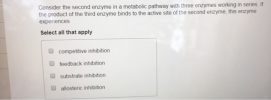 Consider the second enzyme in a metabolic pathway with three enzymes working in series. If the product of the third enzyme binds to the active site of the second enzyme, this enzyme experiences Select all that apply competitive inhibition feedback inhibition substrate inhibition allosteric inhibition
A variety of factors influence enzyme activity. Substances that bind to the enzyme and interfere with...
A variety of factors influence enzyme activity. Substances that bind to the enzyme and interfere with substrate binding or catalysis are inhibitors. Identify the type of inhibition associated with each of the following descriptions and examples by sorting each item into the appropriate bin. The bins are: irriversible inhibition, compenitive inhibition, mixed inhibition The phrases to sort are: -Tamiflu, a transition state analog, reversibly binds to neuraminidase - Inhibitor may perminantely modify an enzyme -DIPF permanently modifies the hydroxyl group...
How you would determine an enzyme regulation? Below is a series of results from tests of...
 How you would determine an enzyme regulation? Below is a series of results from tests of one particular enzyme. List all the potential methods of regulation still possible after each test. The options are: "genetic" control, zymogenic, phosphorylation, competitive inhibition, noncompetitive inhibition, positive allosteric regulation, and irreversible inhibition. 1. The enzyme is always present in the cell. 2. All tests only slow enzyme activity. 3. Adding more substrate does not increase reaction rate. 4. There seems to be a form...
describe how enzymes act as biological catalysts that occurs at the active site. Discuss catalysis and...
describe how enzymes act as biological catalysts that occurs at the active site. Discuss catalysis and competitive inhibition. how do each use the active site of the protein? what is an active site and why is it so inportant to biological catalysis.
 Chapter 8. Enzyme Regulation and Inhibition 1. Competitive inhibitors are always of which type? a) allosteric b) irreversible c) reversible d) suicide 2. DIFP is: a) a competitive inhibitor b) an allosteric inhibitor c) a noncompetitive inhibitor d) a suicide inhibitor 3. Competitive inhibitors: a) bind to the active site b) bind to the enzyme-substrate complex c) bind outside the active site and decrease substrate binding d) bind outside the active site and decrease rate of catalysis.
 enzyme has a molar mass of 30 kilodatons. From this information, calculate Keat for this enzyme-catalyzed reaction both with and without inhibitor. Also explain from the data given on the graph which type of enzyme inhibition any is curring Series 1 - no inhibitor. Series 2 inhibitor present • Seriesi Series2 Linear (Series1) Linear (Series2) Chapter 8. Enzyme Regulation and Inhibition 1. Competitive inhibitors are always of which type? a) allosteric b) irreversible c) reversible d) suicide 2. DIFP is:...
 A variety of factors influence enzyme activity. Substances that bind to the enzyme and interfere with substrate binding or catalysis are inhibitors. Identify the type of inhibition associated with each of the descriptions and examples by classifying each statement as irreversible, competitive, or mixed inhibition. Irreversible inhibition Competitive inhibition Mixed inhibition Answer Bank the Al ion binds to acetylcholinesterase or to the acetylcholinesterase-substrate complex malonate, which resembles succinate, binds to the succinate dehydrogenase active site inhibitor may permanently modify an...
 3. Why is an allosteric enzyme more sensitive to substrate concentration around Km values than a Michaelis-Menten enzyme with the same Vmax? 4. Explain how pH and temperature influence enzyme activity. ( A Lineweaver-Burk (double reciprocal) plot was used to compare the effects of three different reversible inhibitors (A, B and C) on an enzyme. The plot of 1/V vs 1/[S] for the enzyme with no inhibitor is shown in a solid black line. The plot of 1/V vs 1/[S]...
 ( --/ Question 1 What is the incorrect statement about catalysis? The enzyme-substrate complex has lower free energy than the free substrate The stronger the enzyme-substrate interaction, the higher the Km value. At very high substrate concentrations, the reaction rate is independent of the substrate concentration. The enzyme-substrate complex is not the transition-state molecule. The higher the turnover number of a catalyst, the lower the catalyst concentration needed to reach a certain maximum reaction rate.
 Consider the second enzyme in a metabolic pathway with three enzymes working in series. If the product of the third enzyme binds to the active site of the second enzyme, this enzyme experiences Select all that apply competitive inhibition feedback inhibition substrate inhibition allosteric inhibition
 How you would determine an enzyme regulation? Below is a series of results from tests of one particular enzyme. List all the potential methods of regulation still possible after each test. The options are: "genetic" control, zymogenic, phosphorylation, competitive inhibition, noncompetitive inhibition, positive allosteric regulation, and irreversible inhibition. 1. The enzyme is always present in the cell. 2. All tests only slow enzyme activity. 3. Adding more substrate does not increase reaction rate. 4. There seems to be a form...
Most questions answered within 3 hours.
-
Where is the error in this code sequence?
String s1 = "Hello";
String s2 = "ello";...
asked 11 months ago -
Financial data for Joel de Paris, Inc., for last year
follow:
Joel de Paris, Inc.
Balance...
asked 11 months ago -
Consider this reaction:
Al2(SO4)3 (aq)+ BaCl3
(aq) Al2Cl6 (aq)- +
3BaSO4(s) . What is the...
asked 11 months ago -
Suppose that Savneet is considering increasing her
recent random sample from 20 car rentals to 40...
asked 11 months ago -
Trucks arrive at an unloading terminal at an average rate of 120
per hour.
Trucks arrive...
asked 11 months ago -
Why are methanol and ethanol completely soluble in water while
octanol is not very little soluble....
asked 11 months ago -
A facilities manager at a university reads in a research report
that the mean amount of...
asked 11 months ago -
When the CuSO4 is rehydrated by adding water to the anhydrous
compound, is this an endothermic...
asked 11 months ago -
A ray of sunlight is passing from diamond into crown glass; the
angle of incidence is...
asked 11 months ago -
A block of mass 0.249 kg is placed on top of a light, vertical
spring of...
asked 11 months ago -
how do the kidneys compensate in the presences of acidosis
a) trigger hyperventilate
b) reserve acid...
asked 11 months ago -
Question 501 pts
The rental rate of capital to the firm increases. Which of the
following...
asked 11 months ago