What steps of transcription (initiation, elongation, termination) might be affected by a DNA mutation in the...
What steps of transcription (initiation, elongation, termination) might be affected by a DNA mutation in the template strand upstream of the promoter sequence? What about downstream?
Homework Answers
The effect of mutation depends upon the type of mutation.For the start, there are two type of mutations possible in template strand-
1.Substitution- In this kind of mutation one nitrogen base is replaced by another nitrogen base.This kind of mutation can affect Pribnow box in prokaryotes and Hogness box in Eukaryotes.
Pribnow box is basically a sequence of 6 base pairs (TATAAT) which is located 10 Nitrogen bases upstream of starting point in prokaryotes. It plays an important role in initiation step.
And hogness box is sequence of 7 base pairs (TATAAAA) which is located 20 Nitrogen bases upstream of starting point.It plays a similar role to pribnow box.
The substitution mutation in any of these sequence will affect the initiation step.
2. Frame Shift or Gibberish Mutation - It is loss of one or rarely more than one Nitrogen base.It shifts the whole sequence of bases.
So this kind of mutation will affect all three steps of transcription
The mutation downstream can cause change in terminator site and the Rho factor might not be able to detect the terminator site.
Rho factor ( factor ) is
specific protein which helps RNA polymerase enzyme to recognize the
terminator site.
factor ) is
specific protein which helps RNA polymerase enzyme to recognize the
terminator site.
And effect on the amino acids will again be decided by three type of mutations -
1. Mis-Sense Mutation- When change in nucleotide causes change in amino acid of polypeptide chain.
2. Non-sense mutation- When change in nucleotide causes termination of polypeptide synthesis.So it will affect the translation.
3.Non-Sense mutation-When change in nucleotide does not change amino acid.Because both codons code the same amino acid.
Add Answer to:
What steps of transcription (initiation, elongation,
termination) might be affected by a DNA mutation in the...
RNA polymerase releases the DNA template. Initiation Elongation Termination A process called clearance or escape. The...
 RNA polymerase releases the DNA template. Initiation Elongation Termination A process called clearance or escape. The RNA polymerase holoenzyme binds to the promoter A process called clearance or escape. Reaching a terminator sequence causos formation of phosphodiester bonds to stop. The RNA polymerase holoenzyme is formed. Once bound to the promoter, RNA polymerase begins to unwind the DNA. New nucleotides are added to the 3' end of the growing RNA transcript. The RNA-DNA hybrid within the transcription bubble dissociates New...
Describe/draw the three major steps (Initiation, Elongation and Termination) of transcription. In your description be sure...
Describe/draw the three major steps (Initiation, Elongation and Termination) of transcription. In your description be sure to point out significant DNA sequences and proteins involved and describe their role.
Place the labels in the columns. Initiation Elongation Termination Sigma factor involved Polymerase stops synthesizing copy...
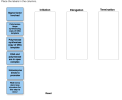 Place the labels in the columns. Initiation Elongation Termination Sigma factor involved Polymerase stops synthesizing copy of DNA template Polymerase synthesizes copy of DNA template DNA and polymerase are in open complex Holoenzyme binds to promoter RNA forms stem loop structure for this step to occur Reset
What DNA/RNA/protein(s) is/are involved in the following processes in... DNA Replication Transcription - Prokaryotes Transcription -...
 What DNA/RNA/protein(s) is/are involved in the following processes in... DNA Replication Transcription - Prokaryotes Transcription - Eukaryotes What serves as the template? Unwinding of DNA Initiation Elongation What direction does elongation occur? Termination What is the end product of this process? How many strands? Processing after?
Describe the process of Prokaryotic RNA transcription in molecular detail You must be able to describe the process and order of events in initiation, elongation, and termination. You must describe t...
Describe the process of Prokaryotic RNA transcription in molecular detail You must be able to describe the process and order of events in initiation, elongation, and termination. You must describe the catalytic/biological purpose function of the key proteins/elements in elongation -35 and -10 (Pribnow box) Promoters Sigma factors (does not matter which one) RNA Polymerase (including structure and subunits and mechanism) Rho-independent and rho-dependent termination How sequence composition affects promoter function
2. Transcription can be divided into 3 main stages: initiation, elongation, and termination, List the role...
 2. Transcription can be divided into 3 main stages: initiation, elongation, and termination, List the role and key characteristics of each stage in transcription
1. Using the following terms, describe the process of transcription a. Template strand, non-template/coding strand, DNA,...
 1. Using the following terms, describe the process of transcription a. Template strand, non-template/coding strand, DNA, RNA, RNA polymerase, 3 5, 5 3', uracil, promoter, termination sequence, enhancer, nucleus, cytoplasm. What process often follows transcription? How is the genetic code used in this process ?
Choose all that apply to the initiation of transcription Promoter segments Ribosome tRNA DNA polymerase Transcription...
 Choose all that apply to the initiation of transcription Promoter segments Ribosome tRNA DNA polymerase Transcription factors Question 25 (4 points) Saved Choose all the molecules that are used in transcription: a) primase b) DNA c) nucleotides d) RNA polymerase e) SSB (single strand binding protein)
Question 8 1 pts What do you think would be the most likely outcome if you...
 Question 8 1 pts What do you think would be the most likely outcome if you shortened the spacer region of a promoter from 17-mer to 7-mer? No transcription initiation Initiation would occur, but no elongation Transcription would occur normally There would be no termination of transcription The alpha subunits of RNAP would be required for successful initiation Question 9 1 pts During transcription the first RNA nucleotide is synthesized at what position relative to the promoter? 0-10 +1 Upstream...
Multiple types of RNAs are involved in translation. Choose the all the types of RNAs and...
 Multiple types of RNAs are involved in translation. Choose the all the types of RNAs and their functions in translation. a. mRNAs are templates that provide coding information to form proteins b. rRNAs are ribozymes that catalyze the addition of amino acids. c. mRNAs are adaptor molecules that contain amino acids. d. tRNAs are ribozymes that catalyze the addition of amino acids. e.rRNAs are templates that provide coding information to form proteins. O f. tRNAs are adaptor molecules that contain...
 RNA polymerase releases the DNA template. Initiation Elongation Termination A process called clearance or escape. The RNA polymerase holoenzyme binds to the promoter A process called clearance or escape. Reaching a terminator sequence causos formation of phosphodiester bonds to stop. The RNA polymerase holoenzyme is formed. Once bound to the promoter, RNA polymerase begins to unwind the DNA. New nucleotides are added to the 3' end of the growing RNA transcript. The RNA-DNA hybrid within the transcription bubble dissociates New...
 Place the labels in the columns. Initiation Elongation Termination Sigma factor involved Polymerase stops synthesizing copy of DNA template Polymerase synthesizes copy of DNA template DNA and polymerase are in open complex Holoenzyme binds to promoter RNA forms stem loop structure for this step to occur Reset
 What DNA/RNA/protein(s) is/are involved in the following processes in... DNA Replication Transcription - Prokaryotes Transcription - Eukaryotes What serves as the template? Unwinding of DNA Initiation Elongation What direction does elongation occur? Termination What is the end product of this process? How many strands? Processing after?
 2. Transcription can be divided into 3 main stages: initiation, elongation, and termination, List the role and key characteristics of each stage in transcription
 1. Using the following terms, describe the process of transcription a. Template strand, non-template/coding strand, DNA, RNA, RNA polymerase, 3 5, 5 3', uracil, promoter, termination sequence, enhancer, nucleus, cytoplasm. What process often follows transcription? How is the genetic code used in this process ?
 Choose all that apply to the initiation of transcription Promoter segments Ribosome tRNA DNA polymerase Transcription factors Question 25 (4 points) Saved Choose all the molecules that are used in transcription: a) primase b) DNA c) nucleotides d) RNA polymerase e) SSB (single strand binding protein)
 Question 8 1 pts What do you think would be the most likely outcome if you shortened the spacer region of a promoter from 17-mer to 7-mer? No transcription initiation Initiation would occur, but no elongation Transcription would occur normally There would be no termination of transcription The alpha subunits of RNAP would be required for successful initiation Question 9 1 pts During transcription the first RNA nucleotide is synthesized at what position relative to the promoter? 0-10 +1 Upstream...
 Multiple types of RNAs are involved in translation. Choose the all the types of RNAs and their functions in translation. a. mRNAs are templates that provide coding information to form proteins b. rRNAs are ribozymes that catalyze the addition of amino acids. c. mRNAs are adaptor molecules that contain amino acids. d. tRNAs are ribozymes that catalyze the addition of amino acids. e.rRNAs are templates that provide coding information to form proteins. O f. tRNAs are adaptor molecules that contain...
Most questions answered within 3 hours.
-
Where is the error in this code sequence?
String s1 = "Hello";
String s2 = "ello";...
asked 11 months ago -
Financial data for Joel de Paris, Inc., for last year
follow:
Joel de Paris, Inc.
Balance...
asked 11 months ago -
Consider this reaction:
Al2(SO4)3 (aq)+ BaCl3
(aq) Al2Cl6 (aq)- +
3BaSO4(s) . What is the...
asked 11 months ago -
Suppose that Savneet is considering increasing her
recent random sample from 20 car rentals to 40...
asked 11 months ago -
Trucks arrive at an unloading terminal at an average rate of 120
per hour.
Trucks arrive...
asked 11 months ago -
Why are methanol and ethanol completely soluble in water while
octanol is not very little soluble....
asked 11 months ago -
A facilities manager at a university reads in a research report
that the mean amount of...
asked 11 months ago -
When the CuSO4 is rehydrated by adding water to the anhydrous
compound, is this an endothermic...
asked 11 months ago -
A ray of sunlight is passing from diamond into crown glass; the
angle of incidence is...
asked 11 months ago -
A block of mass 0.249 kg is placed on top of a light, vertical
spring of...
asked 11 months ago -
how do the kidneys compensate in the presences of acidosis
a) trigger hyperventilate
b) reserve acid...
asked 11 months ago -
Question 501 pts
The rental rate of capital to the firm increases. Which of the
following...
asked 11 months ago