Of the following four anthropometric parameters; mass, center of mass, segment length and moment of inertia;...
Of the following four anthropometric parameters; mass, center of mass, segment length and moment of inertia; which one is not necessary for static biomechanical modeling. Explain.
Homework Answers
Answer: In static modelling moment of inertia is not needed. Moment of inertia is used for dynamic modelling. Rest of all parameters are necessary for static modelling.
In dynamic modelling, when there is an angular acceleration due to applied torque then inertia torque = moment of inertia multiplied by angular acceleration is used.
Add Answer to:
Of the following four anthropometric
parameters; mass, center of mass, segment length and moment of
inertia;...
1. Finding the Moment of Inertia of a Uniform Thin Rod with mass M and length...
 1. Finding the Moment of Inertia of a Uniform Thin Rod with mass M and length L rotating about its center (a thin rod is a ID object; in the figure the rod has a thickness for clarity): For this problem, use a coordinate axis with its origin at the rod's center and let the rod extend along the x axis as shown here (in other problems, you will need to generate the diagram): dx dm Now, we select a...
6. (a) Calculate the moment of inertia about the center of mass. (b) Calculate h, the...
 6. (a) Calculate the moment of inertia about the center of mass. (b) Calculate h, the moment of inertia about an axis through point B. Point B coincides with (the center of) one of the spheres (see the figure). (c) Calculate Ic, the moment of inertia about an axis through point C. Point C is located a distance r from the center of mass (see the figure). (d) Calculate kinetic energy when it rotates about an axis through C with...
6. Find the moment of inertia, I, of a stick of length L and mass M...
 6. Find the moment of inertia, I, of a stick of length L and mass M rotating about its center. (Show all your work as you integrate I) 2. M-3 2. gher
The Parallel-Axis Theorem allows one to find the moment of inertia of an object if the...
The Parallel-Axis Theorem allows one to find the moment of inertia of an object if the moment of inertia through the center of mass (c.o.m.) is known and the second axis is parallel to the axis through the c.o.m.. The equation is given by I= Icom +md2, where Icom is the moment of inertia about an axis through the c.o.m., m is the mass of the object, d is the perpendicular distance from the axis through the c.o.m. to the...
Tables of Second moment of inertia and mass moment of inertia are provided at the end...
 Tables of Second moment of inertia and mass moment of inertia are provided at the end of the assignment. Be sure that you are looking at the right table. Mass moments have units of mass length2, second moment of inertia have units of length Problem 1 (10 pts) A floor joist has a 1" hole drilled in it to accommodate a water pipe. (see Figure at left). Compare the 2nd moment of inertia of the beam about the x axis...
(3) 8. The moment of inertia of a spherical shell about it's center is 2/3 MRS....
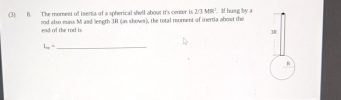 (3) 8. The moment of inertia of a spherical shell about it's center is 2/3 MRS. If hung by a rod also mass M and length 3R (as shown), the total moment of inertia about the end of the rod is
The moment of inertia of the human body about an axis through its center of mass is important in the application of bio...
 The moment of inertia of the human body about an axis through
its center of mass is important in the application of biomechanics
to sports such as diving and gymnastics. We can measure the body's
moment of inertia in a particular position while a person remains
in that position on a horizontal turntable, with the bodys center
of mass on the turntable's rotational axis. The turntable with the
person on it is then accelerated from rest by a torque that...
The moment of inertia of the human body about an axis through
its center of mass is important in the application of biomechanics
to sports such as diving and gymnastics. We can measure the body's
moment of inertia in a particular position while a person remains
in that position on a horizontal turntable, with the bodys center
of mass on the turntable's rotational axis. The turntable with the
person on it is then accelerated from rest by a torque that...
In the figure a stone of mass 14 kg has a moment of inertia of 2.4...
In the figure a stone of mass 14 kg has a moment of inertia of 2.4 kg . m^2 about an axis A which is parallel to an axis through the center of mass. Axis A is .20 m from the center of mass axis. with the help of the parallel axis thm: determine the moment of inertia about the center of mass axis.
QUESTION 1 A uniform bar of total mass m and total length L has been bent into an L-shape such th...
 QUESTION 1 A uniform bar of total mass m and total length L has been bent into an L-shape such that the shorter segment is 1/4 of the total length. The free end of the longer segment is connected to a fixed frame with a frictionless revolute joint at A and the rod is initially held stationary with the longer segment horizontal and the shorter segment vertical as shown in the figure below. 3L 4 4 The horizontal distance from...
44. The system shown in Fig. P7 consists of a slider block of mass m2 and a uniform slender rod of mass m3, length 13, and mass moment of inertia about its center of mass J The slider block is connec...
 44. The system shown in Fig. P7 consists of a slider block of mass m2 and a uniform slender rod of mass m3, length 13, and mass moment of inertia about its center of mass J The slider block is connected to the ground by a spring that has a stiffness coefficient k. The slider block is subjected to the force F(t), while the rod is subjected to the moment M. Obtain the differential equations of motion of this two-degree-of-freedom...
 1. Finding the Moment of Inertia of a Uniform Thin Rod with mass M and length L rotating about its center (a thin rod is a ID object; in the figure the rod has a thickness for clarity): For this problem, use a coordinate axis with its origin at the rod's center and let the rod extend along the x axis as shown here (in other problems, you will need to generate the diagram): dx dm Now, we select a...
 6. (a) Calculate the moment of inertia about the center of mass. (b) Calculate h, the moment of inertia about an axis through point B. Point B coincides with (the center of) one of the spheres (see the figure). (c) Calculate Ic, the moment of inertia about an axis through point C. Point C is located a distance r from the center of mass (see the figure). (d) Calculate kinetic energy when it rotates about an axis through C with...
 6. Find the moment of inertia, I, of a stick of length L and mass M rotating about its center. (Show all your work as you integrate I) 2. M-3 2. gher
 Tables of Second moment of inertia and mass moment of inertia are provided at the end of the assignment. Be sure that you are looking at the right table. Mass moments have units of mass length2, second moment of inertia have units of length Problem 1 (10 pts) A floor joist has a 1" hole drilled in it to accommodate a water pipe. (see Figure at left). Compare the 2nd moment of inertia of the beam about the x axis...
 (3) 8. The moment of inertia of a spherical shell about it's center is 2/3 MRS. If hung by a rod also mass M and length 3R (as shown), the total moment of inertia about the end of the rod is
 The moment of inertia of the human body about an axis through
its center of mass is important in the application of biomechanics
to sports such as diving and gymnastics. We can measure the body's
moment of inertia in a particular position while a person remains
in that position on a horizontal turntable, with the bodys center
of mass on the turntable's rotational axis. The turntable with the
person on it is then accelerated from rest by a torque that...
The moment of inertia of the human body about an axis through
its center of mass is important in the application of biomechanics
to sports such as diving and gymnastics. We can measure the body's
moment of inertia in a particular position while a person remains
in that position on a horizontal turntable, with the bodys center
of mass on the turntable's rotational axis. The turntable with the
person on it is then accelerated from rest by a torque that...
 QUESTION 1 A uniform bar of total mass m and total length L has been bent into an L-shape such that the shorter segment is 1/4 of the total length. The free end of the longer segment is connected to a fixed frame with a frictionless revolute joint at A and the rod is initially held stationary with the longer segment horizontal and the shorter segment vertical as shown in the figure below. 3L 4 4 The horizontal distance from...
 44. The system shown in Fig. P7 consists of a slider block of mass m2 and a uniform slender rod of mass m3, length 13, and mass moment of inertia about its center of mass J The slider block is connected to the ground by a spring that has a stiffness coefficient k. The slider block is subjected to the force F(t), while the rod is subjected to the moment M. Obtain the differential equations of motion of this two-degree-of-freedom...
Most questions answered within 3 hours.
-
Where is the error in this code sequence?
String s1 = "Hello";
String s2 = "ello";...
asked 11 months ago -
Financial data for Joel de Paris, Inc., for last year
follow:
Joel de Paris, Inc.
Balance...
asked 11 months ago -
Consider this reaction:
Al2(SO4)3 (aq)+ BaCl3
(aq) Al2Cl6 (aq)- +
3BaSO4(s) . What is the...
asked 11 months ago -
Suppose that Savneet is considering increasing her
recent random sample from 20 car rentals to 40...
asked 11 months ago -
Trucks arrive at an unloading terminal at an average rate of 120
per hour.
Trucks arrive...
asked 11 months ago -
Why are methanol and ethanol completely soluble in water while
octanol is not very little soluble....
asked 11 months ago -
A facilities manager at a university reads in a research report
that the mean amount of...
asked 11 months ago -
When the CuSO4 is rehydrated by adding water to the anhydrous
compound, is this an endothermic...
asked 11 months ago -
A ray of sunlight is passing from diamond into crown glass; the
angle of incidence is...
asked 11 months ago -
A block of mass 0.249 kg is placed on top of a light, vertical
spring of...
asked 11 months ago -
how do the kidneys compensate in the presences of acidosis
a) trigger hyperventilate
b) reserve acid...
asked 11 months ago -
Question 501 pts
The rental rate of capital to the firm increases. Which of the
following...
asked 11 months ago