Australia’s budget is set to return to a surplus of $4.1 billion in the 2019/20 financial...
Australia’s budget is set to return to a surplus of $4.1 billion in the 2019/20 financial year, according to the Mid-Year Economic and Fiscal Outlook.
- Suppose that the said surplus eventuates as predicted. Using a loanable funds graph, explain the effects of a government budget surplus on the loanable funds market. Explain how it effects the quantity of loanable funds, real interest rate and investment.
Homework Answers
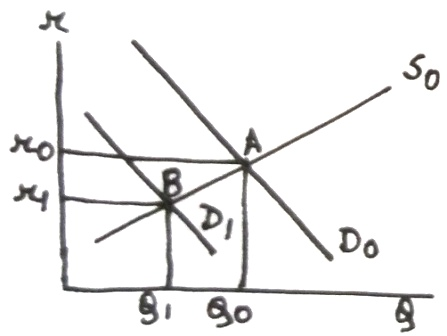
A budget surplus reduces government borrowing for deficit financing purposes. Since borrowing is demand for loanable funds, lower borrowing reduces demand for loanable funds, shifting demand curve leftward. Supply curve remaining unchanged, this decreases real interest rate and decreases the quantity of loanable funds (investment).
In following graph, D0 and S0 are initial demand and supply curves for loanable funds intersecting at point A with initial interest rate r0 and quantity of loanable funds (investment) Q0. As D0 shifts left to D1, it intersects S0 at point B with lower interest rate r1 and lower quantity of loanable funds (investment) Q1.
Add Answer to:
Australia’s budget is set to return to a surplus of $4.1 billion
in the 2019/20 financial...
The following table shows the supply and demand for loanable funds schedule in a small island...
 The following table shows the supply and demand for loanable funds schedule in a small island country in the Caribbean at the beginning of 2016. By the end of the year however, the demand for loanable funds increases by $2 billion at each level of the real interest rate and the supply of loanable funds increased by $1 billion at each interest rate. Predict the conditions of the loanable funds market in this country, under the following two scenarios: Scenario...
Q1 Suppose that investment (I) is $400 billion, private saving (S) is $400 billion, (autonomous) taxes (T) are $500 billion, exports (X) are $300 billion, and imports (M) are $200 billion. (a)...
Q1 Suppose that investment (I) is $400 billion, private saving (S) is $400 billion, (autonomous) taxes (T) are $500 billion, exports (X) are $300 billion, and imports (M) are $200 billion. (a) What is the government expenditure on goods and services? (Hint: S=Yd-C) (b) What is the government budget balance? For parts (c) and (d), think of the loanable funds approach: (c) Is the government exerting a positive or negative impact on investment? (d) What fiscal policy action might increase...
1) Rio de Janeiro requested federal funding to help pay for public services during the Olympics,...
1) Rio de Janeiro requested federal funding to help pay for public services during the Olympics, at a time when Brazil’s federal government revenue has fallen and created a large deficit. Source: International Business Times, July 15, 2016 Draw a graph of the loanable funds market in Brazil. Suppose that the Brazilian government borrows the required funds in the loanable funds market. How will this borrowing change the real interest rate and the quantity of saving in Brazil? (6 points)...
Real interest rate (percent per year) 9.07 SLF The graph shows the supply of loanable funds...
 Real interest rate (percent per year) 9.07 SLF The graph shows the supply of loanable funds and the demand for loanable funds in an economy Suppose the government has a budget deficit of $0.2 trillion and the Ricardo-Barro effect holds. Draw the new demand for loanable funds curve. Label it. Draw the new supply of loanable funds curve. Label it. Draw a point that shows the equilibrium quantity of loanable funds and interest rate. The Ricardo-Barro effect is the proposition...
Let assume an economy in this year with the following loanable funds (LF) market demand equation....
 Let assume an economy in this year with the following loanable funds (LF) market demand equation. Demand: r = 8 – 0.005 * Qp Where, r is the real interest rate (ifr=12 then the interest rate is 12%), Q, in the quantity demanded of loanable funds (total investment). The government expenditures (G) is $300 billion, collected taxes (T) equal to $700 billion, and private saving is $800 billion. 1. Calculate the value of government savings in this economy. Is the...
Q.1 (15 points) Assume that the equilibrium in the loanable funds market is at an interest...
 Q.1 (15 points) Assume that the equilibrium in the loanable funds market is at an interest rate of 5% and the total quantity of loans is $650 billion. In addition, in this initial situation, the government is borrowing $80 billion per year to fund the budget deficit. (a) How much is the private investment in this initial equilibrium? (b) Now the government increases spending by $320 billion per year and finances this spending completely with additional borrowing. (i) Draw a...
“The Hong Kong government has announced 120 billion Hong Kong dollars ($15.4 billion) worth of measures...
“The Hong Kong government has announced 120 billion Hong Kong dollars ($15.4 billion) worth of measures to support an economy that’s been dragged down by pro-democracy protests and the new coronavirus outbreak. That planned spending would result in “an all-time high” fiscal deficit of 139.1 billion Hong Kong dollars for the coming financial year…”. (source: CNBC. Hong Kong plans $15 billion spending to support its economy amid coronavirus outbreak.2020/02/26) Analyse the impact of the budget deficit mentioned above on the...
Using a supply and demand graph as well as written explanations, explain what would happen to...
Using a supply and demand graph as well as written explanations, explain what would happen to the demand, supply, and the equilibrium Real Risk-Free Interest rate (RRFR) in the domestic real loanable funds (credit) market for each of the following scenarios: a. USA: The federal government budget deficit is expected to continue to decrease during the 2019 fiscal year.
The Current U.S. government spending is $4.746 trillion. That's the federal budget for fiscal year 2020...
The Current U.S. government spending is $4.746 trillion. That's the federal budget for fiscal year 2020 covering October 1, 2019, to September 30, 2020. It's 21% of gross domestic product. That means that Government Spending in the United States has increased under the current U.S. Administration. Additionally, last year the Congress passed a tax reform that, among other effects, cut payroll taxes: i) Can you establish the macroeconomics effects of these policies on consumption, investment, interest rate and savings? Use...
Macroeconomics (consumption, investment and loanable funds) question. The Current U.S. government spending is $4.746 trillion. That's...
Macroeconomics (consumption, investment and loanable funds) question. The Current U.S. government spending is $4.746 trillion. That's the federal budget for fiscal year 2020 covering October 1, 2019, to September 30, 2020. It's 21% of gross domestic product. That means that Government Spending in the United States has increased under the current U.S. Administration. Additionally, last year the Congress passed a tax reform that, among other effects, cut payroll taxes: i) Can you establish the macroeconomics effects of these policies on...
 The following table shows the supply and demand for loanable funds schedule in a small island country in the Caribbean at the beginning of 2016. By the end of the year however, the demand for loanable funds increases by $2 billion at each level of the real interest rate and the supply of loanable funds increased by $1 billion at each interest rate. Predict the conditions of the loanable funds market in this country, under the following two scenarios: Scenario...
 Real interest rate (percent per year) 9.07 SLF The graph shows the supply of loanable funds and the demand for loanable funds in an economy Suppose the government has a budget deficit of $0.2 trillion and the Ricardo-Barro effect holds. Draw the new demand for loanable funds curve. Label it. Draw the new supply of loanable funds curve. Label it. Draw a point that shows the equilibrium quantity of loanable funds and interest rate. The Ricardo-Barro effect is the proposition...
 Let assume an economy in this year with the following loanable funds (LF) market demand equation. Demand: r = 8 – 0.005 * Qp Where, r is the real interest rate (ifr=12 then the interest rate is 12%), Q, in the quantity demanded of loanable funds (total investment). The government expenditures (G) is $300 billion, collected taxes (T) equal to $700 billion, and private saving is $800 billion. 1. Calculate the value of government savings in this economy. Is the...
 Q.1 (15 points) Assume that the equilibrium in the loanable funds market is at an interest rate of 5% and the total quantity of loans is $650 billion. In addition, in this initial situation, the government is borrowing $80 billion per year to fund the budget deficit. (a) How much is the private investment in this initial equilibrium? (b) Now the government increases spending by $320 billion per year and finances this spending completely with additional borrowing. (i) Draw a...
Most questions answered within 3 hours.
-
Where is the error in this code sequence?
String s1 = "Hello";
String s2 = "ello";...
asked 10 months ago -
Financial data for Joel de Paris, Inc., for last year
follow:
Joel de Paris, Inc.
Balance...
asked 10 months ago -
Consider this reaction:
Al2(SO4)3 (aq)+ BaCl3
(aq) Al2Cl6 (aq)- +
3BaSO4(s) . What is the...
asked 10 months ago -
Suppose that Savneet is considering increasing her
recent random sample from 20 car rentals to 40...
asked 10 months ago -
Trucks arrive at an unloading terminal at an average rate of 120
per hour.
Trucks arrive...
asked 10 months ago -
Why are methanol and ethanol completely soluble in water while
octanol is not very little soluble....
asked 10 months ago -
A facilities manager at a university reads in a research report
that the mean amount of...
asked 10 months ago -
When the CuSO4 is rehydrated by adding water to the anhydrous
compound, is this an endothermic...
asked 10 months ago -
A ray of sunlight is passing from diamond into crown glass; the
angle of incidence is...
asked 10 months ago -
A block of mass 0.249 kg is placed on top of a light, vertical
spring of...
asked 10 months ago -
how do the kidneys compensate in the presences of acidosis
a) trigger hyperventilate
b) reserve acid...
asked 10 months ago -
Question 501 pts
The rental rate of capital to the firm increases. Which of the
following...
asked 10 months ago