I have to deduce a couple of compounds based on NMR spectra, formulas given, and the...
I have to deduce a couple of compounds based on NMR spectra, formulas given, and the reactions they undergo. I'm having trouble with figuring out the product of a couple of reactions- as in, whether they are alcohols, ketones,carbonyls (of that sort- no halides or anything, all of the general formula CxHyOz).
Organic Chem
Compound A, C9H18O slowly reacted with metallic sodium to give off hydrogen gas- after all the sodium was reacted, it was treated with iodomethane to give compound B, C10H20O.
Compound B did not react with sodium, and is converted into compound C, C9H18O2, if heated with a solution of potassium dichromate in sulfuric acid.
My question is what compound reacts with metallic sodium and then an alkyl halide, and then the product of that undergoes the oxidation of potassium dichromate? At first I thought B was an ether, but ethers cant be oxidized to COOH. Thus, what type of organic molecule is A and B? I can draw out the structures myself, I just want to know whether A and B are alcohols, ketones, aldehydes, etc. Also, what kind of molecule slowly reacts with metallic sodium to give off hydrogen gas?
Homework Answers
This is a really nice question! Enjoyed working it out!
You see, first of all, you compare a few things between compounds A, B and C. Compounds A and B differ by a CH2 unit while compounds A and C differ by one O atom. Compounds B and C however differ by both one CH2 and one O atom.
Now take into consideration the last comparison b/w B and C. It seems like one CH2 group as been replaced by an O atom (That is how we end up with a CH2 being less and an O being extra in compound C) while converting from B to C. So definitely, it must be an oxidation process where a CH2 is being ripped off and replaced by O. And we can see such cases in terminal double bond oxidations.

So our B must have a double bond to be chopped off, and that too a terminal one 'cause that's how you're gonna get one CH2 less.
Now coming to A. A is seen to react slowly with Na right? Remember acidic hydrogens react with Na metal to liberate hydrogen gas. Also remember: alpha hydrogens of aldehydes and ketones are weakly acidic. Correlate these two facts and you have some idea about the structure of A - probably a methyl ketone.
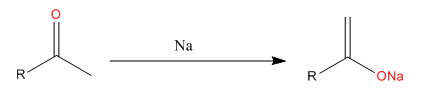
Now in the enolate we have the required terminal double bond, but enolates are not isolable intermediates! We need to trap 'em with an electrophile. There comes your halide. So,

And now we have a vinyl ether which is your compound B, your compound A being a methyl ketone.
This when reacted with an oxidizing agent readily chopps off the double bond to give you an ester which is your compound C.
You can verify the result by matching the molecular formula for each of the species I mentioned.
Add Answer to:
I have to deduce a couple of compounds based on NMR spectra,
formulas given, and the...
i only need g, h and I please Classifying Chemical Reactions continued Classifying Chemical Reactions continued...
 i
only need g, h and I please
Classifying Chemical Reactions continued Classifying Chemical Reactions continued 3. Write a balanced chemical equation for each reaction and classify the reaction. a. Copper metal heated with oxygen gives solid copper(II)oxide. 4 cu +02 → 2420 (5) combination reachon b. Mixing ammonium nitrate and sodium hydroxide solutions gives aqueous sodium nitrate, ammonia gas, and water. NHL NO2+ NaOH -> Na NO₃(aq) + NH₃ (9)+H₂O (e) double replacement c. Mercury(II) nitrate solution reacts with...
i
only need g, h and I please
Classifying Chemical Reactions continued Classifying Chemical Reactions continued 3. Write a balanced chemical equation for each reaction and classify the reaction. a. Copper metal heated with oxygen gives solid copper(II)oxide. 4 cu +02 → 2420 (5) combination reachon b. Mixing ammonium nitrate and sodium hydroxide solutions gives aqueous sodium nitrate, ammonia gas, and water. NHL NO2+ NaOH -> Na NO₃(aq) + NH₃ (9)+H₂O (e) double replacement c. Mercury(II) nitrate solution reacts with...
Please help me figure out what A,B, and C are! The bolded is what is provided...
 Please help me figure out what A,B, and C are! The bolded is
what is provided by the prompt and my notes are the unbolded. IR
for Compound B and D shown.
Compound A, C7H14O2 did
not discharge precipitate in dilute permanganate solution or give a
precipitate with 2,4, DNP or with ceric nitrate.
2,4 DNP tests for aldehydes and ketones
Ceric nitrate tests for alcohols
Potassium Permanganate tests for double bonds
So compound A has 1 degree of unsaturation...
Please help me figure out what A,B, and C are! The bolded is
what is provided by the prompt and my notes are the unbolded. IR
for Compound B and D shown.
Compound A, C7H14O2 did
not discharge precipitate in dilute permanganate solution or give a
precipitate with 2,4, DNP or with ceric nitrate.
2,4 DNP tests for aldehydes and ketones
Ceric nitrate tests for alcohols
Potassium Permanganate tests for double bonds
So compound A has 1 degree of unsaturation...
#46 a-g, i-n, p, q please help, I need answers asap. will give thumbs up right...
 #46 a-g, i-n, p, q
please help, I need answers asap. will give thumbs up right
away.
organic chemistry, the mechanisms, regiochemistry, and stercochemistry are your grammar. You must develop facility with te reactions, as you develop facility with the words and grammar you use in speaking. Problems and multistep syntheses are e sentences of organic chemistry. You must practice combining all aspects of your vocabulary in solving these problems tudents who fail organic chemistry exams often do so because...
#46 a-g, i-n, p, q
please help, I need answers asap. will give thumbs up right
away.
organic chemistry, the mechanisms, regiochemistry, and stercochemistry are your grammar. You must develop facility with te reactions, as you develop facility with the words and grammar you use in speaking. Problems and multistep syntheses are e sentences of organic chemistry. You must practice combining all aspects of your vocabulary in solving these problems tudents who fail organic chemistry exams often do so because...
Please answer in half an hour!!!Thanks!!only need answer, please reply as quick as possible. Thankxx (I...
 Please answer in half an hour!!!Thanks!!only need answer,
please reply as quick as possible. Thankxx (I will like your
reply)
20. Which of the substances below is least soluble in water? A. CH2OHCHOHCH20H B. CH C. CHO,COH D. 21. Which substance(s) could be formed during the incomplete combustion of a hydrocarbon? 1. Carbon IL. Hydrogen III. Carbon monoxide A. I only B. I and II only C. 1 and IlI only D. Il and IIl only 22. What is the...
Please answer in half an hour!!!Thanks!!only need answer,
please reply as quick as possible. Thankxx (I will like your
reply)
20. Which of the substances below is least soluble in water? A. CH2OHCHOHCH20H B. CH C. CHO,COH D. 21. Which substance(s) could be formed during the incomplete combustion of a hydrocarbon? 1. Carbon IL. Hydrogen III. Carbon monoxide A. I only B. I and II only C. 1 and IlI only D. Il and IIl only 22. What is the...
EXPERIMENT 11 THE MICROSCALE REDUCTION OF BENZIL WITH SODIUM BOROHYDRIDE INTRODUCTION Oxidation-reduction (redox) reactions occur in...
 EXPERIMENT 11 THE MICROSCALE REDUCTION OF BENZIL WITH SODIUM BOROHYDRIDE INTRODUCTION Oxidation-reduction (redox) reactions occur in concert. One substance undergoes oxidation by donating electrons to another substance that is then reduced. In organic chemistry certain rules are followed in determining whether a particular substrate is being oxidized or reduced. Oxidation: The loss of hydrogen and/or gain of oxygen by a substrate Reduction: The gain of hydrogen and/or loss of oxygen by a substrate When an organic substrate is reduced, the...
Can you help me determine if I am correct and help me find the ither answers...
 Can
you help me determine if I am correct and help me find the ither
answers to this functional group lab worksheet?
18 w paper 1 we by addin trecome char Discussion of Properties and Test Ora general undergo dition reactions, whereas by substitution reactions. These two types of d e beds and womate compounds we characterized described in equation form as follows: action Addition Reaction Substitution Reaction (Note: numbers in boxes to the left refer to w in the...
Can
you help me determine if I am correct and help me find the ither
answers to this functional group lab worksheet?
18 w paper 1 we by addin trecome char Discussion of Properties and Test Ora general undergo dition reactions, whereas by substitution reactions. These two types of d e beds and womate compounds we characterized described in equation form as follows: action Addition Reaction Substitution Reaction (Note: numbers in boxes to the left refer to w in the...
I need help with this Unknown! Worksheet 4: Identification of Unknown Organic Compounds Reading: For a...
 I need help with this Unknown!
Worksheet 4: Identification of Unknown Organic Compounds Reading: For a quick video about the "Rule of 13" https://www.youtube.com/watch?v=2YNE7w_GQlo Introduction One of the most important tasks that chemists are faced with is the separation and identification of compounds from mixtures. Gratifyingly, chemists have multiple tools in the quest to identify unknown organic compounds. Infrared spectroscopy is useful for determining functional groups that may exist in a molecule. NMR spectroscopy tells information about the connectivity of...
I need help with this Unknown!
Worksheet 4: Identification of Unknown Organic Compounds Reading: For a quick video about the "Rule of 13" https://www.youtube.com/watch?v=2YNE7w_GQlo Introduction One of the most important tasks that chemists are faced with is the separation and identification of compounds from mixtures. Gratifyingly, chemists have multiple tools in the quest to identify unknown organic compounds. Infrared spectroscopy is useful for determining functional groups that may exist in a molecule. NMR spectroscopy tells information about the connectivity of...
งๆ 4 Identification of Unknown Organic Compounds Reading: For a quick video about the "Rule of...
 งๆ 4 Identification of Unknown Organic Compounds Reading: For a quick video about the "Rule of 13" https://www.youtube.com/watch?v=2YNE7w Golo Introduction One of the most important tasks that chemists are faced with is the separation and identification of compounds from mixtures. Gratifyingly, chemists have multiple tools in the quest to identify unknown organic compounds, Infrared spectroscopy is useful for determining functional groups that may exist in a molecule. NMR spectroscopy tells information about the connectivity of C-H bonds, as well as...
I have to do lab report and I'm stuck with the discussion only. If someone can...
I have to do lab report and I'm stuck with the discussion only. If someone can help to write it it will be very nice. EXPERIMENT 3 THE DETERMINATION OF HYDROGEN PEROXIDE BY IODOMETRIC TITRATION ___________________________________________________________ LEARNING AIMS To improve titration technique To determine the concentration of a hydrogen peroxide solution LEARNING OUTCOMES To evaluate the use of titrimetric analysis To manipulate common volumetric apparatus To carry out standard calculations involving concentrations and moles DIRECTED READING Vogel’s Textbook of Quantitative...
I. Carbon atoms are about 25% lighter than oxygen atoms (the ratio of their weights is...
 I. Carbon atoms are about 25% lighter than oxygen atoms (the ratio of their weights is 3 to 4). What is the weight ratio of the carbon and oxygen that go into the formation of carbon monoxide, CO? (a) 4 parts carbon to 3 parts oxygen (b) 1 part carbon to 4 parts oxygen (c) 1 part carbon to 1 part oxygen (d) 4 parts carbon to 1 part oxygen (e) 3 parts carbon to 4 parts oxygen 2. How...
 i
only need g, h and I please
Classifying Chemical Reactions continued Classifying Chemical Reactions continued 3. Write a balanced chemical equation for each reaction and classify the reaction. a. Copper metal heated with oxygen gives solid copper(II)oxide. 4 cu +02 → 2420 (5) combination reachon b. Mixing ammonium nitrate and sodium hydroxide solutions gives aqueous sodium nitrate, ammonia gas, and water. NHL NO2+ NaOH -> Na NO₃(aq) + NH₃ (9)+H₂O (e) double replacement c. Mercury(II) nitrate solution reacts with...
i
only need g, h and I please
Classifying Chemical Reactions continued Classifying Chemical Reactions continued 3. Write a balanced chemical equation for each reaction and classify the reaction. a. Copper metal heated with oxygen gives solid copper(II)oxide. 4 cu +02 → 2420 (5) combination reachon b. Mixing ammonium nitrate and sodium hydroxide solutions gives aqueous sodium nitrate, ammonia gas, and water. NHL NO2+ NaOH -> Na NO₃(aq) + NH₃ (9)+H₂O (e) double replacement c. Mercury(II) nitrate solution reacts with...
 Please help me figure out what A,B, and C are! The bolded is
what is provided by the prompt and my notes are the unbolded. IR
for Compound B and D shown.
Compound A, C7H14O2 did
not discharge precipitate in dilute permanganate solution or give a
precipitate with 2,4, DNP or with ceric nitrate.
2,4 DNP tests for aldehydes and ketones
Ceric nitrate tests for alcohols
Potassium Permanganate tests for double bonds
So compound A has 1 degree of unsaturation...
Please help me figure out what A,B, and C are! The bolded is
what is provided by the prompt and my notes are the unbolded. IR
for Compound B and D shown.
Compound A, C7H14O2 did
not discharge precipitate in dilute permanganate solution or give a
precipitate with 2,4, DNP or with ceric nitrate.
2,4 DNP tests for aldehydes and ketones
Ceric nitrate tests for alcohols
Potassium Permanganate tests for double bonds
So compound A has 1 degree of unsaturation...
 #46 a-g, i-n, p, q
please help, I need answers asap. will give thumbs up right
away.
organic chemistry, the mechanisms, regiochemistry, and stercochemistry are your grammar. You must develop facility with te reactions, as you develop facility with the words and grammar you use in speaking. Problems and multistep syntheses are e sentences of organic chemistry. You must practice combining all aspects of your vocabulary in solving these problems tudents who fail organic chemistry exams often do so because...
#46 a-g, i-n, p, q
please help, I need answers asap. will give thumbs up right
away.
organic chemistry, the mechanisms, regiochemistry, and stercochemistry are your grammar. You must develop facility with te reactions, as you develop facility with the words and grammar you use in speaking. Problems and multistep syntheses are e sentences of organic chemistry. You must practice combining all aspects of your vocabulary in solving these problems tudents who fail organic chemistry exams often do so because...
 Please answer in half an hour!!!Thanks!!only need answer,
please reply as quick as possible. Thankxx (I will like your
reply)
20. Which of the substances below is least soluble in water? A. CH2OHCHOHCH20H B. CH C. CHO,COH D. 21. Which substance(s) could be formed during the incomplete combustion of a hydrocarbon? 1. Carbon IL. Hydrogen III. Carbon monoxide A. I only B. I and II only C. 1 and IlI only D. Il and IIl only 22. What is the...
Please answer in half an hour!!!Thanks!!only need answer,
please reply as quick as possible. Thankxx (I will like your
reply)
20. Which of the substances below is least soluble in water? A. CH2OHCHOHCH20H B. CH C. CHO,COH D. 21. Which substance(s) could be formed during the incomplete combustion of a hydrocarbon? 1. Carbon IL. Hydrogen III. Carbon monoxide A. I only B. I and II only C. 1 and IlI only D. Il and IIl only 22. What is the...
 EXPERIMENT 11 THE MICROSCALE REDUCTION OF BENZIL WITH SODIUM BOROHYDRIDE INTRODUCTION Oxidation-reduction (redox) reactions occur in concert. One substance undergoes oxidation by donating electrons to another substance that is then reduced. In organic chemistry certain rules are followed in determining whether a particular substrate is being oxidized or reduced. Oxidation: The loss of hydrogen and/or gain of oxygen by a substrate Reduction: The gain of hydrogen and/or loss of oxygen by a substrate When an organic substrate is reduced, the...
 Can
you help me determine if I am correct and help me find the ither
answers to this functional group lab worksheet?
18 w paper 1 we by addin trecome char Discussion of Properties and Test Ora general undergo dition reactions, whereas by substitution reactions. These two types of d e beds and womate compounds we characterized described in equation form as follows: action Addition Reaction Substitution Reaction (Note: numbers in boxes to the left refer to w in the...
Can
you help me determine if I am correct and help me find the ither
answers to this functional group lab worksheet?
18 w paper 1 we by addin trecome char Discussion of Properties and Test Ora general undergo dition reactions, whereas by substitution reactions. These two types of d e beds and womate compounds we characterized described in equation form as follows: action Addition Reaction Substitution Reaction (Note: numbers in boxes to the left refer to w in the...
 I need help with this Unknown!
Worksheet 4: Identification of Unknown Organic Compounds Reading: For a quick video about the "Rule of 13" https://www.youtube.com/watch?v=2YNE7w_GQlo Introduction One of the most important tasks that chemists are faced with is the separation and identification of compounds from mixtures. Gratifyingly, chemists have multiple tools in the quest to identify unknown organic compounds. Infrared spectroscopy is useful for determining functional groups that may exist in a molecule. NMR spectroscopy tells information about the connectivity of...
I need help with this Unknown!
Worksheet 4: Identification of Unknown Organic Compounds Reading: For a quick video about the "Rule of 13" https://www.youtube.com/watch?v=2YNE7w_GQlo Introduction One of the most important tasks that chemists are faced with is the separation and identification of compounds from mixtures. Gratifyingly, chemists have multiple tools in the quest to identify unknown organic compounds. Infrared spectroscopy is useful for determining functional groups that may exist in a molecule. NMR spectroscopy tells information about the connectivity of...
 งๆ 4 Identification of Unknown Organic Compounds Reading: For a quick video about the "Rule of 13" https://www.youtube.com/watch?v=2YNE7w Golo Introduction One of the most important tasks that chemists are faced with is the separation and identification of compounds from mixtures. Gratifyingly, chemists have multiple tools in the quest to identify unknown organic compounds, Infrared spectroscopy is useful for determining functional groups that may exist in a molecule. NMR spectroscopy tells information about the connectivity of C-H bonds, as well as...
 I. Carbon atoms are about 25% lighter than oxygen atoms (the ratio of their weights is 3 to 4). What is the weight ratio of the carbon and oxygen that go into the formation of carbon monoxide, CO? (a) 4 parts carbon to 3 parts oxygen (b) 1 part carbon to 4 parts oxygen (c) 1 part carbon to 1 part oxygen (d) 4 parts carbon to 1 part oxygen (e) 3 parts carbon to 4 parts oxygen 2. How...
Most questions answered within 3 hours.
-
Where is the error in this code sequence?
String s1 = "Hello";
String s2 = "ello";...
asked 10 months ago -
Financial data for Joel de Paris, Inc., for last year
follow:
Joel de Paris, Inc.
Balance...
asked 10 months ago -
Consider this reaction:
Al2(SO4)3 (aq)+ BaCl3
(aq) Al2Cl6 (aq)- +
3BaSO4(s) . What is the...
asked 10 months ago -
Suppose that Savneet is considering increasing her
recent random sample from 20 car rentals to 40...
asked 10 months ago -
Trucks arrive at an unloading terminal at an average rate of 120
per hour.
Trucks arrive...
asked 10 months ago -
Why are methanol and ethanol completely soluble in water while
octanol is not very little soluble....
asked 10 months ago -
A facilities manager at a university reads in a research report
that the mean amount of...
asked 10 months ago -
When the CuSO4 is rehydrated by adding water to the anhydrous
compound, is this an endothermic...
asked 10 months ago -
A ray of sunlight is passing from diamond into crown glass; the
angle of incidence is...
asked 10 months ago -
A block of mass 0.249 kg is placed on top of a light, vertical
spring of...
asked 10 months ago -
how do the kidneys compensate in the presences of acidosis
a) trigger hyperventilate
b) reserve acid...
asked 10 months ago -
Question 501 pts
The rental rate of capital to the firm increases. Which of the
following...
asked 10 months ago