Just fill in the bolded stuff with whatever you want and please draw a diagram At...
Just fill in the bolded stuff with whatever you want and please draw a diagram
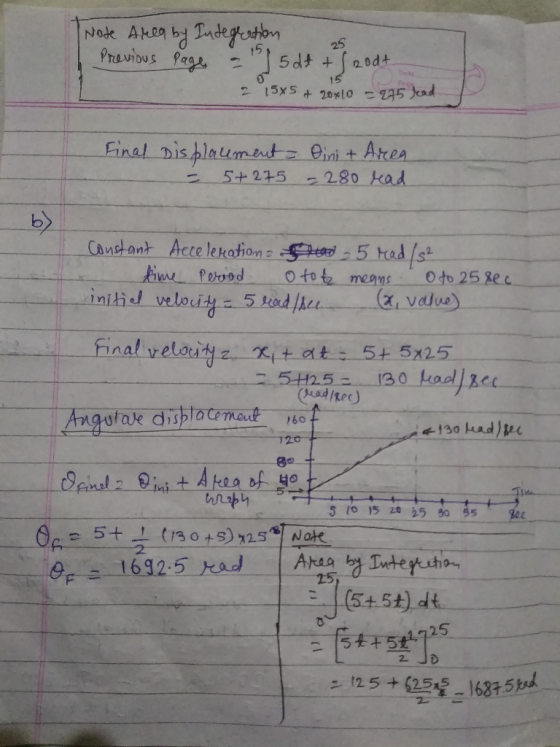
At t=0, a disc has an initial angular velocity ωi= (+/-) X radians/second and makes an initial angle thetainitial=X radians. a) if it has an angular velocity of X1 radians/second up till time t1 and a subsequent angular velocity of X2 rad/sec up till time t2, what is it's final angular displacement? (as we did before, you can 'integrate' the graph of angular-velocity vs. time to solve this) b) If, instead, it simply has a constant angular acceleration of X rad/s2 over the period 0<t<t2, what is both it's final angular velocity as well as its total angular displacement, assuming an initial angular velocity of X1 radians/second?
Homework Answers
To calculate the change in the angular displacement we generally
do integration of the graph between angular velocity and time, or
we can also take the area of the plot between them. I have done by
both the methods. I hope that helps. Thank you.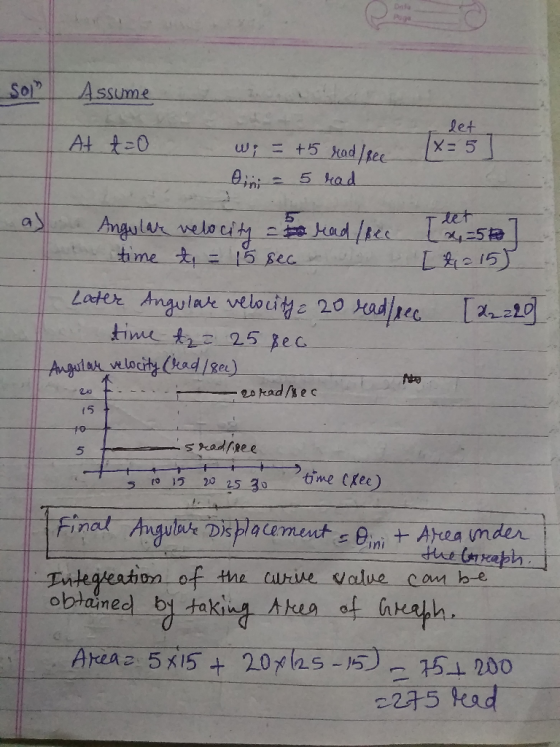
Add Answer to:
Just fill in the bolded stuff with whatever you want and please
draw a diagram
At...
Just fill in the bold with whatever numbers you want and please draw a diagram A...
Just fill in the bold with whatever numbers you want and please draw a diagram A mass m kg is confined to a rough rotating platter with a coefficient of static friction mus, at a distance r m from the center of the platter; determine the maximum velocity that the mass can rotate at before slipping; do the same for the case where a) the mass is doubled, and b) the radius is doubled.
Please show clear steps of how to solve each! (1 point) The graph shows the displacement...
 Please show clear steps of how
to solve each!
(1 point) The graph shows the displacement from equilibrium of a mass-spring system as a function of time after the vertically hanging system was set in motion at time t 0. Assume that the units of time are seconds, and the units of displacement are centimeters. The first t-intercept is (0.75, 0) and the first minimum has coordinates (1.25, -4). (a) What is the period T of the periodic motion? seconds...
Please show clear steps of how
to solve each!
(1 point) The graph shows the displacement from equilibrium of a mass-spring system as a function of time after the vertically hanging system was set in motion at time t 0. Assume that the units of time are seconds, and the units of displacement are centimeters. The first t-intercept is (0.75, 0) and the first minimum has coordinates (1.25, -4). (a) What is the period T of the periodic motion? seconds...
A 25 kg weight is swung in a horizontal circle with a tension of 1250 N in the cord holding it.
1 A 25 kg weight is swung in a horizontal circle with a tension of 1250 N in the cord holding it. A) What is the centripetal acceleration? B) What is the linear velocity if the radius is 135 cm? C) What is the linear displacement traveled after 32 revolutions? 2 A thin spherical shell with a weight of 76 N and radius 0.8 m rotates for 14 minutes, starting at 60 rad/s. If it has an angular displacement of 88200 radians: A) What is...
Help on all sections please HW 07 (CH 7) Begin Date: 5/22/2017 1:00:00 PMDue Date: AM...
 Help on all sections please
HW 07 (CH 7) Begin Date: 5/22/2017 1:00:00 PMDue Date: AM End Date: 6/28/2017 12:59:00 AM (8%) Problem 3: A disk with an initial angular velocity coo 5.5 rad s experiences a constant angular acceleration of α = 55 rad/s2 for a time period 75 s. Please answer the following questions. Randomized Variables a = 5.5 rad/s α = 5.5 rad/s2 75 s ▲ 20% Part (a) Write an expression for the magnitude of the...
Help on all sections please
HW 07 (CH 7) Begin Date: 5/22/2017 1:00:00 PMDue Date: AM End Date: 6/28/2017 12:59:00 AM (8%) Problem 3: A disk with an initial angular velocity coo 5.5 rad s experiences a constant angular acceleration of α = 55 rad/s2 for a time period 75 s. Please answer the following questions. Randomized Variables a = 5.5 rad/s α = 5.5 rad/s2 75 s ▲ 20% Part (a) Write an expression for the magnitude of the...
Just Need help with orange vector a in box can't figure out position, angle and length....
 Just Need help with orange vector a in box can't figure out
position, angle and length.
Tactics Box 1.3 Finding the Acceleration Vector 4 of 1 Below is a motion diagram for an object that moves along a linear path. The dots represent the position of the object at three subsequent instan t1, t2. and t3. The vectors u21 and v32 show the average velocity of the object for the initial time interval Δ 21-t2 t1, and the final time...
Just Need help with orange vector a in box can't figure out
position, angle and length.
Tactics Box 1.3 Finding the Acceleration Vector 4 of 1 Below is a motion diagram for an object that moves along a linear path. The dots represent the position of the object at three subsequent instan t1, t2. and t3. The vectors u21 and v32 show the average velocity of the object for the initial time interval Δ 21-t2 t1, and the final time...
please highlight answer to be inputted thank you Torsional vibration of a shaft is governed by the wave equation, where...
 please highlight answer to be
inputted thank you
Torsional vibration of a shaft is governed by the wave equation, where 0(x,t) is the angular displacement (angle of twist) along the shaft, z is the distance from the end of the shaft and t is time For a shaft of length 3T that is supported by frictionless bearings at each end, the boundary conditions are 0x(0, t) 0 (3m, t) = 0, t > 0. Suppose that the initial angular displacement...
please highlight answer to be
inputted thank you
Torsional vibration of a shaft is governed by the wave equation, where 0(x,t) is the angular displacement (angle of twist) along the shaft, z is the distance from the end of the shaft and t is time For a shaft of length 3T that is supported by frictionless bearings at each end, the boundary conditions are 0x(0, t) 0 (3m, t) = 0, t > 0. Suppose that the initial angular displacement...
(Please show the steps to the solutions, and draw a diagram if you can) 1) In...
 (Please show the steps to the solutions, and draw a diagram
if you can)
1) In a linear motion, velocity changes with time as Find
distance and displacement for the time interval from 1.5 s
to 5 s.
2) A projectile is launched from the edge of 50 m high
vertical cliff at an angle of above horizontal.
The projectile hits the ground at a distance of 150 m from the
bottom of the cliff. FInd the initial and final...
(Please show the steps to the solutions, and draw a diagram
if you can)
1) In a linear motion, velocity changes with time as Find
distance and displacement for the time interval from 1.5 s
to 5 s.
2) A projectile is launched from the edge of 50 m high
vertical cliff at an angle of above horizontal.
The projectile hits the ground at a distance of 150 m from the
bottom of the cliff. FInd the initial and final...
037 CH 19.2 1 of 4> Principle of Impulse and Momentum Constants Part A - Angular velocity of the pulley Learning Goal The pulley shown (Figure 1) has a moment of inertia IA 0.900 kg m2, a radius r...
 037 CH 19.2 1 of 4> Principle of Impulse and Momentum Constants Part A - Angular velocity of the pulley Learning Goal The pulley shown (Figure 1) has a moment of inertia IA 0.900 kg m2, a radius r 0.300 m, and a mass of 20.0 kg A cylinder is attached to a cord that is wrapped around the pulley. Neglecting bearing friction and the cord's mass express the pulley's final angular velocity in terms of the magnitude of the...
someone got 4.76 rad/s but that was incorrect. Review In this example we will apply the...
 someone got 4.76 rad/s but that was incorrect.
Review In this example we will apply the equations for constant angular acceleration to the simple case of a rotating bicycle wheel. The angular velocity of the rear wheel of a stationary exercise bike is wo = 4.00rad/s at time t = 0, and its angular acceleration is constant and equal to a = 2.05rad/s. A particular spoke coincides with the +z axis at time t = 0 (Figure 1). What angle...
someone got 4.76 rad/s but that was incorrect.
Review In this example we will apply the equations for constant angular acceleration to the simple case of a rotating bicycle wheel. The angular velocity of the rear wheel of a stationary exercise bike is wo = 4.00rad/s at time t = 0, and its angular acceleration is constant and equal to a = 2.05rad/s. A particular spoke coincides with the +z axis at time t = 0 (Figure 1). What angle...
just need help with the last one, i) A Spring stretches AL- 0.15 m when a...
 just need help with the last one, i)
A Spring stretches AL- 0.15 m when a mass m 0.3kg is gently attached to it as in Fig.1. The spring is then set up horizontally with the same mass resting on a frictionless table. The mass is pushed so that the spring is compressed to a displacement x= 0.1m 1 from the equilibrium point, and released from rest. f b) Determine the spring constant k; (2pts) FGI e) Find the magnitude...
just need help with the last one, i)
A Spring stretches AL- 0.15 m when a mass m 0.3kg is gently attached to it as in Fig.1. The spring is then set up horizontally with the same mass resting on a frictionless table. The mass is pushed so that the spring is compressed to a displacement x= 0.1m 1 from the equilibrium point, and released from rest. f b) Determine the spring constant k; (2pts) FGI e) Find the magnitude...
 Please show clear steps of how
to solve each!
(1 point) The graph shows the displacement from equilibrium of a mass-spring system as a function of time after the vertically hanging system was set in motion at time t 0. Assume that the units of time are seconds, and the units of displacement are centimeters. The first t-intercept is (0.75, 0) and the first minimum has coordinates (1.25, -4). (a) What is the period T of the periodic motion? seconds...
Please show clear steps of how
to solve each!
(1 point) The graph shows the displacement from equilibrium of a mass-spring system as a function of time after the vertically hanging system was set in motion at time t 0. Assume that the units of time are seconds, and the units of displacement are centimeters. The first t-intercept is (0.75, 0) and the first minimum has coordinates (1.25, -4). (a) What is the period T of the periodic motion? seconds...
 Help on all sections please
HW 07 (CH 7) Begin Date: 5/22/2017 1:00:00 PMDue Date: AM End Date: 6/28/2017 12:59:00 AM (8%) Problem 3: A disk with an initial angular velocity coo 5.5 rad s experiences a constant angular acceleration of α = 55 rad/s2 for a time period 75 s. Please answer the following questions. Randomized Variables a = 5.5 rad/s α = 5.5 rad/s2 75 s ▲ 20% Part (a) Write an expression for the magnitude of the...
Help on all sections please
HW 07 (CH 7) Begin Date: 5/22/2017 1:00:00 PMDue Date: AM End Date: 6/28/2017 12:59:00 AM (8%) Problem 3: A disk with an initial angular velocity coo 5.5 rad s experiences a constant angular acceleration of α = 55 rad/s2 for a time period 75 s. Please answer the following questions. Randomized Variables a = 5.5 rad/s α = 5.5 rad/s2 75 s ▲ 20% Part (a) Write an expression for the magnitude of the...
 Just Need help with orange vector a in box can't figure out
position, angle and length.
Tactics Box 1.3 Finding the Acceleration Vector 4 of 1 Below is a motion diagram for an object that moves along a linear path. The dots represent the position of the object at three subsequent instan t1, t2. and t3. The vectors u21 and v32 show the average velocity of the object for the initial time interval Δ 21-t2 t1, and the final time...
Just Need help with orange vector a in box can't figure out
position, angle and length.
Tactics Box 1.3 Finding the Acceleration Vector 4 of 1 Below is a motion diagram for an object that moves along a linear path. The dots represent the position of the object at three subsequent instan t1, t2. and t3. The vectors u21 and v32 show the average velocity of the object for the initial time interval Δ 21-t2 t1, and the final time...
 please highlight answer to be
inputted thank you
Torsional vibration of a shaft is governed by the wave equation, where 0(x,t) is the angular displacement (angle of twist) along the shaft, z is the distance from the end of the shaft and t is time For a shaft of length 3T that is supported by frictionless bearings at each end, the boundary conditions are 0x(0, t) 0 (3m, t) = 0, t > 0. Suppose that the initial angular displacement...
please highlight answer to be
inputted thank you
Torsional vibration of a shaft is governed by the wave equation, where 0(x,t) is the angular displacement (angle of twist) along the shaft, z is the distance from the end of the shaft and t is time For a shaft of length 3T that is supported by frictionless bearings at each end, the boundary conditions are 0x(0, t) 0 (3m, t) = 0, t > 0. Suppose that the initial angular displacement...
 (Please show the steps to the solutions, and draw a diagram
if you can)
1) In a linear motion, velocity changes with time as Find
distance and displacement for the time interval from 1.5 s
to 5 s.
2) A projectile is launched from the edge of 50 m high
vertical cliff at an angle of above horizontal.
The projectile hits the ground at a distance of 150 m from the
bottom of the cliff. FInd the initial and final...
(Please show the steps to the solutions, and draw a diagram
if you can)
1) In a linear motion, velocity changes with time as Find
distance and displacement for the time interval from 1.5 s
to 5 s.
2) A projectile is launched from the edge of 50 m high
vertical cliff at an angle of above horizontal.
The projectile hits the ground at a distance of 150 m from the
bottom of the cliff. FInd the initial and final...
 037 CH 19.2 1 of 4> Principle of Impulse and Momentum Constants Part A - Angular velocity of the pulley Learning Goal The pulley shown (Figure 1) has a moment of inertia IA 0.900 kg m2, a radius r 0.300 m, and a mass of 20.0 kg A cylinder is attached to a cord that is wrapped around the pulley. Neglecting bearing friction and the cord's mass express the pulley's final angular velocity in terms of the magnitude of the...
 someone got 4.76 rad/s but that was incorrect.
Review In this example we will apply the equations for constant angular acceleration to the simple case of a rotating bicycle wheel. The angular velocity of the rear wheel of a stationary exercise bike is wo = 4.00rad/s at time t = 0, and its angular acceleration is constant and equal to a = 2.05rad/s. A particular spoke coincides with the +z axis at time t = 0 (Figure 1). What angle...
someone got 4.76 rad/s but that was incorrect.
Review In this example we will apply the equations for constant angular acceleration to the simple case of a rotating bicycle wheel. The angular velocity of the rear wheel of a stationary exercise bike is wo = 4.00rad/s at time t = 0, and its angular acceleration is constant and equal to a = 2.05rad/s. A particular spoke coincides with the +z axis at time t = 0 (Figure 1). What angle...
 just need help with the last one, i)
A Spring stretches AL- 0.15 m when a mass m 0.3kg is gently attached to it as in Fig.1. The spring is then set up horizontally with the same mass resting on a frictionless table. The mass is pushed so that the spring is compressed to a displacement x= 0.1m 1 from the equilibrium point, and released from rest. f b) Determine the spring constant k; (2pts) FGI e) Find the magnitude...
just need help with the last one, i)
A Spring stretches AL- 0.15 m when a mass m 0.3kg is gently attached to it as in Fig.1. The spring is then set up horizontally with the same mass resting on a frictionless table. The mass is pushed so that the spring is compressed to a displacement x= 0.1m 1 from the equilibrium point, and released from rest. f b) Determine the spring constant k; (2pts) FGI e) Find the magnitude...
Most questions answered within 3 hours.
-
Where is the error in this code sequence?
String s1 = "Hello";
String s2 = "ello";...
asked 10 months ago -
Financial data for Joel de Paris, Inc., for last year
follow:
Joel de Paris, Inc.
Balance...
asked 10 months ago -
Consider this reaction:
Al2(SO4)3 (aq)+ BaCl3
(aq) Al2Cl6 (aq)- +
3BaSO4(s) . What is the...
asked 10 months ago -
Suppose that Savneet is considering increasing her
recent random sample from 20 car rentals to 40...
asked 10 months ago -
Trucks arrive at an unloading terminal at an average rate of 120
per hour.
Trucks arrive...
asked 10 months ago -
Why are methanol and ethanol completely soluble in water while
octanol is not very little soluble....
asked 10 months ago -
A facilities manager at a university reads in a research report
that the mean amount of...
asked 10 months ago -
When the CuSO4 is rehydrated by adding water to the anhydrous
compound, is this an endothermic...
asked 10 months ago -
A ray of sunlight is passing from diamond into crown glass; the
angle of incidence is...
asked 10 months ago -
A block of mass 0.249 kg is placed on top of a light, vertical
spring of...
asked 10 months ago -
how do the kidneys compensate in the presences of acidosis
a) trigger hyperventilate
b) reserve acid...
asked 10 months ago -
Question 501 pts
The rental rate of capital to the firm increases. Which of the
following...
asked 10 months ago