Compare and contrast the motivations for global expansion. a. Economies of scale- . b. Economies of...
Compare and contrast the motivations for global expansion.
a. Economies of scale- .
b. Economies of scope-
c. Low-cost production factors-
Homework Answers
Economies of Scale- I strongly agree that this factor motivates the company to go global. This happens just to increase the production. I will let you understand with a small example- Suppose you want to make food for yourself. Then you will have to pay $10. Suppose you are two then each one will have to pay lower than 10 let suppose $8 each if there ar 3 then each one have to pay lower amount . This is economies of scale. As the company increase the production cost per product get reduced. Resulting better margin, competitive advantages etc.
Economies of scope- Economies of scale is when a company save cost by manufacturing two or more distinct goods, when the cost of doing so is less than that of producing each separately.
This also helps in global expansion.
Production Factors- Production factors means the things which are used to manufacture products like land. Resources, money etc. Different country have different factor. So the company utilizes it. For an example if a company installs a oil refinery in Saudi Arabia then the refinery cost will be very cheaper than installing the plant in Asian Country.
Add Answer to:
Compare and contrast the motivations for global
expansion.
a. Economies of
scale- .
b. Economies of...
1. Compare and contrast the economies of scale vs the diseconomies of scale. Explain 2. What...
1. Compare and contrast the economies of scale vs the diseconomies of scale. Explain 2. What is a bottleneck in a service provider? Elaborate your answer with an example in a service provider company. 3. List the methods to overcome the imbalance capacity in a manufacturing system.
5. If a hospital has economies of scale with respect to production, then: a. it cannot...
 5. If a hospital has economies of scale with respect to production, then: a. it cannot have economies of scope. b. it must have economies of scope. c. it may or may not have economies of scope. d. it can only have economies of scope for those activities for which it has economies of scale. it can only have economies of scope for those activities for which it does not have economies of scale.
3. Identify the motivations and the risks when considering a global expansion for each of the...
3. Identify the motivations and the risks when considering a global expansion for each of the four basic strategies, be specific.
1. The long-run average cost curve slopes upward if there are: A. economies of scale B....
1. The long-run average cost curve slopes upward if there are: A. economies of scale B. diseconomies of scope in the management of multiplant operates C. Some factors without diminishing marginal returns D. diseconomies of scale E. no factor without diminishing marginal returns
What is "economies of scale"? Compare the impact of economies of scale on both large and...
What is "economies of scale"? Compare the impact of economies of scale on both large and small businesses.
What are economies of scale and diseconomies of scale? How are economies of scale different from...
What are economies of scale and diseconomies of scale? How are economies of scale different from economies of scope? Summarize the different cost-cutting methods employed by firms in their business. What is unique about the business practices and strategy of the company Li and Fung? Visit their website for more current information at www.lifung.com
2) Determine over wtis any) the following cost functions exhibit maltipro economies of scale. Do the...
 2) Determine over wtis any) the following cost functions exhibit maltipro economies of scale. Do the same for economies of scope Multiproduct economies of scale: Economies of scope: Multiproduct economies of scale Economies of scope
Economies of scale arise from all of the following sources, EXCEPT A. serving domestic and international...
Economies of scale arise from all of the following sources, EXCEPT A. serving domestic and international markets from the same production facilities B. serving global markets C. increasing fixed costs by limiting them to small volumes D. bargaining with suppliers to bring down the cost of key inputs
Prob 2. Marginal Analysis 4.10. Economies of Scale? Given: Z = X0.3 γ0.8 (a) What are...
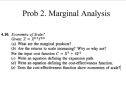 Prob 2. Marginal Analysis 4.10. Economies of Scale? Given: Z = X0.3 γ0.8 (a) What are the marginal products? (b) Are the returns to scale increasing? Why or why not? For the input cost function C = X3 + 4Y2 (c) Write an equation defining the expansion path. (d) Write an equation defining the cost-effectiveness function. (e) Does the cost-effectiveness function show economies of scale
Which statements are true regarding economies of scale.
Which statements are true regarding economies of scale.A. To maximize profits, a monopoly that occurs because of economies of scale should produce an output so that marginal revenue equals marginal costs. B. Economies of scale typically cause an industry to be perfectly competitive. C. When a firm has a natural monopoly it has that type of monopoly because of economies of scale. D. A firm that has economies of scale sees its average total costs decrease when production increases.
 5. If a hospital has economies of scale with respect to production, then: a. it cannot have economies of scope. b. it must have economies of scope. c. it may or may not have economies of scope. d. it can only have economies of scope for those activities for which it has economies of scale. it can only have economies of scope for those activities for which it does not have economies of scale.
 2) Determine over wtis any) the following cost functions exhibit maltipro economies of scale. Do the same for economies of scope Multiproduct economies of scale: Economies of scope: Multiproduct economies of scale Economies of scope
 Prob 2. Marginal Analysis 4.10. Economies of Scale? Given: Z = X0.3 γ0.8 (a) What are the marginal products? (b) Are the returns to scale increasing? Why or why not? For the input cost function C = X3 + 4Y2 (c) Write an equation defining the expansion path. (d) Write an equation defining the cost-effectiveness function. (e) Does the cost-effectiveness function show economies of scale
Most questions answered within 3 hours.
-
Where is the error in this code sequence?
String s1 = "Hello";
String s2 = "ello";...
asked 10 months ago -
Financial data for Joel de Paris, Inc., for last year
follow:
Joel de Paris, Inc.
Balance...
asked 10 months ago -
Consider this reaction:
Al2(SO4)3 (aq)+ BaCl3
(aq) Al2Cl6 (aq)- +
3BaSO4(s) . What is the...
asked 10 months ago -
Suppose that Savneet is considering increasing her
recent random sample from 20 car rentals to 40...
asked 10 months ago -
Trucks arrive at an unloading terminal at an average rate of 120
per hour.
Trucks arrive...
asked 10 months ago -
Why are methanol and ethanol completely soluble in water while
octanol is not very little soluble....
asked 10 months ago -
A facilities manager at a university reads in a research report
that the mean amount of...
asked 10 months ago -
When the CuSO4 is rehydrated by adding water to the anhydrous
compound, is this an endothermic...
asked 10 months ago -
A ray of sunlight is passing from diamond into crown glass; the
angle of incidence is...
asked 10 months ago -
A block of mass 0.249 kg is placed on top of a light, vertical
spring of...
asked 10 months ago -
how do the kidneys compensate in the presences of acidosis
a) trigger hyperventilate
b) reserve acid...
asked 10 months ago -
Question 501 pts
The rental rate of capital to the firm increases. Which of the
following...
asked 10 months ago