Consider the vaporization of water at 150 °C. What are the signs (+ or −) of...
Consider the vaporization of water at 150 °C. What are the signs (+ or −) of ΔH, ΔS, and ΔG for this process? Click here for a copy of the Test 3 cover sheet. Consider the vaporization of water at 150 °C. What are the signs (+ or −) of ΔH, ΔS, and ΔG for this process? Click here for a copy of the Test 3 cover sheet.
ΔH is [ Select ] ["−", "+"] , ΔS is [ Select ] ["+", "−"] , and ΔG is [ Select ] ["+", "−"] .
Homework Answers

Add Answer to:
Consider the vaporization of water
at 150 °C. What are the signs (+ or −) of...
The dissolving of CaCl2 in water is product-favored, but the temperature of the water gets colder...
The dissolving of CaCl2 in water is product-favored, but the temperature of the water gets colder during the process. What would be the signs for ΔG, ΔH and ΔS during this process? CaCl2(s) ---> Ca+2(aq) + 2Cl-1(aq) ΔG = (+) ΔH = (+) ΔS = (-) ΔG = (-) ΔH = (-) ΔS = (+) ΔG = (-) ΔH = (+) ΔS = (-) ΔG = (-) ΔH = (+) ΔS = (+) ΔG = (+) ΔH = (+) ΔS = (+)
Consider the vaporization of water at 90.0C. What are signs of deltaHvap, deltaSvap, and deltaGvap at...
Consider the vaporization of water at 90.0C. What are signs of deltaHvap, deltaSvap, and deltaGvap at this temperature? explain your reasoning.
For the conversion of ice to water at 0°C and 1 atm, ΔG is zero, ΔH...
For the conversion of ice to water at 0°C and 1 atm, ΔG is zero, ΔH is positive, and ΔS is positive. ΔG is zero, ΔH is positive, and ΔS is negative. ΔG is negative, ΔH is positive, and ΔS is negative. ΔG is positive, ΔH is zero, and ΔS is positive.
1a. ) Complete the table with signs and general values for K (ie: K<1 or K>1)...
1a. ) Complete the table with signs and general values for K (ie: K<1 or K>1) Always spontaneous Always nonspontaneous Spontaneous at high temperatures ΔG ΔH ΔS K 2. Calculate the boiling point (in K) for the following: X2 (l) --) X2 (g) ΔH = +35 kJ ΔS = + 215 J/K (HINT: what does ΔG equal when a reaction switches from spontaneous to nonspontaneous?) 1b. ) Trick question (refer to the table in #1): at what temperature does the...
When a stable diatomic molecule spontaneously forms from its constituent atoms, what are the signs of...
When a stable diatomic molecule spontaneously forms from its constituent atoms, what are the signs of ΔH°, ΔS°, and ΔG°? + + - + - + + - - - + + - + - - - - - - + + + +
1. What is the entropy change for a pure solid melting into a liquid? a. ΔS⁰sys...
1. What is the entropy change for a pure solid melting into a liquid? a. ΔS⁰sys > 0 b. ΔS⁰sys < 0 c. ΔS⁰sys = 0 d. Need more information about the liquid to know 2. For a process where ΔH⁰sys < 0 and ΔS⁰sys> 0, when is the sign on ΔG⁰sys < 0? a. ΔG⁰sys is never less than zero b. ΔG⁰sys < 0 for all temperatures c. ΔG⁰sys < 0 for low temperatures d. ΔG⁰sys < 0 for...
12. Predict the signs of the AG and AH for the following: a) Vaporization of water...
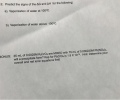 12. Predict the signs of the AG and AH for the following: a) Vaporization of water at 100°C. b) Vaporization of water above 100°C BONUS: 35 mL of 0.0025M KoCrO4 are MIXED with 75 mL of 0.000220M Pb(NOs)2. . Hint: Determine your overall and net ionic equations first!
At 100°C, 1.00 mol of liquid water is allowed to expand isothermally into an evacuated vessel...
At 100°C, 1.00 mol of liquid water is allowed to expand isothermally into an evacuated vessel of such a volume that the final pressure is 0.500 atm. The amount of heat absorbed in the process was found to be 30.0 kJ/mol. Assume ideal behaviour of the gas. What are w, ΔU, ΔH, ΔS, and ΔG Data: ΔvapH = 40600 J/mol (at 1.00 atm) Hint: Employ a step-wise approach to be able to use the given data at the provided pressure.
Calculate ΔG° in kJ at 29.9 °C for the reaction of methane vapor with water vapor...
Calculate ΔG° in kJ at 29.9 °C for the reaction of methane vapor with water vapor to form carbon dioxide gas and hydrogen gas. Be sure to balance the reaction using the lowest whole numbers. Use ΔH° and ΔS° to calculate and assume that they are independent of temperature.
1. Consider a process at 286 K with ΔH = -72.5 kJ/mol and ΔS = -96.8...
1. Consider a process at 286 K with ΔH = -72.5 kJ/mol and ΔS = -96.8 J/K mol Which of the following is true? ΔG = -44.8 kJ/mol and the process will not be spontaneous ΔG = +39.4 kJ/mol and the process will be spontaneous ΔG = -44.8 kJ/mol and the process will be spontaneous ΔG = -19.1 kJ/mol and the process will not be spontaneous ΔG = +39.4 kJ/mol and the process will not be spontaneous 2. Consider a...
 12. Predict the signs of the AG and AH for the following: a) Vaporization of water at 100°C. b) Vaporization of water above 100°C BONUS: 35 mL of 0.0025M KoCrO4 are MIXED with 75 mL of 0.000220M Pb(NOs)2. . Hint: Determine your overall and net ionic equations first!
Most questions answered within 3 hours.
-
Where is the error in this code sequence?
String s1 = "Hello";
String s2 = "ello";...
asked 11 months ago -
Financial data for Joel de Paris, Inc., for last year
follow:
Joel de Paris, Inc.
Balance...
asked 11 months ago -
Consider this reaction:
Al2(SO4)3 (aq)+ BaCl3
(aq) Al2Cl6 (aq)- +
3BaSO4(s) . What is the...
asked 11 months ago -
Suppose that Savneet is considering increasing her
recent random sample from 20 car rentals to 40...
asked 11 months ago -
Trucks arrive at an unloading terminal at an average rate of 120
per hour.
Trucks arrive...
asked 11 months ago -
Why are methanol and ethanol completely soluble in water while
octanol is not very little soluble....
asked 11 months ago -
A facilities manager at a university reads in a research report
that the mean amount of...
asked 11 months ago -
When the CuSO4 is rehydrated by adding water to the anhydrous
compound, is this an endothermic...
asked 11 months ago -
A ray of sunlight is passing from diamond into crown glass; the
angle of incidence is...
asked 11 months ago -
A block of mass 0.249 kg is placed on top of a light, vertical
spring of...
asked 11 months ago -
how do the kidneys compensate in the presences of acidosis
a) trigger hyperventilate
b) reserve acid...
asked 11 months ago -
Question 501 pts
The rental rate of capital to the firm increases. Which of the
following...
asked 11 months ago