Let L = {< A, B > | A and B are DFAs and L(A) ⊆...
Let L = {< A, B > | A and B are DFAs and L(A) ⊆ L(B)}. Show that L is decidable. (Hint: what would be L(B) ∩ L(A) in that case)
Homework Answers
Recall that the proof of theorem 4.5 defines a turing machine F that decide the language EQDFA = {<A,B>|A and B are DFAs and L(A)=L(B)}. Then the following turing machine T decides C ;
T="on input <A,B>,when A and B are DFAs
1.Convert B into DFA BR using the algorithm in the proof of kleenes theorem
2.Run TM decider F frim theorem 4.5 on input <A,BR>
3. If F accepts, accept. If F rejects,reject. "
2. (10 points) Consider the following computational problems: EQDF A = {hA, Bi | A and...
 2. (10 points) Consider the following computational
problems:
EQDF A = {hA, Bi | A and B are DFAs and L(A) = L(B)}
SUBDF A = {hA, Bi | A and B are DFAs and L(A) ⊆ L(B)}
DISJDF A = {hA, Bi | A and B are DFAs and L(A) ∩ L(B) = ∅}.
Prove that SUBDF A and DISJDF A are each Turing-decidable.
You may (and should) use high-level descriptions of any Turing
machines you define. Make sure...
2. (10 points) Consider the following computational
problems:
EQDF A = {hA, Bi | A and B are DFAs and L(A) = L(B)}
SUBDF A = {hA, Bi | A and B are DFAs and L(A) ⊆ L(B)}
DISJDF A = {hA, Bi | A and B are DFAs and L(A) ∩ L(B) = ∅}.
Prove that SUBDF A and DISJDF A are each Turing-decidable.
You may (and should) use high-level descriptions of any Turing
machines you define. Make sure...
5. Let CONTAINPDA DFA L(M1) C (M2)}. Show that CONTAIN PDA DFA is decidable. {{M1, M2)...
 5. Let CONTAINPDA DFA L(M1) C (M2)}. Show that CONTAIN PDA DFA is decidable. {{M1, M2) M1 is a PDA and M2 is a DFA such that =
5. Let CONTAINPDA DFA L(M1) C (M2)}. Show that CONTAIN PDA DFA is decidable. {{M1, M2) M1 is a PDA and M2 is a DFA such that =
5. Let CONTAINPDA DFA L(M1) C (M2)}. Show that CONTAIN PDA DFA is decidable. {{M1, M2) M1 is a PDA and M2 is a DFA such that =
(6 pts- 2 pts each) Let L be a language such that L Sm A your answers to the following questions: and AM Sm L. Just...
 (6 pts- 2 pts each) Let L be a language such that L Sm A your answers to the following questions: and AM Sm L. Justify a) Is L decidable? b) Is L Turing-recognizable? c) Is L Turing-recognizable?
(6 pts- 2 pts each) Let L be a language such that L Sm A your answers to the following questions: and AM Sm L. Justify a) Is L decidable? b) Is L Turing-recognizable? c) Is L Turing-recognizable?
(6 pts- 2 pts each) Let L be a language such that L Sm A your answers to the following questions: and AM Sm L. Justify a) Is L decidable? b) Is L Turing-recognizable? c) Is L Turing-recognizable?
Let INFINITE PDA = {<M>|M is a PDA and L(M) is an infinite language}. Show that...
Let INFINITE PDA = {<M>|M is a PDA and L(M) is an infinite language}. Show that INFINITE PDA is decidable.
(6 pts-2 pts each) Let L be a language such that L Sm Any and Ay Sm L. Justify your answers to the following questi...
 (6 pts-2 pts each) Let L be a language such that L Sm Any and Ay Sm L. Justify your answers to the following questions: 3. TM a) Is L decidable? b) Is L Turing-recognizable? c) Is L Turing-recognizable?
(6 pts-2 pts each) Let L be a language such that L Sm Any and Ay Sm L. Justify your answers to the following questions: 3. TM a) Is L decidable? b) Is L Turing-recognizable? c) Is L Turing-recognizable?
(6 pts-2 pts each) Let L be a language such that L Sm Any and Ay Sm L. Justify your answers to the following questions: 3. TM a) Is L decidable? b) Is L Turing-recognizable? c) Is L Turing-recognizable?
Let INFINITE PDA ={<M>|M is a PDA and L(M) is an infinite language} Show that INFINITE PDA is decidable
Let INFINITE PDA ={<M>|M is a PDA and L(M) is an infinite language} Show that INFINITE PDA is decidable.
Let F IN = {M | L(M) is finite}, and recall HP = {M#w | M...
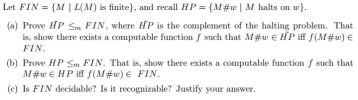 Let F IN = {M | L(M) is finite}, and recall HP = {M#w | M halts
on w}.
(a) Prove HP¯ ≤m F IN, where HP¯ is the complement of the
halting problem. That is, show there exists a computable function f
such that M#w ∈ HP¯ iff f(M#w) ∈ F IN.
(b) Prove HP ≤m F IN. That is, show there exists a computable
function f such that M#w ∈ HP iff f(M#w) ∈ F IN.
(c) Is...
Let F IN = {M | L(M) is finite}, and recall HP = {M#w | M halts
on w}.
(a) Prove HP¯ ≤m F IN, where HP¯ is the complement of the
halting problem. That is, show there exists a computable function f
such that M#w ∈ HP¯ iff f(M#w) ∈ F IN.
(b) Prove HP ≤m F IN. That is, show there exists a computable
function f such that M#w ∈ HP iff f(M#w) ∈ F IN.
(c) Is...
Create a DFA for the language L = {w ∈ {0, 1}∗ : w is a...
Create a DFA for the language L = {w ∈ {0, 1}∗ : w is a set of strings with 011 as a substring AND is not divisible by 3 }. First, create two separate DFAs for is a set of strings with 011 as a substring and not divisible by 3. Then, create the intersection between those DFAs by using the product construction. Show all your work. Hint: Use the least amount of states as possible.
Let L be a regular language on sigma = {a, b, d, e}. Let L' be...
 Let L be a regular language on sigma = {a, b, d, e}. Let L' be the set of strings in L that contain the substring aab. Show that L' is a regular language.
1. (10 points) Show that the Turing Decidable languages are closed under complementation. If L is...
 1. (10 points) Show that the Turing Decidable languages are closed under complementation. If L is Turing Decidable then so is the complement -L. 1. (10 points) Show that the Turing Decidable languages are closed under complementation. If L is Turing Decidable then so is the complement -L.
 2. (10 points) Consider the following computational
problems:
EQDF A = {hA, Bi | A and B are DFAs and L(A) = L(B)}
SUBDF A = {hA, Bi | A and B are DFAs and L(A) ⊆ L(B)}
DISJDF A = {hA, Bi | A and B are DFAs and L(A) ∩ L(B) = ∅}.
Prove that SUBDF A and DISJDF A are each Turing-decidable.
You may (and should) use high-level descriptions of any Turing
machines you define. Make sure...
2. (10 points) Consider the following computational
problems:
EQDF A = {hA, Bi | A and B are DFAs and L(A) = L(B)}
SUBDF A = {hA, Bi | A and B are DFAs and L(A) ⊆ L(B)}
DISJDF A = {hA, Bi | A and B are DFAs and L(A) ∩ L(B) = ∅}.
Prove that SUBDF A and DISJDF A are each Turing-decidable.
You may (and should) use high-level descriptions of any Turing
machines you define. Make sure...
 5. Let CONTAINPDA DFA L(M1) C (M2)}. Show that CONTAIN PDA DFA is decidable. {{M1, M2) M1 is a PDA and M2 is a DFA such that =
5. Let CONTAINPDA DFA L(M1) C (M2)}. Show that CONTAIN PDA DFA is decidable. {{M1, M2) M1 is a PDA and M2 is a DFA such that =
5. Let CONTAINPDA DFA L(M1) C (M2)}. Show that CONTAIN PDA DFA is decidable. {{M1, M2) M1 is a PDA and M2 is a DFA such that =
 (6 pts- 2 pts each) Let L be a language such that L Sm A your answers to the following questions: and AM Sm L. Justify a) Is L decidable? b) Is L Turing-recognizable? c) Is L Turing-recognizable?
(6 pts- 2 pts each) Let L be a language such that L Sm A your answers to the following questions: and AM Sm L. Justify a) Is L decidable? b) Is L Turing-recognizable? c) Is L Turing-recognizable?
(6 pts- 2 pts each) Let L be a language such that L Sm A your answers to the following questions: and AM Sm L. Justify a) Is L decidable? b) Is L Turing-recognizable? c) Is L Turing-recognizable?
 (6 pts-2 pts each) Let L be a language such that L Sm Any and Ay Sm L. Justify your answers to the following questions: 3. TM a) Is L decidable? b) Is L Turing-recognizable? c) Is L Turing-recognizable?
(6 pts-2 pts each) Let L be a language such that L Sm Any and Ay Sm L. Justify your answers to the following questions: 3. TM a) Is L decidable? b) Is L Turing-recognizable? c) Is L Turing-recognizable?
(6 pts-2 pts each) Let L be a language such that L Sm Any and Ay Sm L. Justify your answers to the following questions: 3. TM a) Is L decidable? b) Is L Turing-recognizable? c) Is L Turing-recognizable?
 Let F IN = {M | L(M) is finite}, and recall HP = {M#w | M halts
on w}.
(a) Prove HP¯ ≤m F IN, where HP¯ is the complement of the
halting problem. That is, show there exists a computable function f
such that M#w ∈ HP¯ iff f(M#w) ∈ F IN.
(b) Prove HP ≤m F IN. That is, show there exists a computable
function f such that M#w ∈ HP iff f(M#w) ∈ F IN.
(c) Is...
Let F IN = {M | L(M) is finite}, and recall HP = {M#w | M halts
on w}.
(a) Prove HP¯ ≤m F IN, where HP¯ is the complement of the
halting problem. That is, show there exists a computable function f
such that M#w ∈ HP¯ iff f(M#w) ∈ F IN.
(b) Prove HP ≤m F IN. That is, show there exists a computable
function f such that M#w ∈ HP iff f(M#w) ∈ F IN.
(c) Is...
 Let L be a regular language on sigma = {a, b, d, e}. Let L' be the set of strings in L that contain the substring aab. Show that L' is a regular language.
 1. (10 points) Show that the Turing Decidable languages are closed under complementation. If L is Turing Decidable then so is the complement -L. 1. (10 points) Show that the Turing Decidable languages are closed under complementation. If L is Turing Decidable then so is the complement -L.
Most questions answered within 3 hours.
-
Where is the error in this code sequence?
String s1 = "Hello";
String s2 = "ello";...
asked 10 months ago -
Financial data for Joel de Paris, Inc., for last year
follow:
Joel de Paris, Inc.
Balance...
asked 10 months ago -
Consider this reaction:
Al2(SO4)3 (aq)+ BaCl3
(aq) Al2Cl6 (aq)- +
3BaSO4(s) . What is the...
asked 10 months ago -
Suppose that Savneet is considering increasing her
recent random sample from 20 car rentals to 40...
asked 10 months ago -
Trucks arrive at an unloading terminal at an average rate of 120
per hour.
Trucks arrive...
asked 10 months ago -
Why are methanol and ethanol completely soluble in water while
octanol is not very little soluble....
asked 10 months ago -
A facilities manager at a university reads in a research report
that the mean amount of...
asked 10 months ago -
When the CuSO4 is rehydrated by adding water to the anhydrous
compound, is this an endothermic...
asked 10 months ago -
A ray of sunlight is passing from diamond into crown glass; the
angle of incidence is...
asked 10 months ago -
A block of mass 0.249 kg is placed on top of a light, vertical
spring of...
asked 10 months ago -
how do the kidneys compensate in the presences of acidosis
a) trigger hyperventilate
b) reserve acid...
asked 10 months ago -
Question 501 pts
The rental rate of capital to the firm increases. Which of the
following...
asked 10 months ago