Potassium hydroxide preparation of a sample is useful in the diagnosis of: a. Viral infections b....
Potassium hydroxide preparation of a sample is useful in the diagnosis of:
a. Viral infections b. Fungal infections c. Bacterial infections d. Parasitic infections e. Zoonotic infections
Homework Answers
Potassium Hydroxide is used in the diagnosis of option B fungal infections.
Region affected from fungus such as ringworm art craft and then they are dissolved in the solution of potassium hydroxide. the scrap material consists of both the skin and the fungus which has affected the skin. The keratin of the skin gets dissolved in potassium hydroxide and the fungus is exposed, on which further biochemical tests can be performed.
Add Answer to:
Potassium hydroxide preparation of a sample is useful in the
diagnosis of:
a. Viral infections b....
X-linked agammaglobulinemia in infants is most likely to result in excessive infections with this type of...
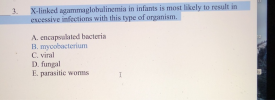 X-linked agammaglobulinemia in infants is most likely to result in excessive infections with this type of organism. A. encapsulated bacteria B. mycobacterium C. viral D. fungal E. parasitic worms
Questions 1. What type of pathogen is Candide glabrata? C. Viral a. Bacterial d. Parasitic b....
 Questions 1. What type of pathogen is Candide glabrata? C. Viral a. Bacterial d. Parasitic b. Fungal What area(s) of the body are commonly colonized by C. glabrata? 3. What type of pathogen is Burkholderia cepacia? c. Viral a. Bacterial b. Fungal d. Parasitic 4. What is usual source/habitat of B. cepacia? is an opportunistic pathogen? pathogens in the family Enterobacteriaceae from the stool. 6. List 3 selective media that are used to isolate 7. What medium is specifically designed...
1)Angie has had many viral infections in her life. She has no problem with extracellular, bacterial...
1)Angie has had many viral infections in her life. She has no problem with extracellular, bacterial infections. The doctor wants to run lots of screenings to determine if she has a deficiency in a protein needed to process these types of infections..What should they test for? a)TLR2 b)Rig like receptor c)NFkB d)MyD88 2) Fill in the blank ___ bound by receptors on NK cells and Macrophages ____macrophage cells that are activated and secreted by dendetric cells ____job is the recruitment...
Match the terms. C. Morbidity B. V virulence A. Capacity of a pathogen to cause significant...
 Match the terms. C. Morbidity B. V virulence A. Capacity of a pathogen to cause significant damage В. The likelihood a pathogen will cuase illness. С. How widespread an infection is in the population D The likelihood an infection will result in death. Av Pathogenicity Mortality D. Match the appropriate terms. Α. ν Malaria C. V Smallpox B. v Bovine Spongiform Encephalopathy C. Streptococcal pneumonia D. Athlete's foot A Parasitic infection B. Prion disease C. Bacterial infection D Fungal infection...
Why is it frequently more difficult to treat fungal infections in humans than it is to...
Why is it frequently more difficult to treat fungal infections in humans than it is to treat bacterial infections? Select one: a. The cells found in fungi and humans are more similar than cells of bacteria and humans. b. Fungi undergo evolution at a much faster rate than bacteria do. c. Fungi normally grow in and on humans, and treating fungal infections would cause death of the human. d. Humans have not developed medications capable of targeting fungi.
Questions: 1. 2. What is the most common viral disease associated with HIV infection and AIDS?...
 Questions: 1. 2. What is the most common viral disease associated with HIV infection and AIDS? In cytomegalic inclusion disease the microscopic morphology exhibited by this disease is described as enlarged cells (cotomegaly), with large intranuclear cytoplasmic inclusions and a surrounding halo. Because this morphology has a characteristic appearance morphology has a nick-name. What is it? What kind of pathogen is Pneumocystis jirovec? resembling the features of a winged animal this 3. c. Viral a. Bacterial b. Fungal d. Parasitic...
Questions: 1. 2. What is the most common viral disease associated with HIV infection and AIDS?...
 Questions: 1. 2. What is the most common viral disease associated with HIV infection and AIDS? In cytomegalic inclusion disease the microscopic morphology exhibited by this disease is described as enlarged cells (cytomegaly), with large intranuclear cytoplasmic inclusions and a surrounding halo. Because this morphology has a characteristic appearance resembling the features of a winged animal this morphology has a nick-name. What is it? What kind of pathogen is Pneumocystis jirovec? 3. c. Viral a. Bacterial b. Fungal d. Parasitic...
1. Which of the following is more error prone? A) human genome replication b) RNA viral...
1. Which of the following is more error prone? A) human genome replication b) RNA viral genome replication c) DNA viral genome replication d) Canine genome replication e) the genetic diversity of virus 2. Which is Not a level of control for viral gene expression? A) Configuration of viral DNA or RNA b) At transcription c) at regeneration d) mRNA half-life e) at translation 3) which of the following defines the Baltimore scheme? A) a chart of DNA transcription mechanisms...
Which statement among A-D is false regarding animal viral infections? A. Uncoating refers to the process...
 Which statement among A-D is false regarding animal viral infections? A. Uncoating refers to the process of viral exit from the host cell. B. Depending on the virus type, assembly of viruses may occur in the nucleus or cytoplasm. C. Budding is a mechanism of virus exit that leads to acquisition of the envelope around the viral particles. D. Endosome formation is a mechanism that allows for the viral genome to be freed from the capsid. none of A-D are...
a) A 25.00-mL sample of monoprotic acid was titrated with 0.0800 M potassium hydroxide solution. The...
a) A 25.00-mL sample of monoprotic acid was titrated with 0.0800 M potassium hydroxide solution. The equivalence point was reached after 18.75 mL of base was added. Calculate the concentration of the acid. b) A 15.00-mL sample of 0.120 M nitric acid was titrated with 0.0800 M potassium hydroxide. Calculate the pH of the sample when 10.00 mL of the base has been added.
 X-linked agammaglobulinemia in infants is most likely to result in excessive infections with this type of organism. A. encapsulated bacteria B. mycobacterium C. viral D. fungal E. parasitic worms
 Questions 1. What type of pathogen is Candide glabrata? C. Viral a. Bacterial d. Parasitic b. Fungal What area(s) of the body are commonly colonized by C. glabrata? 3. What type of pathogen is Burkholderia cepacia? c. Viral a. Bacterial b. Fungal d. Parasitic 4. What is usual source/habitat of B. cepacia? is an opportunistic pathogen? pathogens in the family Enterobacteriaceae from the stool. 6. List 3 selective media that are used to isolate 7. What medium is specifically designed...
 Match the terms. C. Morbidity B. V virulence A. Capacity of a pathogen to cause significant damage В. The likelihood a pathogen will cuase illness. С. How widespread an infection is in the population D The likelihood an infection will result in death. Av Pathogenicity Mortality D. Match the appropriate terms. Α. ν Malaria C. V Smallpox B. v Bovine Spongiform Encephalopathy C. Streptococcal pneumonia D. Athlete's foot A Parasitic infection B. Prion disease C. Bacterial infection D Fungal infection...
 Questions: 1. 2. What is the most common viral disease associated with HIV infection and AIDS? In cytomegalic inclusion disease the microscopic morphology exhibited by this disease is described as enlarged cells (cotomegaly), with large intranuclear cytoplasmic inclusions and a surrounding halo. Because this morphology has a characteristic appearance morphology has a nick-name. What is it? What kind of pathogen is Pneumocystis jirovec? resembling the features of a winged animal this 3. c. Viral a. Bacterial b. Fungal d. Parasitic...
 Questions: 1. 2. What is the most common viral disease associated with HIV infection and AIDS? In cytomegalic inclusion disease the microscopic morphology exhibited by this disease is described as enlarged cells (cytomegaly), with large intranuclear cytoplasmic inclusions and a surrounding halo. Because this morphology has a characteristic appearance resembling the features of a winged animal this morphology has a nick-name. What is it? What kind of pathogen is Pneumocystis jirovec? 3. c. Viral a. Bacterial b. Fungal d. Parasitic...
 Which statement among A-D is false regarding animal viral infections? A. Uncoating refers to the process of viral exit from the host cell. B. Depending on the virus type, assembly of viruses may occur in the nucleus or cytoplasm. C. Budding is a mechanism of virus exit that leads to acquisition of the envelope around the viral particles. D. Endosome formation is a mechanism that allows for the viral genome to be freed from the capsid. none of A-D are...
Most questions answered within 3 hours.
-
Where is the error in this code sequence?
String s1 = "Hello";
String s2 = "ello";...
asked 10 months ago -
Financial data for Joel de Paris, Inc., for last year
follow:
Joel de Paris, Inc.
Balance...
asked 10 months ago -
Consider this reaction:
Al2(SO4)3 (aq)+ BaCl3
(aq) Al2Cl6 (aq)- +
3BaSO4(s) . What is the...
asked 10 months ago -
Suppose that Savneet is considering increasing her
recent random sample from 20 car rentals to 40...
asked 10 months ago -
Trucks arrive at an unloading terminal at an average rate of 120
per hour.
Trucks arrive...
asked 10 months ago -
Why are methanol and ethanol completely soluble in water while
octanol is not very little soluble....
asked 10 months ago -
A facilities manager at a university reads in a research report
that the mean amount of...
asked 10 months ago -
When the CuSO4 is rehydrated by adding water to the anhydrous
compound, is this an endothermic...
asked 10 months ago -
A ray of sunlight is passing from diamond into crown glass; the
angle of incidence is...
asked 10 months ago -
A block of mass 0.249 kg is placed on top of a light, vertical
spring of...
asked 10 months ago -
how do the kidneys compensate in the presences of acidosis
a) trigger hyperventilate
b) reserve acid...
asked 10 months ago -
Question 501 pts
The rental rate of capital to the firm increases. Which of the
following...
asked 10 months ago