In the lab, you will be investigating the properties of projectile motion. Note that the simulations...
In the lab, you will be investigating the properties of projectile motion. Note that the simulations here deal with the special case in which the projectile lands at the same level from which it was launched. In the lab, the projectile lands lower than where it started. The general principles of projectile motion still apply, however.
For a projectile that starts and ends at the same height, use simulation 1 to help fill in the table below, or you can simply calculate the values yourself. The initial speed is 20 m/s.
| Launch Angle | vox (m/s) | voy (m/s) | Time of flight (s) | Range (m) |
|---|---|---|---|---|
| 0 | 20 | 0 | 0 | 0 |
| 15 | ______ | ______ | ______ | ______ |
| 30 | ______ | ______ | ______ | ______ |
| 45 | ______ | ______ | ______ | ______ |
| 60 | ______ | ______ | ______ | ______ |
| 75 | ______ | ______ | ______ | ______ |
| 90 | 0 | 20 | ______ | 0 |
Homework Answers
A handwritten solution for this question is given below
 please upvote this answer If
you are benefited from it
please upvote this answer If
you are benefited from it
Thank you
Add Answer to:
In the lab, you will be investigating the properties of
projectile motion. Note that the simulations...
PROJECTILE MOTION OBJECTIVE: The purpose of this lab is to study the properties of projectile motion....
 PROJECTILE MOTION OBJECTIVE: The purpose of this lab is to study the properties of projectile motion. From the motion of a steel ball projected horizontally, the initial velocity of the ball ean be determined from the measured range. For a given initial velocity, the projectile range will be measured for various initial angles, and calculated by applying the theory for motion with constant acceleration BASIC PRINCIPLES: Projectile motion occurs when an object in a two-dimensional plane experiences motion only due...
Simulation: Projectile motion, with and without air drag, plotted, Question 2 Note: use principles of physics...
 Simulation: Projectile motion, with and without air drag, plotted, Question 2 Note: use principles of physics to solve the problem and then verify your answer using the simulation. Assume that the acceleration due to gravity has a magnitude of g 9.30 m/s2. If the range of the projectile is 6.76 m, the time-of-flight is T-1.28 s, and air resistance is turned off, determine the following (a) What is the launch angle of the projectile? Number Units the absolute tolerance is...
PRE-LAB PROJECTILE MOTION 1. Solve Equation 6 for the time-of-flight of a projec tile launched horizontally...
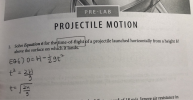 PRE-LAB PROJECTILE MOTION 1. Solve Equation 6 for the time-of-flight of a projec tile launched horizontally from a height H above the surface on which it lands. a 2H d f 18 mls Ignore air resistance in
You launch a projectile at an initial speed of 33.4 m/s from the ground. After 3.30...
You launch a projectile at an initial speed of 33.4 m/s from the ground. After 3.30 seconds of flight, the projectile lands on the ground. At what angle above the horizontal was the projectile launched?
You launch a projectile at an initial speed of 38.8 m/s from the ground. After 2.40...
 You launch a projectile at an initial speed of 38.8 m/s from the ground. After 2.40 seconds of flight, the projectile lands on the ground. At what angle above the horizontal was the projectile launched? O 17.7 degrees 24.8 degrees 0 12.6 degrees O 12.4 degrees
Course # Section # Name Pre-lab B-4 Projectile Motion Read the lab manual B-4 thoroughly The...
 Course # Section # Name Pre-lab B-4 Projectile Motion Read the lab manual B-4 thoroughly The origin of our coordinate system is at the launching point (see Figure 1). If a projectile is launched horizontally (launching angle e-0.0) at a height of y above the table top, and it falls on the table top, how long does it take the projectile to fall onto the table top? Express the time in terms of g and y Let the y-direction be...
You launch a projectile at an initial speed of 41.7 m/s from the ground. After 4.60...
You launch a projectile at an initial speed of 41.7 m/s from the ground. After 4.60 seconds of flight, the projectile lands on the ground. At what angle above the horizontal was the projectile launched? 20.5 degrees 27.9 degrees 32.8 degrees 55.8 degrees
EXPLORE A projectile is launched with a launch angle of 30° with respect to the horizontal...
EXPLORE A projectile is launched with a launch angle of 30° with respect to the horizontal direction and with an initial speed of 40 m/s. (A) How do the vertical and horizontal components of the projectile's velocity vary with time? (B) How long does it remain in flight? (C) For a given launch speed, what launch angle produces the longest time of flight? CONCEPTUALIZE Consider the projectile to be a point mass that starts with an initial velocity, upward and...
(2 dimensions, 1 object, 2 accelerations) 1) A projectile is thrown with a wind. The wind...
(2 dimensions, 1 object, 2 accelerations) 1) A projectile is thrown with a wind. The wind produces a constant acceleration of 2 m/s/s in the same direction as the projectile’s horizontal direction. The projectile is launched with a velocity of 20 m/s at an angle of 30°. The projectile lands at the same height as it was launched. a. How far from the launch point does the projectile land? Do this problem again with no numbers. b. Calculate the range...
Determining Initial Velocity Through Projectile Motion Introduction In this lab we encourage you to play with...
 Determining Initial Velocity Through Projectile Motion Introduction In this lab we encourage you to play with toys! You are going to assemble the Hot Wheels Launcher shown above. The orange Hotwheels car launcher (Not to be confused with the Daredevil Stunt set's yellow motorcycle launcher) is a variable speed launch system with four settings. This makes it ideal for experiments to see the effects of velocity on projectile motion. You are then going to launch a car with various initial...
 PROJECTILE MOTION OBJECTIVE: The purpose of this lab is to study the properties of projectile motion. From the motion of a steel ball projected horizontally, the initial velocity of the ball ean be determined from the measured range. For a given initial velocity, the projectile range will be measured for various initial angles, and calculated by applying the theory for motion with constant acceleration BASIC PRINCIPLES: Projectile motion occurs when an object in a two-dimensional plane experiences motion only due...
 Simulation: Projectile motion, with and without air drag, plotted, Question 2 Note: use principles of physics to solve the problem and then verify your answer using the simulation. Assume that the acceleration due to gravity has a magnitude of g 9.30 m/s2. If the range of the projectile is 6.76 m, the time-of-flight is T-1.28 s, and air resistance is turned off, determine the following (a) What is the launch angle of the projectile? Number Units the absolute tolerance is...
 PRE-LAB PROJECTILE MOTION 1. Solve Equation 6 for the time-of-flight of a projec tile launched horizontally from a height H above the surface on which it lands. a 2H d f 18 mls Ignore air resistance in
 You launch a projectile at an initial speed of 38.8 m/s from the ground. After 2.40 seconds of flight, the projectile lands on the ground. At what angle above the horizontal was the projectile launched? O 17.7 degrees 24.8 degrees 0 12.6 degrees O 12.4 degrees
 Course # Section # Name Pre-lab B-4 Projectile Motion Read the lab manual B-4 thoroughly The origin of our coordinate system is at the launching point (see Figure 1). If a projectile is launched horizontally (launching angle e-0.0) at a height of y above the table top, and it falls on the table top, how long does it take the projectile to fall onto the table top? Express the time in terms of g and y Let the y-direction be...
 Determining Initial Velocity Through Projectile Motion Introduction In this lab we encourage you to play with toys! You are going to assemble the Hot Wheels Launcher shown above. The orange Hotwheels car launcher (Not to be confused with the Daredevil Stunt set's yellow motorcycle launcher) is a variable speed launch system with four settings. This makes it ideal for experiments to see the effects of velocity on projectile motion. You are then going to launch a car with various initial...
Most questions answered within 3 hours.
-
Where is the error in this code sequence?
String s1 = "Hello";
String s2 = "ello";...
asked 10 months ago -
Financial data for Joel de Paris, Inc., for last year
follow:
Joel de Paris, Inc.
Balance...
asked 10 months ago -
Consider this reaction:
Al2(SO4)3 (aq)+ BaCl3
(aq) Al2Cl6 (aq)- +
3BaSO4(s) . What is the...
asked 10 months ago -
Suppose that Savneet is considering increasing her
recent random sample from 20 car rentals to 40...
asked 10 months ago -
Trucks arrive at an unloading terminal at an average rate of 120
per hour.
Trucks arrive...
asked 10 months ago -
Why are methanol and ethanol completely soluble in water while
octanol is not very little soluble....
asked 10 months ago -
A facilities manager at a university reads in a research report
that the mean amount of...
asked 10 months ago -
When the CuSO4 is rehydrated by adding water to the anhydrous
compound, is this an endothermic...
asked 10 months ago -
A ray of sunlight is passing from diamond into crown glass; the
angle of incidence is...
asked 10 months ago -
A block of mass 0.249 kg is placed on top of a light, vertical
spring of...
asked 10 months ago -
how do the kidneys compensate in the presences of acidosis
a) trigger hyperventilate
b) reserve acid...
asked 10 months ago -
Question 501 pts
The rental rate of capital to the firm increases. Which of the
following...
asked 10 months ago