Consider the following equilibrium: PbI2(s)↽−−⇀Pb2+(aq)+2I−(aq) If the concentration of the Pb2+ ion at a certain point...
Consider the following equilibrium: PbI2(s)↽−−⇀Pb2+(aq)+2I−(aq) If the concentration of the Pb2+ ion at a certain point is 2.1×10⁻³ M, and Ksp=7.5×10⁻¹¹, will a precipitate form? Select the correct answer below: yes, because Q>Ksp yes, because QKsp no, because Q
Homework Answers
[Pb2+] = 2.1*10^-3 M
PbI2 <-> Pb2+ + 2 I-
s 2s
So,
[I-] = 2s
= 2*2.1*10^-3 M
= 4.2*10^-3 M
Use:
Qsp = [Pb2+][I-]^2
= (2.1*10^-3) * (4.2*10^-3)^2
= 8.8*10^-6
Qsp > ksp, So, precipitate will form
Answer:
yes, because Q>Ksp
Add Answer to:
Consider the following equilibrium: PbI2(s)↽−−⇀Pb2+(aq)+2I−(aq)
If the concentration of the Pb2+ ion at a certain point...
Predict Precipitation Question Consider the following equilibrium: Ag, PO, (s) 3 Ag (aq) + PO(aq) If the concentrat...
 Predict Precipitation Question Consider the following equilibrium: Ag, PO, (s) 3 Ag (aq) + PO(aq) If the concentration of the Ag ion at a certain point is 6.3 x 10 M, and Ksp=9.1 x 10⁴, will a precipitate form? - Select the correct answer below: Oyes, because Q> K yes, because Q < K no, because o> K no, because < K
Predict Precipitation Question Consider the following equilibrium: Ag, PO, (s) 3 Ag (aq) + PO(aq) If the concentration...
Predict Precipitation Question Consider the following equilibrium: Ag, PO, (s) 3 Ag (aq) + PO(aq) If the concentration of the Ag ion at a certain point is 6.3 x 10 M, and Ksp=9.1 x 10⁴, will a precipitate form? - Select the correct answer below: Oyes, because Q> K yes, because Q < K no, because o> K no, because < K
Predict Precipitation Question Consider the following equilibrium: Ag, PO, (s) 3 Ag (aq) + PO(aq) If the concentration...
1) The molar solubility of PbI2 is 1.5X10⁻³ mol/L. PbI2(s) ? Pb2+(aq) + 2I-(aq) What is the molar concentration of iodi...
1) The molar solubility of PbI2 is 1.5X10⁻³ mol/L. PbI2(s) ? Pb2+(aq) + 2I-(aq) What is the molar concentration of iodide ion in a saturated PbI2 solution in mol/L? Hint: Consider mol ratios. Don't use scientific notation. Use 2 significant figures. ________ 2) The molar solubility of PbI2 is 1.5X10⁻³ mol/L. PbI2(s) ?Pb2+(aq) + 2I-(aq) Determine the solubility constant, ksp, for lead(II) iodide: ksp = [Pb2+][I-]2 Don't use scientific notation. Use 2 significant figures. ________ 3) How is the molar...
6) The molar solubility of PbI2 is 1.5X10⁻³ mol/L. PbI2(s) ??Pb2+(aq) + 2I-(aq) A) What is the molar concentration of...
6) The molar solubility of PbI2 is 1.5X10⁻³ mol/L. PbI2(s) ??Pb2+(aq) + 2I-(aq) A) What is the molar concentration of iodide ion in a saturated PbI2 solution? Hint: consider mol ratios. B) Determine the solubility constant, ksp, for lead(II) iodide: ksp = [Pb2+] x [I-]
Solid PbI2 was added to a 0.030 M NaI solution. Calculate the molar concentration of lead...
Solid PbI2 was added to a 0.030 M NaI solution. Calculate the molar concentration of lead ion in this solution. Ksp = 7.9 x 10⁻⁹ (at 25ºC) (Please show work) PbI2(s) <=> Pb2+ + 2I-
Consider the following equilibrium, where Mg(OH), is the only species in liquid water: Mg(OH),(s) – Mg?...
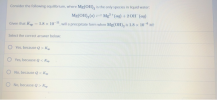 Consider the following equilibrium, where Mg(OH), is the only species in liquid water: Mg(OH),(s) – Mg? + (aq) + 2OH(aq) Given that Kp = 1.8 x 10⁻¹¹will a precipitate form when Mg(OH), is 1.8 x 10-M? Select the correct answer below: Yes, because Q > K, Yes, because Q <K No, because Q <K O No, because Q > K.
1) For the reaction: PbCl2(s) ↔ Pb2+(aq)+2Cl1-(aq), what is Q* when 2.5 mL of 0.070 M...
1) For the reaction: PbCl2(s) ↔ Pb2+(aq)+2Cl1-(aq), what is Q* when 2.5 mL of 0.070 M lead nitrate is added to 19 mL of 0.018 M sodium chloride? Ksp of lead chloride is 1.6 x 10⁻⁵ M3. Hint given in general feedback *Recall: Q is compared to Ksp to determine whether a precipitate forms. 2) Sodium phosphate is added to a solution that contains 0.0041 M aluminum nitrate and 0.028 M calcium chloride. The concentration of the first ion to...
Precipitation is the formation of an insoluble substance. For the equation AB(s)⇌A+(aq)+B−(aq), precipitation represents a shift...
Precipitation is the formation of an insoluble substance. For the equation AB(s)⇌A+(aq)+B−(aq), precipitation represents a shift to the left and the production of a solid. From Le Châtelier's principle, we know that when the product of the concentrations of A+ and B− gets above a certain level, the reaction will respond by shifting left to decrease the concentrations of A+ and B−. This critical level, Ksp, is a constant at a certain temperature. In this case, Q=[A+][B−], where Q is...
Consider the dissolution equation of lead(II) chloride. PbCl2 (s) Pb2+ (aq) + 2 C1- (aq) Suppose...
 Consider the dissolution equation of lead(II) chloride. PbCl2 (s) Pb2+ (aq) + 2 C1- (aq) Suppose you add 0.2331 g of PbCl2(s) to 50.0 mL of water. In the resulting saturated solution, you find that the concentration of Pb2+ (aq) is 0.0159 M and the concentration of Cl - (aq) is 0.0318 M. What is the value of the equilibrium constant, Ksp, for the dissolution of PbCl2? Answer:
Consider the equilibrium of PbCl2(s) in water: PbCl2(s) Pb2+(aq) + 2Cl-(aq) What is the effect of...
Consider the equilibrium of PbCl2(s) in water: PbCl2(s) Pb2+(aq) + 2Cl-(aq) What is the effect of adding NaCl(aq) to the equilibrium solution? The sodium ion reduces the Pb2+ to Pb(s). PbCl2 solubility increases due to the common-ion effect. PbNa2(s) precipitates. The NaCl(aq) has no effect on the system. PbCl2(s) precipitates until equilibrium is reestablished.
1) Use equilibrium ion concentration to calculate Ksp. The Pb2+ concentration in a saturated solution of...
1) Use equilibrium ion concentration to calculate Ksp. The Pb2+ concentration in a saturated solution of lead bromide is measured and found to be 1.19×10⁻² M. Use this information to calculate a Ksp value for lead bromide. Ksp =___________ 2) Use solubility to calculate Ksp. The solubility of Fe(OH)2 is measured and found to be 1.15×10⁻³ g/L. Use this information to calculate a Ksp value for iron(II) hydroxide. Ksp =______________
 Predict Precipitation Question Consider the following equilibrium: Ag, PO, (s) 3 Ag (aq) + PO(aq) If the concentration of the Ag ion at a certain point is 6.3 x 10 M, and Ksp=9.1 x 10⁴, will a precipitate form? - Select the correct answer below: Oyes, because Q> K yes, because Q < K no, because o> K no, because < K
Predict Precipitation Question Consider the following equilibrium: Ag, PO, (s) 3 Ag (aq) + PO(aq) If the concentration...
Predict Precipitation Question Consider the following equilibrium: Ag, PO, (s) 3 Ag (aq) + PO(aq) If the concentration of the Ag ion at a certain point is 6.3 x 10 M, and Ksp=9.1 x 10⁴, will a precipitate form? - Select the correct answer below: Oyes, because Q> K yes, because Q < K no, because o> K no, because < K
Predict Precipitation Question Consider the following equilibrium: Ag, PO, (s) 3 Ag (aq) + PO(aq) If the concentration...
 Consider the following equilibrium, where Mg(OH), is the only species in liquid water: Mg(OH),(s) – Mg? + (aq) + 2OH(aq) Given that Kp = 1.8 x 10⁻¹¹will a precipitate form when Mg(OH), is 1.8 x 10-M? Select the correct answer below: Yes, because Q > K, Yes, because Q <K No, because Q <K O No, because Q > K.
 Consider the dissolution equation of lead(II) chloride. PbCl2 (s) Pb2+ (aq) + 2 C1- (aq) Suppose you add 0.2331 g of PbCl2(s) to 50.0 mL of water. In the resulting saturated solution, you find that the concentration of Pb2+ (aq) is 0.0159 M and the concentration of Cl - (aq) is 0.0318 M. What is the value of the equilibrium constant, Ksp, for the dissolution of PbCl2? Answer:
Most questions answered within 3 hours.
-
Where is the error in this code sequence?
String s1 = "Hello";
String s2 = "ello";...
asked 10 months ago -
Financial data for Joel de Paris, Inc., for last year
follow:
Joel de Paris, Inc.
Balance...
asked 10 months ago -
Consider this reaction:
Al2(SO4)3 (aq)+ BaCl3
(aq) Al2Cl6 (aq)- +
3BaSO4(s) . What is the...
asked 10 months ago -
Suppose that Savneet is considering increasing her
recent random sample from 20 car rentals to 40...
asked 10 months ago -
Trucks arrive at an unloading terminal at an average rate of 120
per hour.
Trucks arrive...
asked 10 months ago -
Why are methanol and ethanol completely soluble in water while
octanol is not very little soluble....
asked 10 months ago -
A facilities manager at a university reads in a research report
that the mean amount of...
asked 10 months ago -
When the CuSO4 is rehydrated by adding water to the anhydrous
compound, is this an endothermic...
asked 10 months ago -
A ray of sunlight is passing from diamond into crown glass; the
angle of incidence is...
asked 10 months ago -
A block of mass 0.249 kg is placed on top of a light, vertical
spring of...
asked 10 months ago -
how do the kidneys compensate in the presences of acidosis
a) trigger hyperventilate
b) reserve acid...
asked 10 months ago -
Question 501 pts
The rental rate of capital to the firm increases. Which of the
following...
asked 10 months ago