A business owner is trying to decide whether to buy, rent, or lease office space and...
A business owner is trying to decide whether to buy, rent, or lease office space and has constructed the following payoff (profit in thousands of dollars) table based on whether business will be brisk, medium, or slow.
Business Level
Decision Brisk Medium Slow
────────────────────────────────────────
Buy 90 50 30
Rent 50 60 45
Lease 40 55 50
(a) What is the best decision using the maximax criterion? What is the payoff for it?
(b) What is the best decision using the maximin criterion? What is the payoff for it?
(c) Determine the average payoff value for each decision. What is the best decision using the equal likelihood criterion? What is the average payoff for it?
(d) Determine the regret table for this problem. What is the best decision using the minimax regret criterion? What is the regret for it?
(e) Calculate the Hurwicz’s value for each decision if α = 0.6. What is the best decision using the Hurwicz’s criterion? What is the payoff for it?
also for this problem,, assume that the probability of brisk business level is 0.4, the probability of medium business level is 0.4 and the probability of slow business level is 0.2.
(a) Calculate the expected value of each decision alternative. What is your recommendation using the expected value criterion?
(b) Calculate the expected opportunity loss value of each decision alternative. What is your recommendation using the expected opportunity loss criterion?
(c) Calculate and interpret the value of perfect information for this problem.
Homework Answers
a)
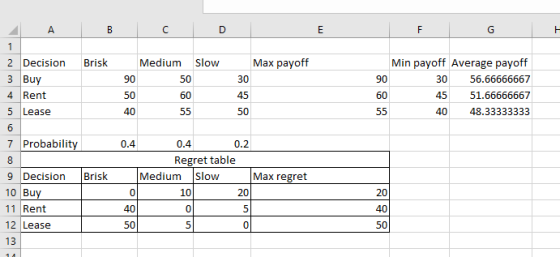
Maximum of the max payoff is 90 which belongs to "Buy" Decision hence it is the best decision according to maximax criterion
Payoff for it is 90 (in thousands of dollars)
b)
Maximum of the min payoff is 45 which belongs to "Rent" Decision hence it is the best decision according to maximin
criterion
Payoff for it is 45 (in thousands of dollars)
c)
Best of the average decision is 56.66666667 which belongs to "Buy" Decision hence it is the best decision according to equal likelihood criterion
Average Payoff for it is 56.66666667 (in thousands of dollars)
d)
Minimum of the maximum regret is 20 which belongs to "Buy" Decision hence it is the best decision according to Minimax regret criterion
Regret for it is 20 (in thousands of dollars)
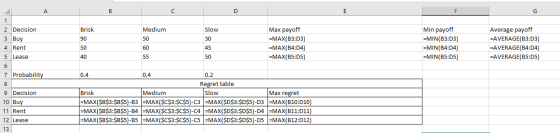
Formula
e)
According to Hurwicz's criterion, payoff = alpha*Max payoff+(1-alpha)*Min payoff
According to Hurwicz's criterion, payoff of "Buy" Decision =
0.6*90+(1-0.6)*30 = 66
According to Hurwicz's criterion, payoff of "Rent" Decision =
0.6*60+(1-0.6)*45 = 54
According to Hurwicz's criterion, payoff of "Lease" Decision =
0.6*55+(1-0.6)*40 = 49
Best decision is "Buy" and payoff for it is 66
a)
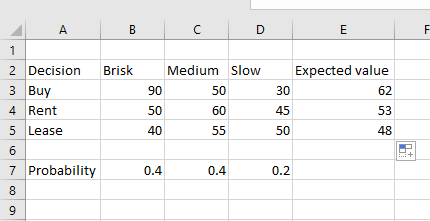
So, according to expected value approach best decision is "Buy" as this decision has highest expected payoff
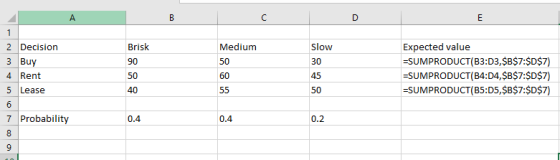
Formula
b)
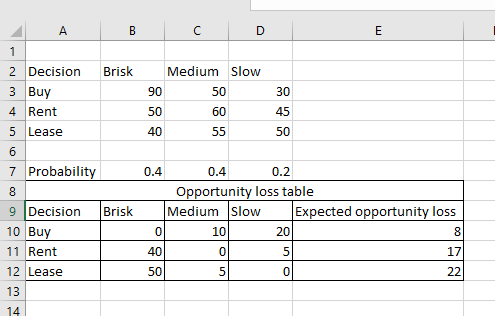
using the expected opportunity loss criterion, best decision is "Buy" as this decision has lowest expected opportunity loss
Formula
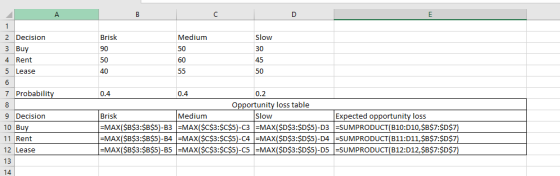
c)
value of perfect information = expected value without perfect information-expected value without perfect information
=90*0.4+60*0.4+50*0.2-62
= 8
Add Answer to:
A business owner is trying to decide whether to buy, rent, or
lease office space and...
A business owner is trying to decide whether to buy, rent, or lease office space and...
A business owner is trying to decide whether to buy, rent, or lease office space and has constructed the following payoff (profit in thousands of dollars) table based on whether a business will be brisk, medium, or slow. Business Level Decision Brisk Medium Slow ──────────────────────────────────────── Buy 90 50 30 Rent 50 60 45 Lease 40 55 50 Assume that the probability of a brisk business level is 0.4, the probability of a medium business level is 0.4 and...
A business owner is trying to decide whether to buy, rent, or lease office space and...
A business owner is trying to decide whether to buy, rent, or lease office space and has constructed the following payoff (profit in thousands of dollars) table based on whether a business will be brisk, medium, or slow. Business Level Decision Brisk Medium Slow ──────────────────────────────────────── Buy 90 50 30 Rent 50 60 45 Lease 40 55 50 Assume that the probability of a brisk business level is 0.4, the probability of a medium business level is 0.4 and the...
For the problem given in Question 3, assume that the probability of a full contract is 0.5, the probability of a partial contract is 0.4, and the probability of no contract is 0.1. (a) Calculate the e...
For the problem given in Question 3, assume that the probability of a full contract is 0.5, the probability of a partial contract is 0.4, and the probability of no contract is 0.1. (a) Calculate the expected value of each decision alternative. What is your recommendation using the expected value criterion? (b) Calculate the expected opportunity loss value of each decision alternative. What is your recommendation using the expected opportunity loss criterion? (c) Calculate and interpret the value of perfect...
3. A machine shop owner is attempting to decide whether to purchase a new drill press,...
3. A machine shop owner is attempting to decide whether to purchase a new drill press, a lathe, or a grinder. The profit from each purchase will be determined by whether the company succeeds in getting a government military full contract, partial contract or no contract. The profit from each purchase associated with each contract outcome is shown in the following payoff table: Purchase Full Contract Partial Contract No Contract __________________________________________________ Drill press $26,000 $34,000 $10,000 Lathe 34,000...
A machine shop owner is attempting to decide whether to purchase a new drill press, a lathe, or a grinder. The profit from each purchase will be determined by whether the company succeeds in getting a...
A machine shop owner is attempting to decide whether to purchase a new drill press, a lathe, or a grinder. The profit from each purchase will be determined by whether the company succeeds in getting a government military full contract, partial contract or no contract. The profit from each purchase associated with each contract outcome is shown in the following payoff table: Purchase Full Contract Partial Contract No Contract __________________________________________________ Drill press $26,000 $34,000 $10,000 Lathe 34,000 24,000 18,000 Grinder ...
please help!! im so confused will give good rating! (6) A manager is deciding whether or...
 please help!! im so confused
will give good rating!
(6) A manager is deciding whether or not to build a small facility. Demand is uncertain and can be either at a high or low level. If the manager chooses a small facility and demand is low, the payoff is $360. If the manager chooses a small facility and demand is high, the payoff is $100. On the other hand, if the manager chooses a large facility and demand is low,...
please help!! im so confused
will give good rating!
(6) A manager is deciding whether or not to build a small facility. Demand is uncertain and can be either at a high or low level. If the manager chooses a small facility and demand is low, the payoff is $360. If the manager chooses a small facility and demand is high, the payoff is $100. On the other hand, if the manager chooses a large facility and demand is low,...
Mary developed the following payoff table based on the plan to build housing units. Mary has 3 decision alternatives to build 30 units, 50 units, and 60 units. The probabilities of strong, fair, and p...
Mary developed the following payoff table based on the plan to build housing units. Mary has 3 decision alternatives to build 30 units, 50 units, and 60 units. The probabilities of strong, fair, and poor housing market are provided. Housing Units Good Market Fair Market Poor Market 30, d1 $50,000 . $20,000 $10,000 50, d2 80,000 30,000 -10,000 60, d3 150,000 35000 -30,000 Probability .5 .3 .2 Question # 1: If Mary wanted to make a decision based on the...
Please provide correct answer for part B. A manager is trying to decide whether to buy...
 Please provide correct answer for part B.
A manager is trying to decide whether to buy one machine or two.
If only one is purchased and demand proves to be excessive, the
second machine can be purchased later. Some sales will be lost,
however, because the lead time for producing this type of machine
is six months. In addition, the cost per machine will be lower if
both are purchased at the same time.
The probability of low demand is...
Please provide correct answer for part B.
A manager is trying to decide whether to buy one machine or two.
If only one is purchased and demand proves to be excessive, the
second machine can be purchased later. Some sales will be lost,
however, because the lead time for producing this type of machine
is six months. In addition, the cost per machine will be lower if
both are purchased at the same time.
The probability of low demand is...
Quantitative Methods (STAT-201) Q3 . A manager is deciding whether or not to build a small...
Quantitative Methods (STAT-201) Q3 . A manager is deciding whether or not to build a small facility. Demand is uncertain and can be either at a high or low level. If the manager chooses a small facility and demand is low, the payoff is $30. If the manager chooses a small facility and demand is high, the payoff is $10. On the other hand, if the manager chooses a large facility and demand is low, the payoff is -$20, but...
ABC Inc. must make a decision on its current capacity for next year. Estimated profits (in $000's) based on next year's demand are shown in the table below.
ABC Inc. must make a decision on its current capacity for next year. Estimated profits (in $000's) based on next year's demand are shown in the table below. Next Year's Demand Alternative Low Medium HighExpand $100 $200 $250Subcontract $50 $120 $125Do Nothing $40 $50 $ 55 a. Which alternative should be chosen based on the maximax criterion? b. Which alternative should be chosen based on the maximin...
 please help!! im so confused
will give good rating!
(6) A manager is deciding whether or not to build a small facility. Demand is uncertain and can be either at a high or low level. If the manager chooses a small facility and demand is low, the payoff is $360. If the manager chooses a small facility and demand is high, the payoff is $100. On the other hand, if the manager chooses a large facility and demand is low,...
please help!! im so confused
will give good rating!
(6) A manager is deciding whether or not to build a small facility. Demand is uncertain and can be either at a high or low level. If the manager chooses a small facility and demand is low, the payoff is $360. If the manager chooses a small facility and demand is high, the payoff is $100. On the other hand, if the manager chooses a large facility and demand is low,...
 Please provide correct answer for part B.
A manager is trying to decide whether to buy one machine or two.
If only one is purchased and demand proves to be excessive, the
second machine can be purchased later. Some sales will be lost,
however, because the lead time for producing this type of machine
is six months. In addition, the cost per machine will be lower if
both are purchased at the same time.
The probability of low demand is...
Please provide correct answer for part B.
A manager is trying to decide whether to buy one machine or two.
If only one is purchased and demand proves to be excessive, the
second machine can be purchased later. Some sales will be lost,
however, because the lead time for producing this type of machine
is six months. In addition, the cost per machine will be lower if
both are purchased at the same time.
The probability of low demand is...
Most questions answered within 3 hours.
-
Where is the error in this code sequence?
String s1 = "Hello";
String s2 = "ello";...
asked 11 months ago -
Financial data for Joel de Paris, Inc., for last year
follow:
Joel de Paris, Inc.
Balance...
asked 11 months ago -
Consider this reaction:
Al2(SO4)3 (aq)+ BaCl3
(aq) Al2Cl6 (aq)- +
3BaSO4(s) . What is the...
asked 11 months ago -
Suppose that Savneet is considering increasing her
recent random sample from 20 car rentals to 40...
asked 11 months ago -
Trucks arrive at an unloading terminal at an average rate of 120
per hour.
Trucks arrive...
asked 11 months ago -
Why are methanol and ethanol completely soluble in water while
octanol is not very little soluble....
asked 11 months ago -
A facilities manager at a university reads in a research report
that the mean amount of...
asked 11 months ago -
When the CuSO4 is rehydrated by adding water to the anhydrous
compound, is this an endothermic...
asked 11 months ago -
A ray of sunlight is passing from diamond into crown glass; the
angle of incidence is...
asked 11 months ago -
A block of mass 0.249 kg is placed on top of a light, vertical
spring of...
asked 11 months ago -
how do the kidneys compensate in the presences of acidosis
a) trigger hyperventilate
b) reserve acid...
asked 11 months ago -
Question 501 pts
The rental rate of capital to the firm increases. Which of the
following...
asked 11 months ago